
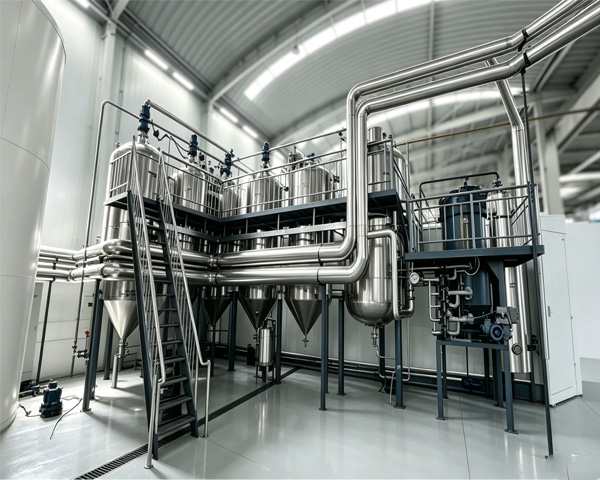
Crude palm oil (CPO) straight from the press is deep red in colour and contains free fatty acids, phospholipids, pigments, and odorous compounds – it cannot be consumed directly. To become the clear, stable refined palm oil found on supermarket shelves, it must undergo a series of refining processes: degumming, deacidification, bleaching, and deodorization.
A complete palm oil refinery requires multiple pieces of specialised equipment, each performing a specific process task. This article provides a complete palm oil refinery equipment list by process stage, explaining the function of each machine.
I. Core Refining Equipment (Four Main Process Stages)
1. Degumming Process Equipment – Removing Phospholipids and Gums
Degumming is the first step in refining, removing phospholipids, proteins, and other gum impurities from crude palm oil.
| Equipment Name | Function Description |
|---|---|
| Crude palm oil storage tank | Temporarily stores crude palm oil awaiting refining; made of food-grade materials to prevent contamination |
| Phosphoric/citric acid tank | Stores acid used for degumming to convert non-hydratable phospholipids |
| Degumming tank | Crude oil and acid are mixed and reacted here to coagulate phospholipids |
| Mixer | Ensures thorough mixing of acid and oil |
| Centrifugal separator | High-speed separation of coagulated gums from clear oil |
2. Deacidification/Neutralisation Process Equipment – Removing Free Fatty Acids
Free fatty acids (FFA) in crude palm oil affect oil stability and flavour, and must be removed through chemical or physical methods.
| Equipment Name | Function Description |
|---|---|
| Heater | Heats oil to the appropriate deacidification temperature |
| Neutralisation tank / alkali refining kettle | Alkali (NaOH) is added to react with free fatty acids, forming soapstock |
| Alkali agitator | Ensures thorough mixing of alkali and oil |
| Disc centrifuge separator | High-speed separation of soapstock from neutralised oil |
3. Bleaching/Decolorisation Process Equipment – Removing Pigments and Impurities
Bleaching removes pigments such as carotenoids, as well as residual metal ions and soaps from the oil.
| Equipment Name | Function Description |
|---|---|
| Bleaching tank / bleaching tower | Under vacuum, oil is mixed with bleaching earth to adsorb pigments |
| Bleaching earth mixing tank | Pre-mixes activated bleaching earth or activated carbon with oil |
| Leaf filter | Filters out bleaching earth that has adsorbed pigments from the oil |
| Vacuum system | Provides vacuum environment for bleaching to prevent oil oxidation |
4. Deodorisation Process Equipment – Removing Odours and Volatile Compounds
Deodorisation is the final step in refining, removing aldehydes, ketones, and other volatile odour compounds through high-temperature, high-vacuum steam distillation.
| Equipment Name | Function Description |
|---|---|
| Deodorisation tower (stainless steel) | Core equipment – steam distillation under high temperature (240–260°C) and high vacuum |
| Steam ejector | Generates high vacuum (up to 755 mmHg) to extract volatile odour compounds |
| Fatty acid trap | Recovers distilled free fatty acids (PFAD by-product) |
| Thermal oil heater | Provides high-temperature heat (up to 280°C) required for deodorisation |
II. Auxiliary Equipment and Systems
Beyond the four core process stages, a palm oil refinery also requires the following auxiliary systems:
| Equipment Name | Function Description |
|---|---|
| Thermal oil heater | Supplies heat energy for the entire refining process |
| Steam generator | Provides stripping steam for the deodorisation stage |
| Vacuum pump | Provides vacuum for bleaching and deodorisation |
| Air compressor | Used for drying bleaching earth and filter pressing |
| Plate and frame filter press | Final fine filtration to remove trace impurities |
| Cooling system | Cools refined oil to suitable temperature for storage or packaging |
| Heat exchanger | Recovers heat to improve energy efficiency |
| Refined oil storage tank | Temporarily stores finished refined oil; temperature-controlled storage required |
| Wastewater treatment system | Treats wastewater and spent bleaching earth generated during refining |
III. Fractionation Equipment (Optional – For Producing Palm Olein and Palm Stearin)
If the target market requires clear, transparent palm olein or palm stearin, a fractionation stage is required after refining.
| Equipment Name | Function Description |
|---|---|
| Crystalliser tank | Core equipment – precise temperature control causes palm stearin to crystallise out |
| Cooling unit | Provides chilled water for crystallisation |
| Membrane filter press | Separates liquid olein from solid stearin after crystallisation |
| Stearin melting tank | Melts filtered stearin for storage or further processing |
After fractionation, palm olein yield typically ranges from 70% to 82% depending on the process and crystalliser type. For RBD palm oil single-stage fractionation, olein yields generally fall between 78% and 82% for olein with an iodine value of 56.
IV. Equipment Configuration Differences by Refinery Scale
Based on capacity and budget, palm oil refinery equipment configurations can be divided into three tiers:
| Scale Type | Capacity | Equipment Characteristics | Typical Configuration |
|---|---|---|---|
| Small (Batch) | 1–20 TPD | Low investment, flexible operation | Neutralisation tank + bleaching tank + deodorisation tank + thermal oil heater + vacuum pump |
| Medium (Semi-continuous) | 20–50 TPD | Partial automation, stable quality | Continuous degumming centrifuge + physical deacidification tower + vacuum bleaching tower + multi-stage deodorisation tower |
| Large (Fully continuous) | 50–300+ TPD | Fully automated, lowest energy consumption | Continuous degumming system + physical distillation deacidification tower + high-capacity vacuum bleaching tower + multi-stage deodorisation tower + fractionation system |
Continuous refining systems are significantly more energy-efficient than batch systems – a batch system may consume approximately 750 kg of steam per tonne of oil, whereas a continuous system uses only about 472 kg. Continuous systems can achieve heat recovery rates above 70%, reducing overall steam consumption by more than 30% compared to batch processes. Steam consumption in a continuous deodoriser is roughly a third or less than in a batch deodoriser.
V. Key Considerations for Equipment Selection
1. Material selection: Equipment in contact with oil can be made of carbon steel or 304/316L stainless steel. Stainless steel is corrosion-resistant, easy to clean, and suitable for export markets and premium edible oil production, but carries a higher cost. For example, a 10 TPD carbon steel refining line costs approximately $94,000–105,000 for a standard configuration, while a full 304 stainless steel configuration runs $171,000–185,000.
2. Automation level: Fully automatic PLC control systems increase upfront investment but can save over 30% on labour costs and ensure consistent product quality.
3. Process route: Physical refining (steam distillation deacidification) and chemical refining (alkali refining deacidification) have different equipment requirements. Physical refining eliminates the alkali neutralisation and water washing stages, but the deodorisation tower must withstand higher temperatures and vacuum levels.
VI. Our Palm Oil Refining Equipment Solutions
We offer a complete range of palm oil refining equipment – from batch, semi-continuous, to fully continuous systems – covering the full process from crude palm oil storage tanks, degumming tanks, neutralisation tanks, bleaching tanks, leaf filters, deodorisation towers, and vacuum systems to fractionation crystallisers and membrane filter presses.
Whether you are planning a 1 TPD small refining workshop or a 100+ TPD large refinery, we can provide the most suitable equipment configuration based on your budget, raw material quality, and capacity targets.
Contact us today for a customised palm oil refinery equipment list and quotation!