
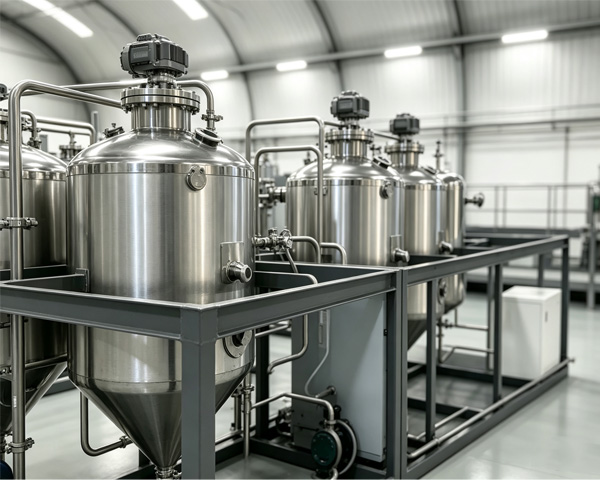
When investing in a palm oil refinery, the question that troubles most investors is: what scale can I afford with my budget?
A palm oil refinery can cost anywhere from $20,000 for a mini batch system to over $10 million for a fully continuous large-scale plant. The huge variation comes down to three key factors: capacity, process route, and automation level.
This article breaks down the investment ranges, equipment configurations, and operating characteristics of small, medium, and large refineries – helping you make the right choice for your budget.
I. Three Refining Process Types – Understanding Your Options First
Before selecting a scale, it’s important to understand the three basic refining process types:
- Batch refining: 1–20 TPD – low investment, flexible operation, ideal for small-scale production and switching between multiple oil types
- Semi-continuous refining: 20–50 TPD – stable quality, higher automation, suitable for growing brands
- Fully continuous refining: 50–200+ TPD – fully automated, lowest energy consumption, most consistent quality
These three process types essentially correspond to three different investment scales and target markets.
II. Small Refinery (1–10 TPD) – The Lowest-Cost Entry Point
Small refineries are the ideal starting point for small and medium investors – suitable for cooperatives, plantation owners, or regional small-scale oil mills.
Typical process: Batch refining
Typical equipment configuration: Neutralisation/deacidification tank, bleaching tank, deodorisation tank, thermal oil heater, vacuum system, leaf filter, electrical control panel
| Capacity | Equipment Investment (USD) | Total Estimated Budget (USD) | Floor Space |
|---|---|---|---|
| 1–3 TPD | $20,000–32,000 | $45,000–65,000 | 100–150 m² |
| 5 TPD | $35,000–45,000 | $70,000–95,000 | 150–250 m² |
| 10 TPD | $50,000–65,000 | $110,000–160,000 | 250–400 m² |
Source: Industry equipment supplier quotations
Need fractionation? Add to the budget. If your target market requires clear, transparent liquid oil (palm olein), fractionation is essential – small-scale fractionation equipment adds approximately $13,000–22,000.
Material choice impacts cost: For a 10 TPD refining line, a carbon steel standard configuration costs approximately $94,000–105,000, while a full 304 stainless steel configuration runs $171,000–185,000.
Operating cost reference: Refining losses are approximately 1.5%–1.8%, with refining costs of roughly $30/tonne of crude oil.
Best for: Investors with budgets of $50,000–150,000, just starting out, targeting local markets.
III. Medium Refinery (10–50 TPD) – The Growth-Oriented Choice Balancing Investment and Efficiency
Medium refineries suit regional suppliers and growing oil enterprises, with more complete equipment configurations and higher automation.
Typical process: Semi-continuous or continuous refining
Typical equipment configuration: Continuous degumming centrifuge, physical deacidification tower, high-capacity vacuum bleaching tower, multi-stage deodorisation tower
| Capacity | Equipment Investment (USD) | Total Estimated Budget (USD) |
|---|---|---|
| 5–10 TPD | $50,000–150,000 | $100,000–300,000 |
| 10–20 TPD | $100,000–300,000 | $250,000–600,000 |
| 20–50 TPD | $200,000–500,000 | $400,000–900,000 |
Source: Industry equipment supplier quotations
Operational efficiency advantage: Continuous systems consume significantly less energy than batch systems – for example, batch systems consume approximately 750 kg of steam per tonne of oil, while continuous systems require only about 472 kg. Over the long term, the energy cost savings are substantial.
Savings from automation: PLC automatic control systems, while increasing upfront costs, can save over 30% on labour costs and ensure consistent product quality.
Best for: Investors with budgets of $200,000–500,000, with stable raw material and sales channels, pursuing scaled operations.
IV. Large Refinery (50–300+ TPD) – The Industrial-Scale Choice for Maximum Economies of Scale
Large refineries serve export markets, large food companies, and industrial-scale production.
Typical process: Fully continuous refining
Typical equipment configuration: Continuous degumming system, physical distillation deacidification tower, high-capacity vacuum bleaching tower, multi-stage deodorisation tower, fractionation system
| Capacity | Equipment Investment (USD) | Total Estimated Budget (USD) |
|---|---|---|
| 50–100 TPD | $170,000–500,000 | $400,000–1,200,000 |
| 100+ TPD | $200,000–2,000,000 | $800,000–5,000,000+ |
Source: Industry equipment supplier quotations
Real project reference: A palm oil refinery construction contract in Malaysia was valued at 40 million ringgit (approximately $9 million). Another large refinery was built at a cost of approximately $60 million. Large plants involve highly complex system configurations, including continuous degumming, physical distillation deacidification, high-capacity vacuum bleaching, and multi-stage deodorisation.
Best for: Investors with budgets of $500,000+, targeting export or national markets, pursuing economies of scale.
V. Complete Cost Breakdown
Regardless of which scale you choose, the total investment in a palm oil refinery includes the following components:
1. Core process equipment (40%–60% of total investment)
- Degumming and deacidification systems
- Bleaching and deodorisation systems
- Fractionation system (optional)
- Vacuum and thermal oil systems
- Storage tanks (crude and refined oil)
2. Building and civil works (20%–30% of total investment)
- Refining workshop, tank farm, boiler house and laboratory, office and fire protection facilities
3. Utility systems (often underestimated)
- Steam boiler system, cooling water circulation, compressed air system, power distribution, water treatment system
4. Installation and commissioning (5%–10% of total investment)
- Equipment and piping installation, electrical and instrumentation, system commissioning, operator training
5. Environmental compliance
- Wastewater/gas treatment, odour control – increasingly essential as environmental regulations tighten
VI. How to Choose the Right Scale for Your Budget?
Budget $70,000–210,000:
- Recommended: 1–5 TPD small batch refinery
- Suitable for: Local markets, small-scale production, family or cooperative operations
Budget $210,000–700,000:
- Recommended: 5–20 TPD semi-continuous refinery
- Suitable for: Regional markets, growing enterprises, pursuing quality consistency
Budget $700,000–4.2 million:
- Recommended: 20–100 TPD continuous refinery
- Suitable for: National markets, export business, large-scale production
Budget $4.2 million+:
- Recommended: 100+ TPD fully continuous refining + fractionation
- Suitable for: Large industrial groups, export-oriented enterprises
VII. Decision Recommendations
- Start with raw material supply, then determine scale: Base refining capacity on available CPO supply – don’t blindly pursue larger capacity
- Leave budget buffer: Equipment is only part of total cost – civil works, installation, and utilities are equally important
- Choose materials to match target markets: Export markets and premium edible oils warrant 304 stainless steel equipment
- Plan fractionation early: If your target market requires liquid oil (palm olein), incorporate fractionation from the design stage
- Automation level determines long-term costs: While PLC systems increase upfront investment, they can save over 30% on labour costs
VIII. Our Palm Oil Refining Equipment Solutions
We offer a complete range of palm oil refining equipment – from batch, semi-continuous, to fully continuous systems – covering the full process of degumming, deacidification, bleaching, deodorisation, and fractionation. Whether you are planning a 1 TPD small refining workshop or a 100+ TPD large refinery, we can provide the most suitable equipment configuration based on your budget, raw material quality, and capacity targets.
Contact us today for a customised palm oil refinery investment plan and quotation!