
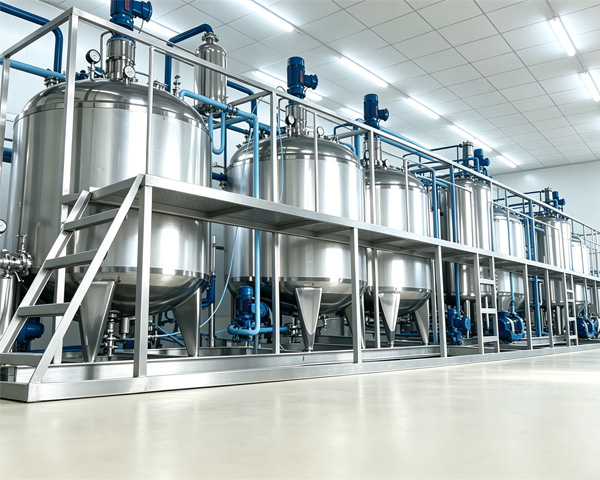
Crude palm oil (CPO) straight from the press is deep red in colour and contains free fatty acids (FFA), phospholipids, pigments, and odorous compounds – it cannot be consumed directly. To become the clear, stable refined oil found on supermarket shelves, it must undergo refining.
There are two main refining routes for palm oil: chemical refining (alkali refining) and physical refining (steam distillation). Physical refining eliminates the alkali neutralisation and water washing stages found in chemical refining, combining deacidification with deodorisation into a single step. Today, the vast majority of palm oil refineries in Malaysia use physical refining – a choice that aligns well with palm oil’s naturally low phospholipid content and high FFA characteristics.
The complete physical refining process can be broken down into three critical stages: degumming, bleaching, and deodorisation. Below, we examine the core function, process conditions, and key equipment at each stage.
Stage One: Degumming – The “Pre-Treatment” of Refining
Degumming is the first step in physical refining. Its purpose is to remove phospholipids (gums) and other colloidal impurities from crude palm oil. Because palm oil has naturally low phospholipid content, the degumming stage in physical refining can effectively remove impurities, preparing the oil for subsequent stages.
Core function: Removes phospholipids, proteins, and trace metal ions (iron, copper, etc.), preventing these impurities from decomposing or reacting adversely with the oil during high-temperature deodorisation.
Typical process conditions:
Degumming is typically carried out at 70–100°C. Phosphoric or citric acid is added at 0.05%–0.1% of oil weight, with a reaction time of approximately 15–30 minutes. The acid treatment converts non-hydratable phospholipids into hydratable form. The coagulated gums are then separated from the clear oil using a centrifugal separator. Research has identified optimal acid degumming conditions as 0.06% phosphoric acid, 90°C, and 30 minutes reaction time.
Key equipment:
- Degumming tank (acid mixing reaction vessel)
- Phosphoric/citric acid metering and dosing system
- Disc centrifuge separator
Stage Two: Bleaching – Removing Pigments and Impurities
After degumming, the oil enters the bleaching stage. The primary purpose of bleaching is to adsorb and remove pigments, residual metal ions, and soaps from the oil.
Core function: Removes pigments such as carotenoids, adsorbs residual metal ions, and eliminates trace impurities present before bleaching. The oil after this stage is called degummed and bleached palm oil (DB oil).
Typical process conditions:
Bleaching is carried out under vacuum to prevent oil oxidation. The temperature is typically 90–110°C. Activated bleaching earth is added as the adsorbent, with dosages typically ranging from 0.5% to 1.0% of oil weight – though in physical refining, higher dosages of 1%–2% are sometimes used. The reaction time is approximately 30 minutes. After completion, the spent bleaching earth – which has adsorbed pigments and impurities – is separated from the oil using a leaf filter.
Key equipment:
- Bleaching tank / bleaching tower (vacuum agitated vessel)
- Activated bleaching earth metering and dosing system
- Vacuum system
- Leaf filter
Stage Three: Deodorisation – Completing Both Deacidification and Deodorisation
Deodorisation is the final and most critical stage determining the quality of the finished oil. The distinctive feature of physical refining is that deacidification and deodorisation are accomplished in a single step – through high-temperature, high-vacuum steam distillation, which simultaneously removes free fatty acids and volatile odour compounds.
Core function: Through high-temperature, high-vacuum steam distillation, free fatty acids (FFA) are distilled off and recovered as high-value Palm Fatty Acid Distillate (PFAD); simultaneously, volatile odour compounds such as aldehydes and ketones are removed. After deodorisation, FFA content can be reduced to below 0.1%, with significant colour improvement.
Typical process conditions:
Deodorisation is carried out at elevated temperatures of 240–270°C. High vacuum is essential, typically 2–6 mbar (approximately 1.5–4.5 mmHg). High-pressure “live” steam is injected at 2%–4% as the stripping medium. The treatment time is generally 1–3 hours.
According to the Malaysian Palm Oil Council (MPOC), bleached palm oil is heated to 260–265°C for FFA stripping, then held at the same temperature for 60 minutes to complete thermal bleaching and deodorisation.
Key equipment:
- Deodorisation tower (stainless steel construction with packing or trays)
- Steam ejector (generates high vacuum)
- Fatty acid trap (recovers PFAD by-product)
- Thermal oil heater (provides high-temperature heat)
The Core Advantages of Physical Refining
Compared to chemical refining, physical refining offers multiple advantages for palm oil processing:
Higher oil yield: In chemical refining, the soapstock produced during alkali neutralisation carries away some neutral oil – the higher the FFA, the greater the loss. Physical refining produces no soapstock, resulting in significantly lower oil losses.
Lower operating costs: By eliminating the alkali neutralisation and water washing stages, chemical consumption is reduced, and the process is simpler to operate.
More environmentally friendly: No soapstock or alkaline wastewater is generated, and wastewater discharge is minimal.
Valuable by-product: The free fatty acids distilled off during deodorisation can be directly recovered as high-purity PFAD.
Equipment Configuration Across the Three Physical Refining Stages
| Stage | Core Equipment | Key Process Conditions | Primary Function |
|---|---|---|---|
| Degumming | Degumming tank, centrifuge separator | 70–100°C, phosphoric acid 0.05%–0.1%, 15–30 min | Removes phospholipids and gums |
| Bleaching | Bleaching tank, leaf filter, vacuum system | 90–110°C, vacuum, bleaching earth 0.5%–1.0%, ~30 min | Adsorbs pigments and impurities |
| Deodorisation | Deodorisation tower, vacuum system, fatty acid trap | 240–270°C, 2–6 mbar, steam stripping | Deacidification + deodorisation, PFAD recovery |
Bringing It All Together
The three critical stages of palm oil physical refining – degumming, bleaching, and deodorisation – form the complete pathway from crude palm oil to refined, bleached, and deodorised palm oil (RBD palm oil). Degumming clears the way for subsequent stages, bleaching removes pigments and impurities, and deodorisation accomplishes both deacidification and deodorisation simultaneously – each stage is essential, and none can be omitted.
We offer complete physical refining equipment solutions – from degumming tanks, centrifugal separators, bleaching tanks, leaf filters, and vacuum systems to deodorisation towers and fatty acid traps. Whether you are planning a small batch refinery or a large continuous plant, our engineers can provide the optimal equipment configuration based on your capacity targets and budget.
Contact us today for a customised palm oil physical refining equipment solution and quotation!