
Coconut oil is one of the most widely consumed vegetable oils in the world. In 2025, the global coconut oil market was valued at approximately $6.93 billion, with projections indicating growth to $12.43 billion by 2034 – representing a compound annual growth rate of approximately 6.71%. Supporting this vast market is a sophisticated industrial extraction system. And at the heart of coconut oil extraction – pressing and separation – two technology routes consistently present themselves to investors: the screw press and the centrifuge.
Neither technology is inherently superior; each has its own strengths and limitations. The right choice depends on your specific production goals, raw material availability, and target market. This article compares the two technologies across multiple dimensions – including technical principles, oil yield, energy consumption, maintenance costs, and oil quality – to help you make an informed equipment selection decision.
1. The Fundamental Difference Between the Two Technologies
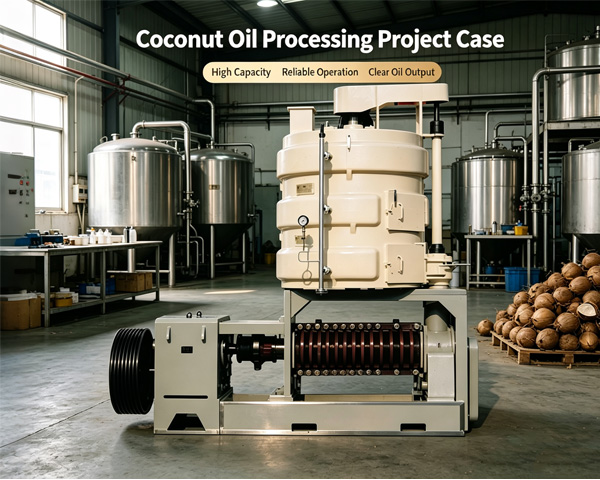
The screw press (expeller) is a mechanical pressing technology. Pre-treated copra is fed into the screw oil press, where the continuous rotation of the screw shaft generates high pressure (exceeding 100 bar according to the source material), physically squeezing the oil out of the coconut meat cells. This is a “dry” extraction process – the raw material is dried copra, and no water is added.
The centrifuge is a centrifugal separation technology. The coconut meat undergoes wet processing (grinding and mixing with water to form a coconut milk emulsion), and the high-speed rotation of the centrifuge (operating at 3,000–6,000 rpm according to the source material) separates the oil from the solids and water in the emulsion. This method is gentler and does not require extensive heating.
2. Core Technical Parameters Comparison
| Comparison Dimension | Screw Press | Centrifuge |
|---|---|---|
| Extraction method | Mechanical pressing (dry) | Centrifugal separation (wet) |
| Raw material form | Dried copra | Coconut milk emulsion (wet coconut meat) |
| Oil yield | 88%–91% | 92%–95% |
| Temperature range | 70–80°C | 40–60°C (gentler) |
| Maintenance interval | 800–1,000 hours | 1,200–1,500 hours |
| Energy consumption | 85–90 kWh/tonne | 70–75 kWh/tonne |
| Lauric acid retention | Partially lost | Up to 98% |
The key differences are clear: the screw press operates at higher temperatures, consumes more energy, and requires more frequent maintenance – but the technology is mature and well-suited to large-scale continuous production. The centrifuge operates at lower temperatures, achieves higher oil yields, and better preserves natural nutritional components, making it particularly suitable for producing virgin coconut oil (VCO).
3. Cost and Investment Considerations
Equipment Investment Cost
From a pricing perspective, screw presses have a lower entry barrier. Small screw presses (around 200 kg/h capacity) are priced at approximately $1,800–$2,000; medium commercial screw presses (1–2 tonnes/hour) are priced at approximately $1,700–$1,900.
Centrifuges typically require higher initial investment. Small tubular centrifuges are priced at approximately $3,800–$4,800; industrial disc centrifuges can cost upwards of $8,500; large industrial three-phase decanter centrifuges are priced at approximately $19,500.
For small startups with limited budgets, the lower initial investment of a screw press is more attractive. Dry systems typically have a capital expenditure approximately 30% lower than wet systems.
Operating Costs
Energy consumption typically accounts for 10%–15% of operating costs in a coconut oil extraction plant. Screw presses consume 85–90 kWh per tonne, while centrifuges consume 70–75 kWh per tonne – at industrial electricity rates, centrifuges can save approximately 15–20 kWh per tonne in electricity costs.
Over the long term, centrifuges’ longer maintenance intervals (1,200–1,500 hours vs 800–1,000 hours) mean less downtime and lower maintenance labour costs.
Payback Reference
According to industry data, a medium-sized coconut oil mill processing 30 tonnes per day, assuming an 18% net profit margin and 330 operating days per year, has a payback period of approximately 3.5–4 years. Choosing a more efficient, lower-energy-consumption equipment configuration can directly shorten the payback period.
4. Oil Quality and Market Positioning
This is the most fundamental strategic difference between the two technologies.
Screw presses produce copra oil – traditional coconut oil produced through drying, pressing, and refining. While the 70–80°C processing temperature helps achieve higher oil yields, temperatures exceeding 85°C can cause oxidation, and some heat-sensitive nutrients and natural antioxidants are lost during the process.
Centrifuges produce virgin coconut oil (VCO) – extracted using a wet process at temperatures of 40–60°C, without the need for chemical refining. The low-temperature process improves antioxidant retention by 10%–15% and achieves lauric acid retention of up to 98%. VCO typically commands a price 2–3 times higher than conventional copra oil in the global health food market. The global virgin coconut oil (VCO) market reached $2.93 billion in 2025 and is projected to grow to $6.1 billion by 2034, at a CAGR of 8.60% – significantly outpacing conventional coconut oil.
In short: if you are targeting the mass edible oil market, the screw press is a mature and reliable choice. If you are aiming for a premium health food brand, the centrifuge and wet process are essential.
5. Equipment Selection Decision Guide
Choose a screw press if:
- You have access to a stable, low-cost supply of copra
- Your target market is mass edible oil or industrial raw materials
- Your initial investment budget is limited (entry-level equipment starts at under $2,000)
- You do not require “virgin,” “cold-pressed,” or other premium product labels
Choose a centrifuge if:
- You have access to fresh coconuts, or are willing to adopt a wet process
- Your target market is virgin coconut oil (VCO), health foods, or export markets
- You are pursuing higher oil yields (92%–95%) and lower long-term operating costs
- You are willing to invest higher upfront capital for premium product margins
Hybrid approach: Some modern mills adopt a combined “screw press pre-treatment + centrifuge polishing” approach – using the screw press for initial extraction and the centrifuge for fine separation and purification. This approach can strike a balance between throughput and quality.
6. What KMEC Can Do for You
Whether you choose a screw press or a centrifuge, KMEC offers complete coconut oil processing equipment solutions.
Our product range covers:
- Screw press series: From tens of kilograms per hour to several tonnes per hour – meeting the production needs of copra oil at various scales
- Centrifuge separation systems: Disc centrifuges, tubular centrifuges, three-phase decanter centrifuges – designed specifically for virgin coconut oil (VCO)
- Complete supporting equipment: Coconut dehusking machines, copra dryers, crushers, plate and frame filter presses, and refining equipment
Our engineers can recommend the most suitable technical configuration based on your raw material type, capacity targets, budget, and product positioning. Whatever technology route you choose, KMEC can help you select the right equipment and build the right production line.
Contact KMEC today for a customised coconut oil processing equipment solution and quotation!