
In many small and medium-sized oil mills, oilseed roasting remains a matter of “guesswork.”
Operators pour seeds into a cast iron pan, stir by hand, and judge when it’s “about right” by looking at the colour and smelling the aroma. But this method is far from ideal in most cases – low oil yield, unstable temperatures, and sometimes a burnt flavour.
If you’re running a small oil mill, or considering entering this industry, upgrading your equipment – from a cast iron pan to a drum roaster – may be the most important step you can take to improve both oil yield and quality.
I. The Three Major Shortcomings of Manual Pan Roasting
Traditional pan roasting is still common in small and medium-sized oil mills, but its limitations have become increasingly apparent:
First, temperature is uncontrollable. The pan sits directly over an open flame, creating highly uneven heat distribution – hot at the bottom, cooler at the edges. Operators can only adjust the heat by “feel,” making it impossible to control roasting temperature precisely. This not only affects oil yield but also leads to scorched or undercooked seeds.
Second, heating is uneven. Manual stirring cannot ensure every seed receives the same heat exposure. In the same batch, some seeds may be charred black while others remain moist inside. Traditional pan roasting can result in 3%–5% yield losses.
Third, quality is inconsistent. Different operators and different batches produce vastly different results. For edible oils sold in the market, consistency is critical – and manual pan roasting cannot deliver it.
II. The Drum Roaster – Why It’s the Best Upgrade Choice
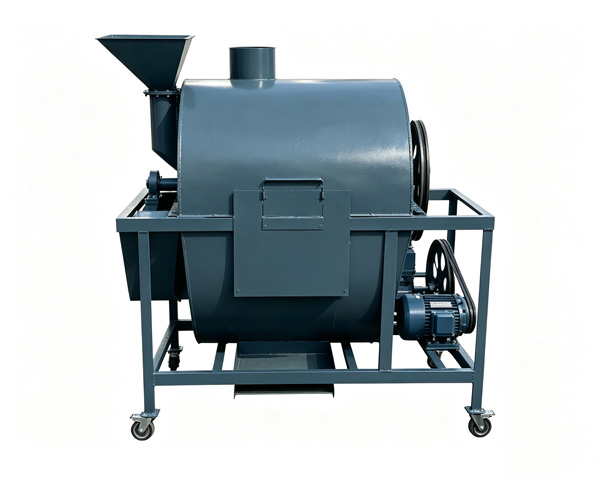
A drum roaster is a professional device specifically designed for oilseed pre-treatment. The fundamental difference from pan roasting is this: the drum roaster ensures uniform heat distribution through continuous rotation, rather than relying on manual stirring.
How it works: Seeds tumble continuously inside a rotating drum, with heat evenly enveloping every kernel. The drum, made of food-grade stainless steel or carbon steel, ensures decades of reliable operation. With an automatic temperature control system, roasting temperature accuracy can be maintained within ±2°C.
Why is the drum roaster better suited for small and medium-sized oil mills?
- Wide applicability: The drum roaster is the most versatile roasting device available, suitable for any high-oil or easily scorched seeds and nuts – peanuts, soybeans, rapeseed, palm kernels, and more.
- Flexible capacity: Small drum roasters typically handle 80–300 kg/hour – perfectly matching the output needs of small and medium-sized oil mills.
- Easy operation: One-touch start, automatic temperature control, timed shutdown – operators no longer need to stand by the pan constantly.
- Labour savings: A single drum roaster can replace the manual stirring work of 1–2 workers.
III. From Pan to Drum: The Tangible Benefits of Upgrading
After upgrading to a drum roaster, oil mills can achieve significant improvements in several areas:
1. Higher oil yield
Proper roasting reduces seed moisture to a level ideal for pressing (typically around 5%), creates micropores, softens proteins, and enhances oil fluidity. Combined with a screw oil press or hydraulic oil press, oil yield can be consistently improved.
2. Stable oil quality
Uniform roasting ensures consistent roasting results across every batch, guaranteeing consistent aroma, colour, and taste in the finished oil – essential for building a brand and earning customer trust.
3. Lower labour costs
A drum roaster runs continuously – operators simply set the temperature and time, then move on to other tasks such as filtration or filling.
4. Reduced raw material waste
Precise temperature control eliminates scorched or undercooked seeds, reducing raw material waste. The 3%–5% yield losses associated with traditional pan roasting can be completely eliminated.
IV. Roasting Parameters for Common Oilseeds
Once you’ve upgraded to a drum roaster, the next step is mastering the roasting parameters for different oilseeds. Below are recommended roasting temperatures and times for four common oilseeds:
| Oilseed | Recommended Roasting Temp (°C) | Recommended Roasting Time (minutes) | Key Considerations |
|---|---|---|---|
| Peanut | 120–170 | 10–25 | Temperatures below 160°C preserve nutty aroma and improve oil yield |
| Sesame | 170–180 | 18–30 | Optimises aromatic oil release while preventing carbonisation |
| Soybean | 110–200 | 10–25 | 140°C is the optimal balance between oil yield and quality |
| Cottonseed | 120–130 | 30–40 | Roast to light golden colour to inactivate gossypol toxin |
The above temperatures are for reference only and should be adjusted according to local seed varieties and desired oil quality.
V. Upgrade Recommendations – How to Choose the Right Drum Roaster
For small and medium-sized oil mills planning to upgrade, here are some practical recommendations:
1. Choose capacity based on your output
Small drum roasters typically handle 80–300 kg/hour. If your mill processes 1–5 tonnes per day, this range is more than sufficient.
2. Pay attention to materials
Food-grade stainless steel (SS304/316L) and carbon steel are the mainstream choices. Stainless steel is corrosion-resistant and easy to clean – ideal for food processing environments; carbon steel is more affordable for budget-conscious customers.
3. Look for automatic temperature control
Automatic temperature control is the core function of a drum roaster. Choosing a model with precise temperature control and timed shutdown can significantly reduce operational difficulty.
4. Consider supporting equipment
Roasting is just the first step. When upgrading your roaster, it’s advisable to simultaneously evaluate whether your existing screw oil press or hydraulic oil press is compatible with the new roasting capacity. The balance between roasting, pressing, and filtration ultimately determines the quality and yield of your finished oil.
From a cast iron pan to a drum roaster – on the surface, it may seem like a simple equipment replacement. But in reality, it represents a shift from “guesswork” to “standards” in your process.
The cast iron pan may carry the memories of tradition, but in today’s pursuit of consistent quality and higher efficiency, the drum roaster has become an indispensable pre-treatment tool for small and medium-sized oil mills. It delivers not just higher oil yield, but also improved oil quality, production efficiency, and market competitiveness.
Contact us today for a drum roaster solution tailored to your mill’s capacity!