
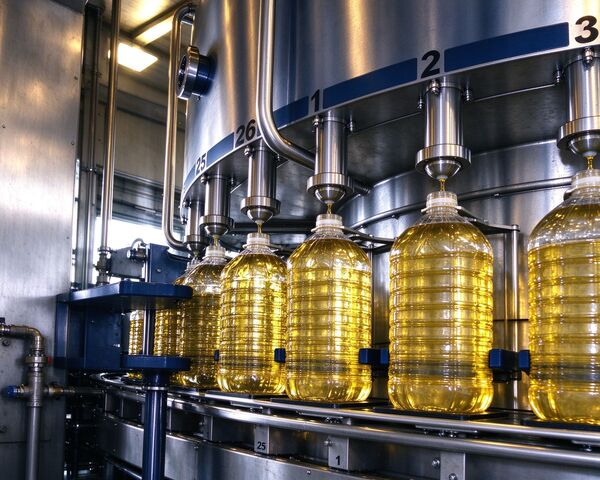
Refined edible oil still has one last hurdle to clear before it reaches the consumer’s kitchen: filling and packaging.
This stage may look simple, but it actually determines three things: whether the product can be legally sold with a consistent net content, whether the oil gets contaminated during filling, and whether the production cost per bottle can be kept under control. For a commercial edible oil processing plant, the edible oil filling machine is just as important as the oil press or refining equipment.
The global automatic edible oil filling machine market was valued at approximately US$792 million in 2024 and is projected to reach US$1.013 billion by 2031, growing at a compound annual growth rate of 3.6%. Behind this growth is the industry’s continuous upgrade toward higher filling accuracy, stricter hygiene standards, and greater automation.
I. Filling Accuracy: Why Is ±0.5% a Hard Threshold?
Edible oil is a high-value liquid food. Small filling errors, accumulated over time, can cause significant raw material losses and damage to brand reputation.
Modern edible oil filling machines use servo motor control systems and high-precision weight filling technology to keep filling errors strictly within ±0.5%. Taking Shouda Machinery’s measured equipment data as an example, its filling error can be maintained at ±0.2%, far below the ±1% error range allowed by national metrology regulations for prepackaged goods. This means that for a 5L bottle of edible oil, the net content deviation does not exceed 10 millilitres.
Drip-proof design is equally critical. After filling, if residual oil remains on the filling nozzle, it not only wastes product but also contaminates the bottle mouth and label area. Shouda Machinery’s patented drip-proof suction-back design instantly draws back residual oil at the end of filling, keeping material loss at 0.1% and saving tens of thousands of dollars in raw material costs per year compared with conventional equipment.
II. How Does Oil Viscosity Affect Filling Equipment Selection?
This is a key variable that many people overlook when choosing an edible oil filling machine.
Different vegetable oils vary significantly in viscosity. Soybean oil and rapeseed oil are low-viscosity oils with good flowability, while sesame oil and peanut oil are high-viscosity oils with poor flowability. Filling equipment must be able to adapt to the physical characteristics of oils with different viscosities.
Shouda Machinery’s solution is a dual-mode metering system – the equipment is equipped with both a high-precision flow meter and a pulse transmitter, which can capture density fluctuations caused by temperature changes in real time and perform temperature compensation, allowing free switching between volumetric metering and gravimetric metering. For low-viscosity oils, the volumetric mode enables faster filling speeds; for high-viscosity oils, the gravimetric mode ensures metering accuracy is not affected by viscosity.
In addition, the equipment allows independent filling parameters to be configured for oils of different viscosities. Low-viscosity soybean oil and high-viscosity peanut oil can run stably on the same machine, both ensuring filling accuracy and anti-stringing performance. This design is particularly important for plants producing multiple types of edible oil – one machine covers the full range from soybean oil to peanut oil.
III. An Easily Overlooked Detail: Residual Oil on PET Bottles and Temperature Control
There is an industry pain point in edible oil filling – residual oil on PET bottles.
PET bottle walls tend to retain an oil film after filling, which affects label adhesion. More critically, oil temperature directly affects the severity of this problem. Studies show that when oil temperature rises, viscosity decreases and flowability increases, making it easier for residual oil to form on the bottle wall. At the same time, temperature fluctuations can also cause filling volume deviations – time-based filling machines may output different doses when flow rates change, and even metering systems can behave differently during the nozzle cut-off phase due to temperature changes.
Engineering solutions:
Real-time temperature compensation. Modern filling lines embed temperature sensors in the filling area to monitor oil temperature in real time (0–50°C range) and automatically correct volume deviations caused by thermal expansion and contraction (compensation coefficient 0.00075/°C), ensuring consistent filling accuracy in both winter and summer.
Segmented filling speed control. A high-speed main filling stage ensures capacity, while a low-speed fine filling stage improves cut-off performance and reduces splashing near the bottle mouth.
Drip-proof suction-back valve. The filling nozzle is equipped with a suction-back function that instantly draws back residual oil after filling, eliminating drips and stringing and keeping the bottle clean.
IV. Energy Consumption and Capacity Comparison of Four Filling Machine Types
According to capacity scale and automation level, edible oil filling machines can be divided into four types. Energy consumption and capacity vary significantly between them:
| Machine Type | Typical Capacity | Power Range | Suitable Application |
|---|---|---|---|
| Linear filling machine | 2,000–7,000 bottles/hour | 1.5–3.75 kW | Small and medium plants with limited space and budget |
| Rotary filling machine | 7,000–36,000 bottles/hour | 3.5–12 kW | Large plants, large-scale continuous production |
| Semi-automatic filling machine | 500–2,000 bottles/hour | 1.5–3 kW | Medium and small output, limited investment budget |
| Fully automatic filling machine | 5,000–20,000 bottles/hour | 2.5–6.55 kW | Large commercial plants, high output and high precision |
Data source: Made-in-China platform equipment specifications and TECH-LONG product specifications
Taking rotary filling machines as an example, an 8-head model has a power of 2.5 kW and a capacity of 2,000 bottles/hour (500ml); a 40-head model has a power of 6.55 kW and a capacity of up to 20,000 bottles/hour. Fully automatic filling machines can achieve a capacity of 36,000 bottles/hour, with power ranging from 2.5–12 kW depending on configuration.
From an energy consumption perspective, linear filling machines typically have a power of around 1.5 kW, suitable for small and medium-scale production. The power of rotary filling machines increases with the number of filling heads, but energy consumption per unit of capacity is actually lower – this is exactly the advantage of scale production.
V. From Storage Tank to Retail Bottle: Complete Packaging Line Configuration
A complete edible oil packaging line includes not only the filling machine but also supporting equipment to form a complete closed loop:
| Stage | Core Equipment | Function |
|---|---|---|
| Oil storage and transfer | Stainless steel storage tank, transfer pump | Temporarily store refined oil, supply oil to the filling machine |
| Bottle unscrambling and washing | Bottle unscrambler, bottle washer | Arrange empty bottles, clean bottle interiors |
| Filling | Linear / rotary filling machine | Quantitative filling of edible oil |
| Capping | Automatic capping machine | Seal the cap |
| Labeling and coding | Labeling machine, inkjet coder | Label application, production date printing |
| Inspection and casing | Level detection, case packer | Finished product inspection and packaging |
Filling specifications cover a wide range from 100ml to 20L, including 100ml, 200ml, 250ml, 500ml, 750ml, 900ml, 1L, 1.5L, 1.8L, 2.5L, 4L, 5L, 8L, 10L, 20L, etc. Packaging forms include PET bottles, glass bottles, tinplate cans, etc. Applicable oil types include coconut oil, olive oil, sunflower oil, soybean oil, mustard oil, rapeseed oil, peanut oil, palm oil, sesame oil, and more.
VI. CIP Clean-in-Place: A Part of Food Safety That Cannot Be Ignored
The hygiene level of an edible oil filling line directly affects product shelf life and food safety. Modern filling lines increasingly integrate CIP (Clean-in-Place) systems, which automatically complete cleaning and disinfection without dismantling equipment.
The CIP cleaning process typically includes: pre-rinse (using hot water to flush away most residual oil), alkaline wash (circulating a hot alkaline solution such as sodium hydroxide to break down fats and oils), intermediate rinse, disinfection, and final rinse. Filling lines with integrated CIP systems effectively prevent old oil oxidation and bacterial growth, ensuring hygiene consistency from batch to batch.
TECH-LONG’s filling equipment is equipped with an automatic CIP dummy bottle function and an optimised filling valve flow path design, ensuring that CIP cleaning liquid can reach all oil-contact surfaces.
VII. Frequently Asked Questions (FAQ)
Q1: What filling accuracy can an edible oil filling machine achieve?
Modern filling equipment uses servo motor control systems and high-precision weighing technology, keeping filling errors within ±0.5%, with high-end models reaching ±0.2%. Drip-proof filling valves and suction-back structures further eliminate oil waste.
Q2: How do I choose between linear and rotary filling machines?
Linear machines suit small and medium enterprises with limited space and budget. Power is typically 1.5–3.75 kW, capacity 2,000–7,000 bottles/hour. Rotary machines suit large-scale production, with capacity 7,000–36,000 bottles/hour; power increases with the number of filling heads.
Q3: Can the same filling machine handle oils of different viscosities?
Yes. Filling lines equipped with dual filling modes (volumetric + gravimetric metering) can switch freely according to oil viscosity. Low-viscosity oils use volumetric mode for higher speed; high-viscosity oils use gravimetric mode for accuracy.
Q4: What should I pay attention to when filling edible oil into PET bottles?
PET bottle walls tend to retain an oil film. Residual oil can be reduced through real-time temperature compensation (compensation coefficient 0.00075/°C), segmented filling speed control (low-speed metering at the final stage), and a drip-proof suction-back valve.
Q5: Does an edible oil filling line need a CIP cleaning system?
It is recommended. A CIP system can complete cleaning and disinfection without dismantling equipment, preventing old oil oxidation and bacterial growth and ensuring hygiene consistency. Modern filling lines typically integrate an automatic CIP dummy bottle function.
Q6: Can KMEC provide a complete edible oil filling and packaging line?
Yes. KMEC provides complete packaging line equipment from stainless steel storage tanks, linear/rotary edible oil filling machines to capping machines, labeling machines, and inkjet coders, as well as complete line integration with upstream oil presses and refining equipment. Our engineers can provide customised configurations based on your oil types, packaging specifications, and capacity targets.
Final Thoughts
Filling is the last step before edible oil leaves the factory for the market, and it is a direct presentation of the brand image. Filling accuracy determines compliance and profit, drip-proof design determines product appearance, oil viscosity adaptation determines equipment efficiency, the CIP system determines hygiene compliance, and the level of automation determines long-term labour costs. Once these five variables are clear, the investment decision for an edible oil filling line becomes clear.
If you are planning or upgrading an edible oil packaging line, please contact KMEC. We can provide a professional configuration plan based on your actual situation, from a single filling machine to a complete packaging line.
Data sources: Global Info Research (2025), Made-in-China Equipment Specifications, Shouda Machinery Technical Documentation, HZM Machinery Filling Guide, TECH-LONG Product Specifications, Sunter Machinery CIP Systems, and industry technical literature.