
The Impact of Free Fatty Acids (FFA) on Edible Oil Quality
Free fatty acids (FFA) are naturally present in edible oils. However, high FFA content can cause off-flavors, shorten shelf life, and pose potential health risks during high-temperature cooking or frying. Therefore, effectively removing FFA is critical to ensuring oil quality and safety during edible oil production.
Whether it is crude oil produced by oil press equipment or subsequent refining, controlling FFA content is essential. This article focuses on current mainstream FFA removal methods and discusses the important role of oil press equipment in raw material pretreatment and initial oil quality control.
1. Causes of FFA and Starting Points for Control
FFA mainly comes from the hydrolysis of oils and fats. High temperature, humidity, long-term storage, or damaged fruits accelerate this process. Taking palm oil as an example, if fruits are squeezed or delayed during harvesting, transportation, and storage, lipase activity increases rapidly, leading to higher FFA content.
Therefore, strictly controlling the freshness and processing time of raw materials before they enter oil press equipment is the starting point for reducing FFA. For instance, using gentle harvesting tools, rapid sterilization, and avoiding water contact can effectively inhibit FFA formation.
2. Main Methods for Removing FFA from Edible Oils
2.1 Chemical Neutralization
Chemical neutralization is one of the most commonly used FFA removal methods in oil refineries. This method involves adding alkaline substances such as sodium hydroxide (caustic soda) to crude oil, which reacts with FFA to form soapstock. The soapstock is then separated from the oil using centrifugal separators.
This method is suitable for crude oils with high FFA content (e.g., >5%), offers flexible process control, but generates soapstock waste and entails certain refining losses.
2.2 Physical Refining (Steam Stripping)
Physical refining does not rely on chemical reagents. Instead, it uses direct steam distillation under high temperature and vacuum to vaporize and condense FFA for separation. This method offers high oil yield and low chemical usage, making it suitable for crude oils with low impurities and stable color.
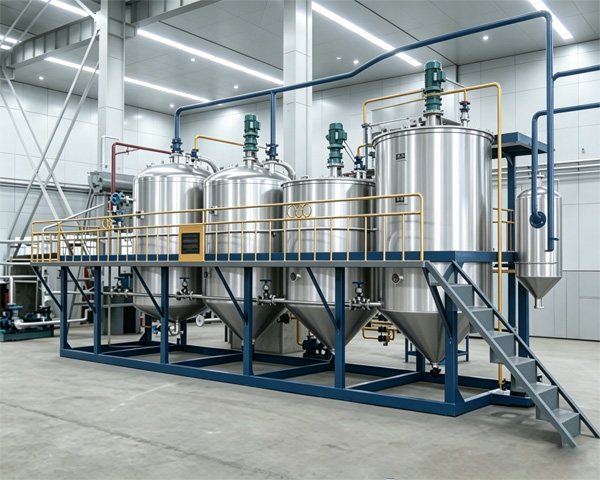
Physical refining typically requires coordination with edible oil refining equipment processes such as degumming, bleaching, and deodorization to ensure final oil color, flavor, and stability.
3. Best Practices for FFA Removal in Palm Oil
Crude palm oil (CPO) is an important raw material for the global food and non-food industries. Its FFA content directly affects product market value. Below are key control points for FFA removal in palm oil:
– Harvesting and transportation: Minimize fruit damage, transport quickly, avoid water contact.
– Sterilization: Perform high-temperature sterilization (130–140°C for 90 minutes) within 24 hours of harvesting to inactivate lipase.
– Clarification and storage: Quickly remove sludge and water after pressing, and store under inert gas to prevent hydrolysis.
In these steps, choosing an efficient and stable palm oil press machine helps better control pressing temperature and time, reducing FFA generation.
4. Process Essentials of Chemical and Physical Refining
Chemical Refining Process (Suitable for High-FFA Crude Oil):
- Degumming: Remove phospholipids to prevent emulsification during neutralization.
- Alkaline neutralization: Add calculated amount of NaOH based on FFA titration, control temperature at 60–80°C.
- Soapstock separation: Use high-efficiency centrifugal separators.
- Washing and drying: Multiple hot water washes to remove residual soapstock, vacuum drying to prevent hydrolysis.
Physical Refining Process (Suitable for Low-Impurity Crude Oil):
- Pretreatment: Degumming + bleaching to remove phospholipids, metals, and pigments.
- Steam stripping deacidification: High vacuum (2–4 mmHg), 240–270°C, direct steam injection for 30–60 minutes.
- Deodorization: Further removal of off-flavors and odor compounds, longer residence time.
In the above processes, supporting oil press equipment such as screw oil presses and hydraulic oil presses can provide higher quality crude oil for subsequent refining, reducing the difficulty of FFA removal.
5. Emerging Technologies: Enzymatic and Membrane Methods
With the growing demand for green manufacturing, enzymatic and membrane technologies are gaining attention:
– Enzymatic esterification: Uses enzymes and alcohol (e.g., methanol) to convert FFA into esters. Moderate operating temperature (50–70°C), low oil loss, suitable for high-FFA crude oils.
– Membrane separation: Uses ultrafiltration or nanofiltration to selectively separate FFA. Still under development, not yet commercially available, but promising as an alternative to traditional refining processes.
The promotion of these new technologies also requires oil press equipment to have better raw material adaptability and operational stability to support subsequent efficient refining.
6. Equipment Selection Recommendations
Removing FFA from edible oils requires both scientific refining processes and high-quality raw material pretreatment and pressing. Whether chemical neutralization, physical refining, or future enzymatic or membrane technologies, selecting reliable and stable oil press equipment and edible oil refining equipment is key to improving oil quality and reducing production costs.
In practice, it is recommended that enterprises choose chemical or physical refining routes flexibly based on the initial FFA content, impurity composition, and end-product requirements, while supporting them with complete degumming, bleaching, and deodorization systems. At the same time, optimize raw material handling and pressing to control FFA generation from the source.