
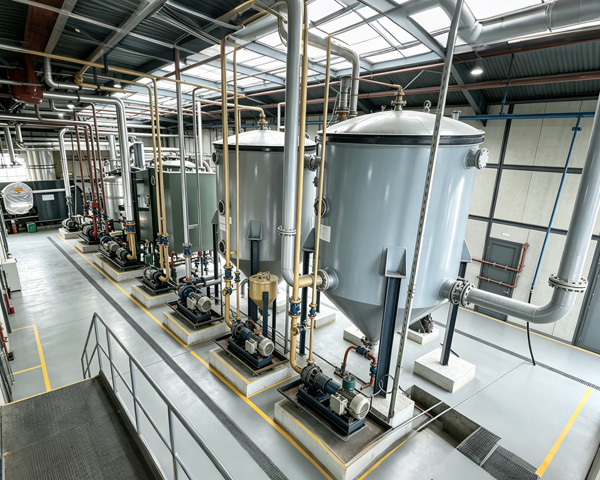
Rice bran is known as a “nutritional treasure trove,” with an oil content of 15%–22%. The global rice bran oil market is growing rapidly, projected to rise from approximately US$7 billion in 2025 to over US$10 billion by 2032. However, rice bran oil processing faces an unavoidable challenge: rice bran contains extremely high lipase activity, making it highly prone to rancidity. Improper handling not only reduces oil yield but also significantly compromises oil quality.
For rice bran oil mills, scientific pretreatment is the key to improving oil yield and economic returns. Data shows that rice bran without pretreatment yields only about 12.5% oil, while rice bran that undergoes complete pretreatment can achieve an oil yield of 15.1% – over 20% more oil from the same raw material. This article details the 4 key steps of rice bran oil pretreatment and helps you calculate the real profit difference.
1. Rice Bran Separation – Removing Impurities, Building a Solid Foundation
Freshly milled rice bran contains impurities such as rice husk powder, broken rice, and stones. Excess impurities not only reduce oil yield but also increase impurities in the finished oil.
Objective: Separate rice husk powder and impurities from rice bran, maintaining a separation efficiency of over 90%.
Core equipment: Vibrating screen, cyclone separator, magnetic separator
Clean raw material is the first guarantee of high oil yield. Impurities not only occupy pressing space but also accelerate equipment wear. Proper separation makes subsequent steps much more effective.
2. Stabilization – Racing Against Time to Lock in Every Drop of Oil
This is the most unique and critical step in rice bran oil processing.
Rice bran contains highly active lipase. Once rice bran is separated from the grain, lipase immediately begins hydrolyzing the oil, producing free fatty acids. Without timely treatment, the acid value of rice bran can spike dramatically within 24 hours. The higher the acid value of rice bran, the greater the neutral oil loss during refining – oil that could have become a saleable product is instead removed as “impurity.”
Core principle of stabilization: Use heat or steam to inactivate lipase and prevent rancidity.
Operating parameters: Maintain steam temperature at 105–115°C for 3–5 minutes to prevent oil degradation from overheating.
Core equipment: Rice bran stabilizer (cooker or expander)
After stabilization, the shelf life of rice bran extends from 24 hours to 30 days, providing a sufficient time window for subsequent processing. Without stabilization, there is no high-quality rice bran oil.
Data comparison: Rice bran without stabilization yields only 12.5% oil; after stabilization, oil yield increases to 14.3%.
3. Conditioning – Optimizing Physical State to Help Oil Flow Out More Easily
After stabilization, rice bran needs further physical conditioning.
Purpose of conditioning: Improve the plasticity and oil-absorbing properties of rice bran through moisture and heat addition. Uniform conditioning makes oil cell walls more fragile, improving extraction efficiency.
Operating tip: Regularly calibrate conditioning equipment to ensure uniform humidification and avoid local hot spots that could affect oil yield.
Core equipment: Conditioner (moisture-heating device)
Proper conditioning keeps oil pathways clear. Uneven conditioning – with some rice bran too wet or too dry – compromises subsequent pressing or extraction performance.
4. Flaking – Increasing Contact Area to Extract Every Last Drop
This is the final step of the pretreatment stage and a critical factor directly affecting oil yield.
Purpose of flaking: Flatten rice bran into thin flakes to increase the contact area during extraction. Uniform flake thickness facilitates solvent penetration and reduces residual oil content.
Operating parameters: Flake thickness should be controlled at 0.3–0.4 mm. Use multi-point pressure sensors to ensure uniform flake thickness.
Core equipment: Flaking mill
Data comparison: With stabilization + conditioning + optimized flaking, oil yield reaches 15.1%.
Oil Yield Improvement at a Glance
| Pretreatment Status | Oil Yield | Improvement |
|---|---|---|
| No stabilization, no conditioning | 12.5% | — |
| With stabilization and conditioning | 14.3% | +14.4% |
| Stabilization + conditioning + optimized flaking | 15.1% | +20.8% |
The same raw material, the same input – over 20% difference in oil yield. For an oil mill processing 10 tonnes of rice bran per day, this means an extra 260 kilograms of rice bran oil per day. At market prices, the monthly additional profit is substantial.
Automation Upgrades: Making Pretreatment More Efficient and Stable
With advances in automation technology, rice bran oil pretreatment has gradually introduced continuous stabilizers, automated conditioning systems, and high-efficiency flaking mills. These equipment upgrades reduce human error, stabilize process parameters, and further improve oil yield by 2%–3% while lowering energy consumption.
Core value of automation: Stable process parameters → stable oil yield → stable oil quality → stable customers.
How Should Small Oil Mills Choose a Pretreatment Solution?
Small oil mills have limited capital and cannot invest in fully automated systems all at once. Recommendations:
- Prioritize stabilization and conditioning: These two steps have the greatest impact on oil yield
- Choose simple, flexible equipment with manual controls to meet capacity needs
- Stabilization and conditioning are indispensable and cannot be skipped
Future Trends: Intelligence and Green Technology
In the future, rice bran oil pretreatment will increasingly rely on low-temperature stabilization, online quality monitoring, and energy-efficient flaking technologies. These innovations will not only further improve oil yield but also enhance nutrient retention and market competitiveness of rice bran oil.
Our Rice Bran Oil Pretreatment Equipment Solutions
We provide complete rice bran oil pretreatment equipment, including:
- Cleaning equipment: Vibrating screens, cyclone separators, magnetic separators – ensuring raw material purity
- Stabilization equipment: Cookers/expanders – locking in oil and extending shelf life
- Conditioning equipment: Conditioners – optimizing physical state and clearing oil pathways
- Flaking equipment: Flaking mills – uniform flaking for maximum oil yield
- Automation control systems: Precision temperature, moisture, and pressure control
Rice bran oil yield from 12.5% to 15.1% – the difference is not in the variety, but in the pretreatment. Separation, stabilization, conditioning, flaking – with these four steps in place, oil yield increases by over 20%.
If you are planning a rice bran oil production line or looking to improve the yield of your existing line, please contact us. We will provide the most suitable pretreatment solution based on your capacity and budget.
Contact us today – make every grain of rice bran count!