
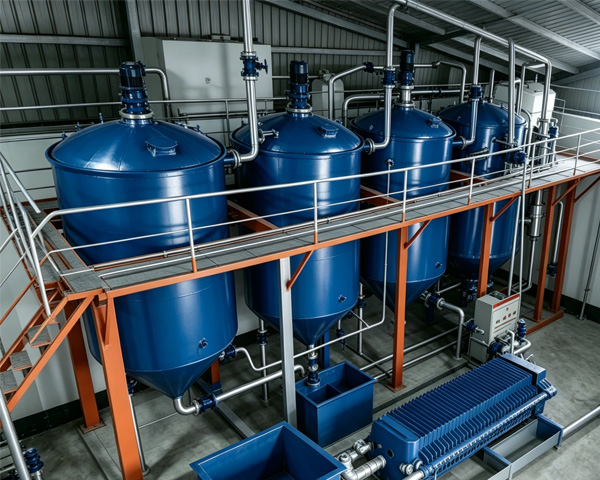
Investing in building an edible oil refinery plant is a critical leap from crude oil to high-quality finished oil. Whether it is a new project or upgrading an existing production line, understanding “where the money goes” is the prerequisite for budgeting and evaluating return on investment. Many investors tend to underestimate certain hidden costs during the planning stage, leading to a shortage of funds later on. This article will break down the five major cost components of investing in oil refining equipment, helping you build a more realistic financial model and make sound investment decisions.
1. Equipment Procurement Cost: The Largest Weight in Investment
The procurement cost of oil refining equipment usually accounts for the largest proportion of the total project investment, and it is also the part with the highest technical content and the widest selection options. A complete refining production line mainly includes the following core units:
– Degumming and Deacidification Units:
Used to remove phospholipids and free fatty acids from crude oil, these represent the first critical step in refining. The material of construction and the chosen process route (physical refining or chemical refining) directly affect the price.
– Decolorization Unit:
Removes pigments and trace impurities from the oil by adding adsorbents such as activated bleaching earth, resulting in a clear and bright oil color. The volume of the bleaching tank and the level of automation are key pricing variables.
– Deodorization Unit:
Uses high-temperature, high-vacuum steam distillation to remove odoriferous compounds and residual free fatty acids; this is the core section that determines the flavor and smoke point of the finished oil. The structural design of the deodorizing tower and the configuration of the vacuum system can lead to significant differences in the quotations from different oil processing plant equipment suppliers.
– Winterization/Dewaxing and Fractionation Unit:
If your target product is salad oil or liquid oil that must remain clear at low temperatures, you must equip the line with refrigeration crystallization and filtration equipment.
– Supporting Auxiliary Equipment:
Includes thermal oil heaters, steam boilers, vacuum pump sets, oil filter machines, and automation control systems. Although the individual amounts for these auxiliary units may not be high, improper configuration will compromise the energy efficiency and stability of the entire oil refining equipment.
Practical Suggestion:
Do not use the initial quoted price as the sole criterion for equipment procurement. Comprehensive consideration must be given to equipment materials (such as stainless steel 304/316), the level of automatic control, energy consumption indicators, and the supplier’s track record on similar projects. A seemingly inexpensive piece of oil processing equipment will often cost back the initial difference many times over through subsequent maintenance and energy consumption.
2. Plant and Infrastructure Construction Costs
Plant construction costs are a section easily “oversimplified” but impossible to ignore in the investment. They include:
– Land Cost:
This varies greatly depending on the industrial land price in the project location and represents a significant part of the initial one-time expenditure.
– Plant Building and Structure:
The refining workshop typically requires a multi-layer steel structure platform to accommodate the elevation layout of the equipment, and the floor must meet oil-proof, anti-slip, and load-bearing requirements. Supporting areas for raw oil tank farms, finished oil tank farms, and chemical storage warehouses are also needed.
– Utility Connections:
The connection and modification costs for water, electricity, and gas (natural gas or steam) must be included in the budget. A refinery is a large energy consumer, and the configuration of power transformers and backup power generation equipment directly impacts production continuity.
Site Selection Tip:
When selecting a site, priority should be given to areas close to the crude oil supply from a screw oil press machine or extraction workshop, with convenient transportation and logistics, while fully assessing the environmental capacity and the space for supporting environmental protection facilities.
3. Labor Costs: Fixed but Optimizable Expenses
Labor costs encompass the salaries, social insurance, and training expenses for frontline operators, quality control analysts, equipment maintenance technicians, and management personnel. The refining workshop operates as a continuous process, and the level of automation directly affects the number of staff required.
– Highly Automated Production Line:
Oil refining equipment with full PLC or DCS automatic control allows for centralized operation from a control room, significantly reducing the number of on-site patrol personnel.
– Semi-Automated or Manually Operated Line:
The initial equipment investment is lower, but long-term labor costs are high, and it is more affected by the proficiency of the operators.
When preparing the labor budget, it is necessary to investigate local labor market salary levels and the supply of skilled workers, and to reserve training time and costs for key positions.
4. Raw Material Procurement and Working Capital
Although this is a variable cost, a considerable amount of initial working capital must be set aside at the very beginning of the project, covering:
– Crude Oil Procurement:
The grade of crude oil (such as crude soybean oil, crude palm oil, crude rice bran oil) and its quality level determine the unit purchase price. Different oilseeds have different refining loss rates, which must be included in cost accounting.
– Auxiliary Materials and Consumables:
These include phosphoric acid, liquid caustic soda, activated bleaching earth, citric acid, filter aids, and packaging materials. Price fluctuations of these consumables directly affect the processing cost per ton of refined oil.
– Inventory Turnover:
Maintaining a reasonable safety stock of raw materials and finished oil is a prerequisite for keeping the oil processing plant equipment running continuously, but it also ties up a large amount of capital.
5. Operating and Maintenance Costs: Hidden Costs That Determine Long-Term Profitability
Operating costs run throughout the entire lifecycle of the equipment and determine whether an edible oil refinery plant can remain profitable in the long term.
– Energy Consumption:
The costs of electricity, steam, or fuel for the thermal oil heater account for over 60% of total operating costs. Highly energy-efficient oil refining equipment can achieve a significant difference in this area.
– Equipment Maintenance and Spare Parts:
Mechanical seals for centrifugal pumps, valves, and agitator seals are wear parts. Establishing an inventory of commonly used oil press spare parts and consumables and replacing them on schedule can prevent unexpected downtime.
– Environmental Compliance:
The costs for wastewater treatment (from deacidification washing), exhaust gas treatment (deodorizer distillate), and solid waste (spent bleaching earth) disposal are expenditure items subject to increasingly strict regulations worldwide and must be planned from the very beginning of the project.
– Taxes and Insurance:
Includes VAT/sales tax, corporate income tax, and property insurance, accrued according to local policies.
Cost Reduction Strategy:
Rather than passively paying environmental fines or bearing high energy bills later on, it is better to prioritize, when purchasing oil equipment, technical solutions with high energy utilization efficiency and well-designed wastewater and exhaust gas recycling systems.
The Essence of Refinery Plant Investment is a Systematic Trade-Off
The investment cost of an edible oil refinery plant is by no means a simple arithmetic sum of “equipment quotation plus plant budget.” It requires a holistic consideration that integrates equipment procurement, civil infrastructure, human resource allocation, supply chain turnover, and long-term operation into one cohesive system. A well-thought-out investment plan can ensure that your oil processing plant equipment remains competitive for decades. If you are planning a new finished oil refining project or evaluating a technical upgrade of an existing line, feel free to contact [KMEC]. Our engineering team can provide you with one-stop professional consulting covering equipment selection, process layout, and investment estimation.