
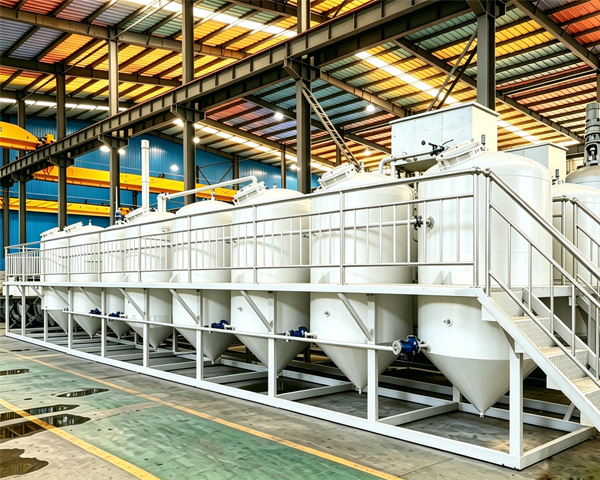
Rice bran oil is known as “nutritious golden oil”, rich in gamma-oryzanol, vitamin E, and phytosterols. However, refining rice bran oil is much more difficult than common vegetable oils like soybean oil or rapeseed oil. Why? Because the colloidal impurities in crude rice bran oil – especially hydratable phospholipids and non-hydratable phospholipids – are high in content and hard to remove. They directly affect subsequent deacidification, bleaching, and deodorization, and can even cause significant neutral oil loss.
Degumming is the first and most critical step in rice bran oil refining. This article details the difficulties of rice bran oil degumming, the principles and equipment configurations of two mainstream degumming methods (water degumming and acid degumming), helping you select the right degumming equipment to lay a solid foundation for high-quality rice bran oil.
I. Why Is Rice Bran Oil Degumming Particularly Difficult?
The colloidal impurities in rice bran oil are mainly phospholipids, which exist in two forms:
| Phospholipid Type | Characteristics | Removal Difficulty |
| Hydratable phospholipids | Absorb water, swell, and agglomerate | Relatively easy |
| Non-hydratable phospholipids (calcium/magnesium salts) | Insoluble in water, cannot be removed by conventional water degumming | Very difficult |
Rice bran oil has a high proportion of non-hydratable phospholipids. If degumming is incomplete, residual phospholipids will thermally decompose during subsequent deacidification and deodorization, leading to darker oil colour, poorer flavour, and increased refining losses. Therefore, rice bran oil degumming cannot rely only on ordinary water degumming – acid treatment is often necessary.
II. Core Objectives of Degumming and Related Equipment
The core of degumming is to remove colloidal impurities such as phospholipids, proteins, and mucilage from crude oil. Commonly used degumming equipment includes:
– Degumming tank: Used for water degumming, with functions for stirring, heating, and water addition.
– Acid refining tank: Used for acid degumming, with corrosion-resistant design for adding phosphoric acid, citric acid, etc.
– Centrifuge separator: Separates agglomerated gums from clear oil, typically a disc stack centrifuge.
A complete degumming section usually includes: crude oil preheater → degumming tank (or acid refining tank) → centrifuge separator → dryer.
III. Water Degumming: A Low-Cost Basic Solution
Principle
Using the hydrophilic property of phospholipids, a certain amount of hot water or dilute electrolyte solution (e.g., brine, dilute alkali) is added to heated crude oil. The phospholipids absorb water, swell, and agglomerate into gum clusters, which are then removed by settling or centrifugation.
Typical Process Conditions
– Oil temperature: approx. 70–85°C
– Water addition: 2%–5% of oil weight
– Stirring time: 30–60 minutes
– Separation method: settling or centrifugation
Advantages
– Simple equipment, low investment
– Easy operation, low operating cost
– Suitable for oils with low phospholipid content
Disadvantages
– Cannot remove non-hydratable phospholipids, resulting in incomplete degumming
– Poor effect for high non-hydratable phospholipid oils like rice bran oil
Applicable Equipment
Degumming tank (with steam jacket and agitator) + centrifuge separator
IV. Acid Degumming: The Tool to Conquer Rice Bran Oil
Principle
An acid electrolyte (phosphoric acid, citric acid, or oxalic acid) is added to crude oil to convert non-hydratable phospholipids into hydratable form. Then water is added to hydrate them, causing them to swell and agglomerate, after which they are removed by centrifugation. The acid also chelates calcium and magnesium ions bound to phospholipids, helping to release them.
Why Recommend Citric Acid?
– Oxalic acid is toxic and not suitable for the food industry.
– Phosphoric acid is effective, but it can cause acidolysis of some pigments, forming dark flocs; it may also denature phospholipids, losing some of their nutritional function.
– Citric acid: Food grade, high safety, less damage to phospholipids and pigments, making it more suitable for rice bran oil degumming.
Typical Process Conditions
– Acid dosage: 0.05%–0.2% of oil weight (depending on oil quality)
– Reaction temperature: 60–85°C
– Reaction time: 20–40 minutes
– Water hydration: add hot water after acid reaction
Advantages
– Effectively removes non-hydratable phospholipids for more thorough degumming
– Reduces subsequent refining losses
– Improves finished oil stability
Disadvantages
– Equipment must be acid-resistant (stainless steel recommended)
– Slightly higher cost than plain water degumming
Applicable Equipment
Acid refining tank (316L stainless steel, acid-resistant, with agitator and heating) + centrifuge separator
V. Combined Process in Practice
For rice bran oil refining, plain water degumming is ineffective, and acid-only degumming is costly. The commonly used approach in mills is a water + acid combination process:
1. Acid treatment first: Add a moderate amount of citric acid (or phosphoric acid) to convert non-hydratable phospholipids.
2. Then water degumming: Add hot water to hydrate and agglomerate the total phospholipids.
3. Centrifugal separation: Use a centrifuge separator to remove gums.
4. Drying: Send degummed oil to a vacuum dryer to remove moisture.
This combination process achieves ideal degumming results at a relatively low cost, laying a foundation for subsequent deacidification, bleaching, and deodorization.
VI. Our Degumming Equipment Solutions
We offer customised solutions from a single degumming tank to a complete rice bran oil refining line. Targeting the characteristics of rice bran oil, we recommend the following:
| Equipment Name | Material | Features |
| Water degumming tank | 304 stainless steel | Jacketed heating, variable frequency stirring, automatic temperature control |
| Acid refining tank | 316L stainless steel | Resists strong acids, precise acid metering system |
| Disc stack centrifuge separator | Stainless steel | High speed, separation efficiency ≥99% |
| Degummed oil dryer | 304 stainless steel | Vacuum dehydration, prevents oxidation |
Why choose us?
– ✅ Process expertise: We understand degumming characteristics of rice bran oil, soybean oil, rapeseed oil, and other oils.
– ✅ Durable equipment: Key parts made of high-quality stainless steel – corrosion-resistant and easy to clean.
– ✅ Automation: PLC controls acid addition, water addition, temperature, and stirring time, reducing human error.
– ✅ Global service: Installation, commissioning, operator training, and after-sales support.
Degumming is the “gatekeeper” of rice bran oil refining. If degumming fails, subsequent deacidification, bleaching, and deodorization are in vain. Because rice bran oil has a high content of non-hydratable phospholipids, you must use acid degumming or an acid + water combination degumming process to thoroughly remove gums, protect neutral oil, and improve finished oil quality.
If you are planning a rice bran oil refining project or experiencing poor degumming results, please contact us. We will recommend the most suitable degumming equipment and process solution based on your crude oil quality and capacity requirements, helping you produce high-quality rice bran oil.
Contact us today for a free consultation and quotation!