
Crude palm oil (CPO) cannot be consumed directly. It must be refined to become the quality edible oil the market demands. However, many investors face the same dilemma: a limited budget, yet wanting to build a fully functional refinery that produces oil meeting quality standards.
Going straight for a full continuous refining line? The investment is too high. Buying only a few tanks and cobbling them together? You worry about substandard oil quality. In fact, there is a clear path between “low cost” and “fully functional” – batch refining equipment.
This article compares the low-cost batch solution and the high-end continuous solution from the perspectives of investment cost, process flow, equipment configuration, operating expenses, and finished oil quality – helping you build a truly “better” palm oil refinery within your budget.
I. What Processes Does a “Better” Palm Oil Refinery Need?
Regardless of equipment type, a complete palm oil refinery must include the following four core processes:
| Process | Function | Key Equipment |
| Degumming | Removes phospholipids, proteins, and other gums | Degumming tank, centrifuge separator |
| Deacidification | Removes free fatty acids, lowers acid value | Alkali refining kettle / deacidification tower |
| Bleaching | Adsorbs pigments (carotenoids, etc.) and impurities | Bleaching tank, activated clay filter |
| Deodorization | Removes odours and volatile substances | Deodorizer tower, vacuum system |
Without any of these four steps, the finished oil will be dark, have strong odours, oxidise easily, and cannot enter supermarkets or be exported. “Better” does not mean expensive equipment – it means having all four processes and being able to run them stably.
II. Batch vs. Continuous: Core Comparison
| Comparison Item | Batch Refining Equipment | Continuous Refining Equipment |
| Daily capacity | 1–20 tonnes | 50–300+ tonnes |
| Equipment investment | Low (USD 20,000–100,000) | High (USD 200,000–2,000,000) |
| Footprint | Small (50–150 m²) | Large (500–2,000 m²) |
| Operation mode | Manual + semi‑automatic | Fully automatic (PLC) |
| Batch cycle time | 4–8 hours | Continuous, no stopping |
| Energy consumption (per tonne oil) | Slightly higher | Lower (economies of scale) |
| Oil quality | Can reach Grade 1 standard | Consistent, export‑grade |
| Suitable for | Small output, frequent oil type changes | Large output, single oil type |
> Conclusion: With a limited budget, the batch solution fully achieves complete refining – degumming, deacidification, bleaching, deodorization – and the finished oil can meet international standards.
III. Low-Cost Batch Solution: Specific Configuration and Investment
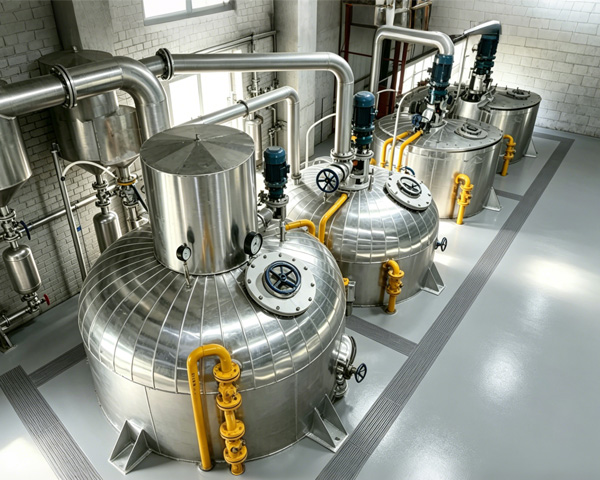
A complete batch palm oil refining equipment set (5–10 tonnes/day) typically includes:
1. Degumming/deacidification tank (alkali refining kettle): stainless or carbon steel, steam heating, agitator – for degumming and alkali refining.
2. Washing tank: for washing away residual soap after deacidification.
3. Vacuum dryer: removes moisture under vacuum.
4. Bleaching tank: equipped with vacuum system, adds activated clay to adsorb pigments.
5. Leaf filter or plate‑and‑frame filter: separates spent bleaching clay.
6. Deodorizer tower (combined type): with vacuum system and fatty acid trap – for high‑temperature steam distillation.
7. Cooler: cools deodorized oil to filterable temperature.
Investment reference (ex‑works equipment price) :
– 5 tonnes/day: approx. USD 30,000–60,000
– 10 tonnes/day: approx. USD 50,000–100,000
Advantages: low investment, flexible operation, can refine multiple oils (palm oil, soybean oil, sunflower oil, etc.).
Disadvantages: more manual operation, slightly higher energy consumption, cleaning needed between batches.
IV. High-End Continuous Solution: When Is It Worth It?
If you have sufficient budget and meet the following conditions, consider continuous refining equipment:
– Daily capacity > 50 tonnes
– Product needs to be exported or supplied to large food companies (requiring perfect batch‑to‑batch consistency)
– Want to significantly reduce labour costs through automation
– Have stable crude oil supply and sales channels
Continuous equipment typically includes: automatic dosing system, continuous degumming centrifuge, continuous deacidification tower, continuous bleaching tower, continuous deodorizer tower, heat recovery system, and full PLC control room.
Investment reference: 50 tonnes/day approx. USD 200,000–500,000; over 100 tonnes/day USD 800,000–2,000,000.
V. A “Better” Upgrade Path for Budget‑Limited Users
If funds are tight now but you plan to upgrade later, use a step‑by‑step strategy:
1. Step 1: Buy a batch refining tank (degumming, deacidification, washing, drying in one) with a simple vacuum bleaching tank – produce bleached palm oil for low‑to‑mid markets.
2. Step 2: Add a separate deodorizer tower and vacuum system – upgrade to a complete batch refinery (degumming + deacidification + bleaching + deodorization) producing Grade‑1 oil that meets international standards.
3. Step 3: When volume grows and funds allow, purchase a continuous line – keep the old batch equipment for small batches or specialty oil refining.
VI. Why Batch Equipment Is Also “Better” and Reliable
Many investors mistakenly believe only continuous lines are “modern”. In fact, batch refining equipment is widely used in small and medium‑sized oil mills across Europe, Africa, and Southeast Asia. It offers:
– ✅ Independent tanks for deacidification, bleaching, deodorization – complete processes
– ✅ Vacuum deodorization system (steam ejector available)
– ✅ Activated clay bleaching + precision filtration
– ✅ Finished oil acidity, colour, and odour can meet international standards (e.g., RBD palm oil requirements)
As long as the equipment material is adequate (oil‑contact parts made of 304 stainless steel) and process parameters are properly controlled, palm oil produced by batch refining can be bottled and sold or exported.
VII. Our Services: Customise the “Better” Low‑Cost Solution for You
We supply batch palm oil refining equipment for 1–20 tonnes/day, and continuous refining equipment for higher capacities. For budget‑limited customers, we specifically offer:
– ✅ Tailored configuration: Buy only core units (deacidification tank + bleaching tank + deodorizer tower) – expand later.
– ✅ Used / refurbished equipment: Some in stock, lower prices.
– ✅ Process guidance: Free refining process documentation, operation manuals, quality testing methods.
– ✅ Turnkey service: Equipment installation, commissioning, worker training.
– ✅ Global track record: Successful operations in Nigeria, Ghana, Tanzania, Pakistan, and other countries.
A limited budget does not mean you cannot build a better palm oil refinery. By choosing batch refining equipment, you can complete the full refining process – degumming, deacidification, bleaching, deodorization – at a lower investment and still produce high‑quality refined palm oil. When your business grows, upgrade to a continuous line – you have both flexibility and a clear path forward.
If you are planning to build a palm oil refinery but are unsure which solution best fits your budget and capacity, please contact us. We will provide you with a free investment comparison analysis and equipment quotation, helping you build the best possible refinery at the most reasonable cost.
Contact us today – make every dollar count!