
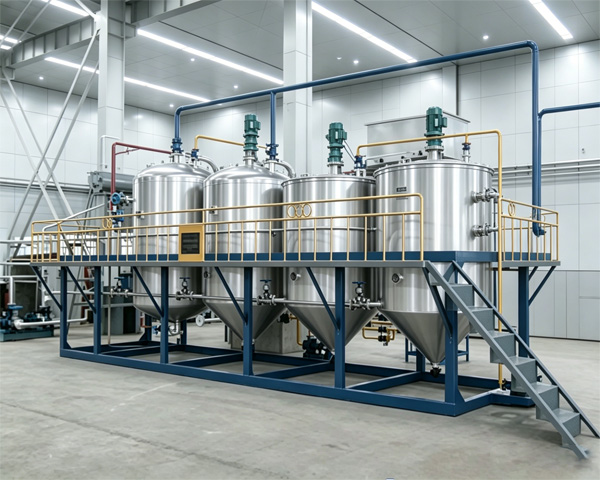
In the edible oil processing industry, palm oil is highly favored for its high yield and wide range of applications. However, for many start-up businesses or small to medium-sized farm owners, investing heavily in a large continuous refining plant is often impractical. If you wish to enter the palm oil refining sector without bearing excessive upfront costs and risks, batch-type small-scale palm oil refinery plant is undoubtedly the ideal key to unlocking your business potential.
This type of equipment features a low investment threshold, compact footprint, and simple, flexible operation. Its core advantage lies in the ability to easily switch between processing various crude oil types—whether palm oil, soybean oil, or peanut oil—allowing a single set of equipment to meet diverse production needs and efficiently convert crude oil into high-quality refined edible oil that meets market standards.
Before establishing a refining production line, an efficient pressing section is typically required. If you have not yet secured a source of crude oil, we recommend exploring our palm oil press and screw oil press series to ensure a stable upstream supply of raw material.
Below are two small-scale batch-type palm oil refinery plant solutions tailored to different production capacities and budgets, helping you accurately select the most suitable option.
1. Electric Heating Batch-Type Palm oil refinery plant: The Preferred Choice for Small-Batch Trials
This equipment is specifically designed for small-batch, on-demand production with a daily processing capacity of 0.5-2 tons. It utilizes direct resistance wire heating, enabling rapid response and precise control of refining temperatures.
– Core Advantages: Extremely low initial investment and compact equipment structure, making it ideal for laboratory research or start-up home-based edible oil refinery operations.
– Considerations: This model requires relatively high voltage stability from the local power grid. Additionally, due to the energy consumption characteristics of direct electric heating, long-term operational electricity costs tend to be higher. If electricity rates are low in your region and production is flexible, this represents an excellent low-cost entry solution.
2. Thermal Oil Heating Batch-Type Palm Oil Refining Plant: The Choice for Stability and Expansion
For small enterprises planning moderate-scale production, a thermal oil heating refining plant with a daily processing capacity of 1-20 tons is a more professional choice.
– Technical Advantages: This equipment employs a thermal oil heater for indirect circulating heating, ensuring uniform and stable temperature distribution within the refining tank. This effectively prevents localized overheating that could darken the oil’s color or degrade nutritional components, resulting in exceptionally consistent finished oil quality.
– Economic Efficiency: Compared to electric heating, thermal oil systems offer higher thermal efficiency, significantly reducing long-term operating costs. Coupled with a vacuum pump and steam generator, this equipment flawlessly executes advanced processes such as bleaching and deodorization, making it highly suitable for growing small-scale palm oil processing plants seeking stable oil quality.
Core Refining Process: Four Steps to Golden Quality
Our batch-type refining equipment employs the mature and reliable chemical refining process, encompassing the following four critical steps to ensure crude oil is transformed into clear, bright, high-quality edible oil:
1. Degumming: Treatment with phosphoric acid or hot water to remove phospholipids and other gum-soluble impurities from the crude oil.
2. Neutralization: Addition of sodium hydroxide solution to neutralize free fatty acids, producing soapstock which can also be sold as a by-product.
3. Bleaching: Addition of activated bleaching earth to adsorb pigments and residual impurities from the oil, followed by separation of the spent bleaching earth using a leaf filter.
4. Deodorization: Introduction of steam under negative pressure and high temperature to thoroughly eliminate low-boiling-point odoriferous compounds from the oil.
One Machine, Multiple Uses: Meeting Diversified Production Needs
Our small-scale refining equipment is not only suitable for palm oil and palm kernel oil but, with flexible process parameter adjustments, is also widely applied in the deep processing of various common edible oils, including peanut oil refining equipment, soybean oil refining, cottonseed oil, rice bran oil, and sunflower oil. If you are engaged in corn germ oil pressing or rice bran expansion and extraction, this refining equipment will be the final piece completing your production line.
Key Advantages of the 1-10 Tons/Day Small-Scale Palm Oil Refining Plant at a Glance
| Item | Reference Information |
| Applicable Capacity | 1-2-3-5-10 Tons/Day (Modular Expansion) |
| Core Process | Degumming + Neutralization + Bleaching + Deodorization |
| Workforce Required | 5-7 Personnel to Operate the Entire Line |
| Auxiliary Systems | Thermal Oil Heater, Vacuum Pump, Air Compressor, Steam Generator |
| Overall Advantages | 20 Years of Project Manufacturing Experience, Excellent Energy Efficiency Ratio, Meeting Diverse Domestic and International Palm Oil Refining Requirements |
| Core Vessels | Neutralizing Tank, Bleaching Tank, Deodorizing Tank |
KMEC has been deeply engaged in the oil and fats machinery sector for decades. We not only provide advanced twin-screw oil press machines and palm fruit oil press production lines, but also specialize in the design and installation of various refining projects. Whether you are planning to build a new small edible oil refining workshop or upgrading an existing crude oil filtration system, our engineering team can deliver customized turnkey solutions based on your actual budget and site conditions.
If you are interested in the above batch-type small-scale palm oil refinery plant or wish to obtain detailed equipment quotations and technical specifications, please feel free to contact us.