
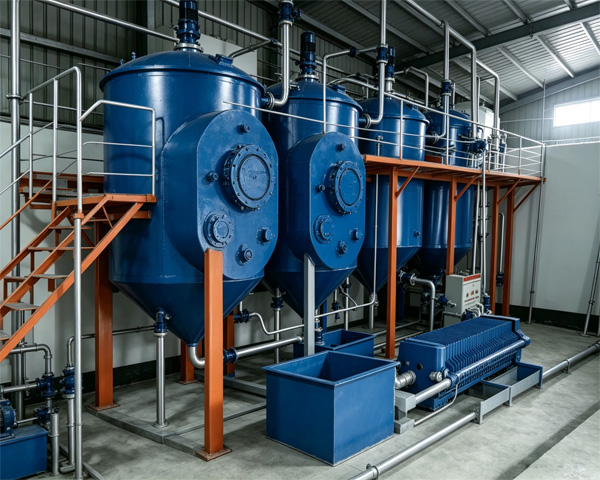
Hitting a Profit Ceiling with Crude Oil? The Problem Lies in “Primary Processing”
If your facility already operates a mature oil press production line, yet finds the market price of crude oil stagnant and profit margins under constant pressure, or if you are planning to enter the more lucrative refined oil market but lack clear technical direction, you are facing a bottleneck common to many traditional oil processing enterprises.
The core issue is this: Crude oil produced solely by an oil expeller or pre-pressing equipment contains natural impurities such as free fatty acids, phospholipids, and pigments. These impurities not only reduce oil stability but severely limit market premium potential—crude oil is often sold as a low-value primary industrial raw material, unable to access the higher-margin food-grade consumer market.
The good news is that you do not need to tear down and rebuild or modify your existing screw oil press system or hydraulic oil press configuration. You simply need to add a compatible and efficient edible oil refinery equipment line downstream of your existing pressing workshop. This is more than just adding hardware; it is a quantum leap in product value.
Step 1: Degumming—Eliminating the “Invisible Killer” of Oil Stability at the Source
The first critical step in upgrading an edible oil processing line is the application of oil degumming equipment. The core objective is the precise removal of phospholipids (gums) from the crude oil.
Why is degumming so crucial? Any residual gum will compromise oil stability during subsequent high-temperature stages, leading to sediment formation in the finished product over its shelf life—severely degrading product quality. Depending on the gum content of the crude oil, the refining process offers two flexible degumming process options: For oils with low gum content, water degumming equipment is used for mixing and separation; for feedstock with high gum content, an acid degumming tank is employed, utilizing food-grade acid to efficiently separate the gums and ensure a pristine oil base.
Step 2: Neutralization (Deacidification)—Eliminating Rancidity and Crossing the “Food-Grade” Threshold
After degumming, residual free fatty acids are the culprit behind oil rancidity and off-flavors, rendering the oil unsuitable for strict food-grade standards. This is where the oil neutralizer tank and alkali refining equipment play a vital role.
In this section, edible oil alkali refining equipment precisely adds caustic soda (sodium hydroxide) to react with free fatty acids, forming separable soapstock. This process significantly reduces the acid value, enhances oxidative stability, lowers the risk of deterioration during storage and transport, and imparts the physical characteristics necessary for cooking and frying. Notably, the separated soapstock is high-purity and serves as a quality feedstock for soap manufacturing or animal feed processing, adding a supplementary revenue stream through oil by-product deep processing.
Step 3: Bleaching—Achieving the “Clear Appearance” Consumers Demand
When consumers select cooking oil, first impressions are visual. Naturally occurring pigments like carotenoids in crude oil impart an undesirable dark brown or deep yellow hue. In the oil bleaching section, a bleaching tower or bleaching pot mixes activated bleaching earth (adsorbent) with heated oil to efficiently adsorb pigments. Subsequently, a plate and frame filter press or hermetic leaf filter completely separates the adsorbent and residue, yielding a bright, clear, and visually appealing edible oil. This step is critical for elevating the output grade of salad oil production equipment.
Step 4: Deodorization—The Transformation from “Flavored” to “Neutral Taste”
Many crude oils carry inherent beany or grassy odors, or volatile compounds generated during processing, which severely restrict their application in high-end baking, blended oils, and health products. Oil deodorization equipment and the deodorizer tower utilize high-temperature steam under a high vacuum to thoroughly strip away odoriferous substances and volatile compounds. Deodorized oil possesses a neutral flavor profile, meaning it will not mask the natural taste of ingredients—a cornerstone requirement for premium food service and the food industry.
Step 5 (Value-Added Option): Fractionation—Unlocking Hidden Added Value
To further maximize market potential, you can install oil fractionation equipment at the end of the refining line. This equipment leverages the physical differences in melting points of various triglycerides. By precisely controlling cooling and crystallization temperatures, refined oil is separated into liquid olein (e.g., palm olein) and solid stearin (e.g., palm stearin). The liquid fraction is ideal for mid-to-high-end edible oil filling equipment lines, while the solid fraction serves as a key raw material for shortening and margarine production. A palm oil fractionation plant often opens a second major profit center for the factory beyond just cooking oil.
Customized Edible Oil Refining Solutions
Transitioning from crude oil to high-quality refined oil involves more than just connecting pieces of oil machinery; it is a systematic engineering process involving chemistry and physics. Whether you currently operate oilseed pressing equipment for soybeans, rapeseed, or palm fruit, KMEC can provide a full range of customized edible oil refinery equipment solutions based on your specific crude oil type, target capacity, and market positioning—from laboratory trials to complete plant planning.
We offer comprehensive, worry-free support from project consultation and equipment manufacturing to installation and commissioning, helping you seamlessly close the profit loop of your oil pressing and refining line. Do not let your profits remain trapped at the crude oil stage. Contact us today to begin a new chapter in high-value-added edible oil production.