
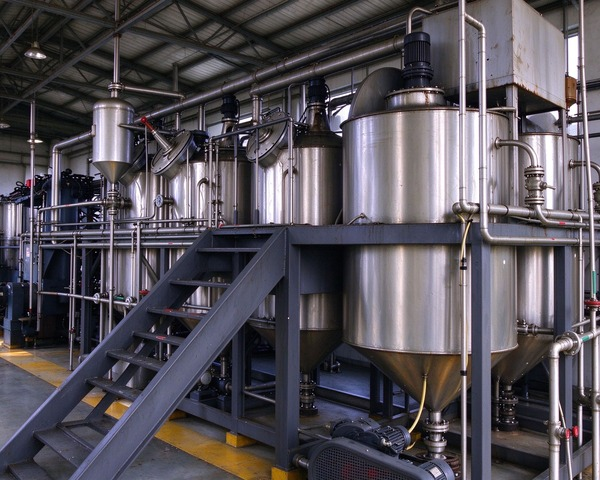
The Equipment List Does Not Change. The Definition of “Refined” Does.
A high-oleic feedstock entering a refinery passes through the same four stages as any commodity oil: degumming, neutralization, bleaching, deodorization. The equipment inventory is unchanged. What has shifted is the objective function of each stage—and the standard by which “good enough” is judged.
Conventional refining logic is built around removal. Remove phospholipids, remove free fatty acids, remove colour bodies, remove odour compounds. Deodorization, in particular, is pushed toward maximum stripping: higher temperature, deeper vacuum, more sparge steam, and the oil comes out “cleaner.” Tocopherol and phytosterol losses are treated as an acceptable price for purity.
High-oleic oils break the premise of that logic. Their commercial value is the oxidative stability they carry naturally. If refining removes the tocopherols that underpin that stability, the certificate of analysis can show compliant FFA and peroxide values while the product has lost the very characteristic that justifies its premium. High-oleic refining is therefore not a different process—it is the same process run against a different objective: a deliberate balance between removal and retention.
That balance point determines the deodorizer temperature setpoint, the vacuum stability requirement and the nitrogen blanketing configuration downstream. KMEC has over two decades of experience in oil refining equipment and process configuration. The sections below examine the chemical basis, the deodorizer window by feedstock, the equipment implications and the phased investment logic.
1. The Chemical Basis: Why High-Oleic Oils Have a Narrower Refining Margin
1.1 The Oxidation Pathway Shifts, and So Does the Role of Tocopherols
Commodity sunflower, soybean and corn oils carry linoleic acid (C18:2) as their dominant polyunsaturate. The bis-allylic structure of linoleic acid makes it far more susceptible to oxidation than oleic acid (C18:1). High-oleic varieties raise oleic acid typically above 70–80% while pressing polyunsaturates well below commodity levels, removing the most oxidation-prone sites at the source.
The consequence is that high-oleic oils oxidise more slowly in storage and frying. But that also means the endogenous defence system—tocopherols and phytosterols—contributes a larger share of the remaining stability. In a commodity oil, even after partial tocopherol loss, residual linoleic acid will oxidise quickly and the tocopherol “buffer” is overwhelmed. In a high-oleic oil, the oxidation rate is already low, so tocopherol loss translates more directly into a shorter OSI and a shorter shelf life.
1.2 Refining Removes Tocopherols, and the Loss Is Measurable
Industrial refining of high-oleic safflower oil provides a concrete data point. α- and γ-tocopherols accounted for 93.3% of total tocopherols in the crude oil, and the refining process removed 28.5% of the tocopherols, with deodorization the main step for tocopherol loss and the main step for trans fatty acid formation.
A separate plant-scale study on physically refined rapeseed oil—not a high-oleic variety, but directly relevant to the temperature–retention relationship—found total tocopherol retention falling from 91.5% at 220°C to 54.7% at 270°C, with a value of about 80% in the 230–240°C range.
These data point to one conclusion: tocopherol loss in high-oleic refining is not an unavoidable industry constant. It is the result of deodorizer parameter selection.
2. The Deodorizer Window: 220–235°C Is a Multi-Objective Compromise, Not a “Low-Temperature Preference”
2.1 The High-Oleic Sunflower Benchmark
Martincic et al. (2008) used response surface methodology to optimise industrial-scale deodorization of high-oleic sunflower oil. The study framed the problem correctly: deodorization optimisation requires a suitable compromise between often mutually opposing demands dictated by different oil quality indicators. The conclusion was specific: producing high-oleic sunflower oil with high tocopherol and phytosterol contents, low free and trans fatty acid contents and high oxidative stability requires deodorization temperatures between 220°C and 235°C and a total sparge steam above 2.0% (wt/wt in oil).
This window must be read correctly. It is not a claim that “lower is always better.” Below 220°C, FFA and odour compound stripping becomes insufficient. Above 240°C, thermal breakdown, oxidation and tocopherol esterification accelerate. The 220–235°C band sits between those two failure modes—an operable compromise between removal and retention.
2.2 The Window Shifts by Feedstock
The sunflower window should not be applied as a universal setpoint. A study on high-oleic canola oil (HOCO) found that the initial quality of HOCO was impaired by the use of a high deodorization temperature during processing, and that regular canola oil retained higher initial tocopherol levels than HOCO and low-linolenic canola oil. The implication is that the appropriate deodorization temperature is feedstock-specific: a setpoint optimised for high-oleic sunflower will not automatically be optimal for high-oleic canola, safflower or soybean.
For the deodorizer, this translates into two equipment requirements. First, the unit must hold a narrow temperature band consistently, rather than oscillating between a “high-temperature zone” and a “low-temperature zone.” Tray-to-tray temperature uniformity matters more than the nameplate maximum temperature. Second, the sparge steam distribution must be uniform enough to meet the >2.0% requirement without local over-stripping or under-stripping. A deodorizer with uneven steam distribution can be set to 230°C and still produce uneven FFA removal and uneven tocopherol loss across the tray stack.
| Dimension | Conventional Refining Logic | High-Oleic Refining Logic |
|---|---|---|
| Primary deodorization objective | Maximise FFA and odour removal | Achieve FFA compliance while maximising tocopherol/sterol retention |
| Typical temperature orientation | 240–260°C | 220–235°C (sunflower benchmark); feedstock-specific |
| Tocopherol loss | Treated as a necessary cost | Monitored as a core quality indicator |
| Trans fat control | Compliance item | Quality item tied to the temperature window |
| Acceptance indicators | FFA, PV, colour, smoke point | Above plus OSI retention and tocopherol content |
3. OSI Is Not a Simple Proxy for Tocopherol Content: What the Data Actually Shows
3.1 The Tocopherol–OSI Relationship Is Real but Not Linear
It is tempting to treat OSI as a direct readout of tocopherol content. The data is more nuanced. A patent study on high-oleic soybean oil deodorized at 240°C and 265°C for varying times showed that when tocopherol content fell from 192.3 mg/100 g to 32.5 mg/100 g at 240°C/240 min, AOM induction time fell only from 122.0 hours to 94.8 hours. At 265°C/360 min, tocopherol fell to 28.1 mg/100 g and AOM fell to 94.5 hours. The study noted that while tocopherol content was significantly reduced, oxidative stability was not reduced by more than 25% in the sample with the lowest tocopherol content.
This does not mean tocopherols are unimportant. It means OSI is governed by the interaction of fatty acid composition, tocopherol content and tocopherol profile, not by tocopherol alone. For a refinery, the practical implication is that OSI should be used as an acceptance indicator for the deodorization setpoint, not as a standalone tocopherol substitute. A high-oleic oil with a short OSI relative to its fatty acid basis points to over-severe deodorization or to a tocopherol profile depleted beyond the level the fatty acid composition can tolerate.
3.2 Why OSI Belongs in the Refinery’s Release Testing
Conventional refinery release testing is built around FFA, PV, colour and smoke point. That set is insufficient for high-oleic oils. OSI or Rancimat induction time should be added to the release protocol as a direct feedback signal on whether the deodorizer is operating inside its effective window. Tocopherol content by HPLC can serve as a batch-release adjunct, particularly for products positioned on a “high-stability, clean-label” platform.
The diagnostic logic then becomes: a low OSI is not simply a quality deviation—it points to excessive deodorization temperature, excessive residence time or unstable vacuum. The deodorizer temperature and vacuum records should be analysed jointly with OSI results, not filed separately.
4. Nitrogen Blanketing: From “Shelf-Life Optimisation” to “Structural Requirement”
4.1 The Oxygen Concentration Effect Is Measurable
If the refinery has carefully preserved tocopherols at 220–235°C, the remaining stability must be protected downstream. Industry guidance is specific on storage: deodorized oil must be cooled, saturated with nitrogen and stored in nitrogen-blanketed tanks, with the tank headspace held to a maximum oxygen content of 0.5%. A separate source notes that nitrogen blanketing does not prevent oxidation completely, and that oxidation can be initiated at oxygen concentrations far below ambient. This is an important qualification: nitrogen blanketing is not a guarantee, but it is the difference between protecting the remaining stability and allowing it to be consumed before the oil reaches the customer.
4.2 Why the Economic Argument Is Stronger for High-Oleic Oils
For commodity oils, nitrogen blanketing is an optimisation that extends shelf life. For high-oleic oils, it protects the product’s core economic claim. Foodservice held approximately 39.6% of the high-oleic oil market in 2025, driven by long frying life and the cost savings from less frequent oil replacement. Food processing—baked goods, snacks and frying oils—accounted for more than half of total high-oleic oil demand in 2024. These buyers are not purchasing “oil” in the abstract. They are purchasing stability under high-temperature, long-cycle use. Industry reports for high-oleic soybean oil consistently cite fry life and shelf life extended twofold to threefold compared with commodity soybean oil. If refining preserves tocopherols but storage and filling allow oxygen to erode them, the frying life that justifies the premium is shortened, and the economic case against commodity oil weakens.
In the refining equipment line, nitrogen blanketing should therefore be planned as part of the refining scope—not appended later as a “shelf-life optimisation” project. The finished-oil tank nitrogen blanketing, pipeline tightness and filling-line headspace oxygen control should be designed alongside the deodorizer, not after it.
5. Market Drivers: Why the Refining Side Must Adjust Now
5.1 Demand Is Structural, Not Speculative
Market size estimates vary by product scope and regional coverage, but the growth direction is consistent. More importantly, the demand signal is application-specific. Foodservice’s 39.6% share in 2025 is attributed directly to high oxidative stability and long frying life. Food processing’s majority share in 2024 is concentrated in applications where stability under heat is the purchase criterion. These are customers who will notice if the refined oil underperforms in the fryer, and they will switch back to commodity oil if the premium does not deliver measurable operational savings.
5.2 The Regulatory Tailwind
FDA has authorised a qualified health claim for oils high in oleic acid, recognising a reduced risk of coronary heart disease when they replace oils higher in saturated fats. This reinforces the premium positioning and gives producers a further reason to protect the nutritional and stability characteristics of the oil through refining, rather than stripping them out in pursuit of maximum “cleanliness.”
6. Phased Equipment Configuration Logic
For equipment buyers planning high-oleic refining capacity, the configuration logic should centre on retention capability rather than maximum removal capability.
Phase one: deodorizer parameter capability. In the refining equipment line, the first parameters to verify are the deodorizer’s temperature control precision (can it hold 220–235°C consistently, not just reach 260°C?), vacuum stability (residual pressure fluctuation range) and sparge steam distribution uniformity. A deodorizer that can run hot but cannot hold a narrow band is not suitable for high-oleic feedstocks.
Phase two: nitrogen blanketing and storage integration. Finished-oil tank nitrogen blanketing, pipeline tightness and filling-line headspace oxygen control should be planned with the refining line, not added later. KMEC configures deodorizer and downstream storage as an integrated scope, with nitrogen blanketing interfaces designed into the line rather than treated as isolated equipment.
Phase three: OSI testing capability. Without Rancimat or OSI capability, deodorizer adjustments lack the most direct feedback signal. Laboratory capability should be configured in step with refining capacity expansion, not after production has started.
7. FAQ
Q1: How does high-oleic oil refining differ from conventional oil refining in equipment terms?
The equipment types are the same, but the parameter capability and control precision requirements differ. High-oleic oils require stable operation within a narrower deodorization window (220–235°C for high-oleic sunflower), placing higher demands on tray temperature uniformity, vacuum stability and sparge steam distribution. Nitrogen blanketing moves from optional optimisation to structural requirement.
Q2: Why can’t high-oleic oils use the conventional 240–260°C deodorization temperature?
The commercial value of high-oleic oils rests on their natural oxidative stability, and tocopherols are a key carrier of that stability. Above 240°C, thermal breakdown, oxidation reactions and tocopheryl ester formation accelerate tocopherol loss. The 220–235°C window with sparge steam above 2.0% balances FFA compliance against tocopherol retention.
Q3: How much tocopherol is lost during refining?
Industrial refining of high-oleic safflower oil removed 28.5% of total tocopherols, with deodorization the main loss step. The exact figure depends on deodorization temperature, residence time and vacuum conditions; it is not a fixed industry constant.
Q4: Can OSI be used directly as a tocopherol proxy?
Not as a simple proxy. In high-oleic soybean oil deodorized at 240–265°C, tocopherol content fell from 192.3 to 28.1 mg/100 g while AOM induction time fell only from 122.0 to 94.5 hours. OSI is governed by fatty acid composition, tocopherol content and tocopherol profile together. It is best used as an acceptance indicator for the deodorization setpoint, alongside tocopherol analysis.
Q5: Why is nitrogen blanketing described as a “structural requirement” for high-oleic oils?
Deodorized oil must be cooled, saturated with nitrogen and stored in nitrogen-blanketed tanks, with headspace oxygen held to a maximum of 0.5%. Nitrogen blanketing does not stop oxidation completely, but it protects the remaining stability that the deodorizer has preserved. For high-oleic oils sold on frying life, that protection is part of the product’s economic claim, not an optional shelf-life enhancement.
Q6: Does the deodorization window differ between high-oleic oil types?
Yes. The 220–235°C window with sparge steam above 2.0% is the benchmark established for high-oleic sunflower oil. High-oleic canola has been shown to suffer initial quality impairment from high deodorization temperatures. The setpoint should be established per feedstock, not transferred across oil types.
References
- Martincic, V. et al., “Optimization of industrial-scale deodorization of high-oleic sunflower oil via response surface methodology,” European Journal of Lipid Science and Technology, 2008 — deodorization temperature 220–235°C, total sparge steam above 2.0% (wt/wt in oil).
- Ortega-García, J. et al., “Refining of high oleic safflower oil: Effect on the sterols and tocopherols content,” European Food Research and Technology, 223(6), 2006 — α- and γ-tocopherols 93.3% of total tocopherols; refining removed 28.5% of tocopherols; deodorization the main step for tocopherol loss and trans fatty acid increase.
- Čmolík, J. et al., “Tocopherol retention in physically refined rapeseed oil as a function of deodorization temperature,” European Journal of Lipid Science and Technology, 110(8), 2008 — total tocopherol retention 91.5% at 220°C, ~80% at 230–240°C, 54.7% at 270°C.
- US Patent 5,981,781, Soybean oil having high oxidative stability — high-oleic soybean oil deodorized at 240°C and 265°C; tocopherol 192.3→28.1 mg/100 g; AOM 122.0→94.5 hours.
- Deodorized oil must be cooled, saturated with nitrogen, and stored in nitrogen-blanketed tanks — headspace oxygen maximum 0.5%.
- IUPAC / American Soybean Association, Soybean Oil Processing; Quality Criteria and Flavor Reversion — nitrogen blanketing does not prevent oxidation completely.
- Persistence Market Research, High Oleic Oil Market Share & Growth Analysis, 2032 — foodservice 39.6% share in 2025 driven by frying life.
- Expert Market Research, High Oleic Oil Demand Growth & Application Insights — food processing more than half of total high-oleic oil demand in 2024.
- Petukhov, I., Frying performance and storage stability of potato chips fried in genetically modified canola oils, 2009 — initial quality of high-oleic canola oil impaired by high deodorization temperature; regular canola retained higher initial tocopherols.
- Elsevier, High-oleic soybean oil, in Soybean Oil, 2021 — fry life and shelf life extended twofold to threefold compared with commodity soybean oil.
For high-oleic refining line deodorizer setpoint optimisation, nitrogen blanketing system configuration, or OSI acceptance indicator design, contact the KMEC engineering team.