
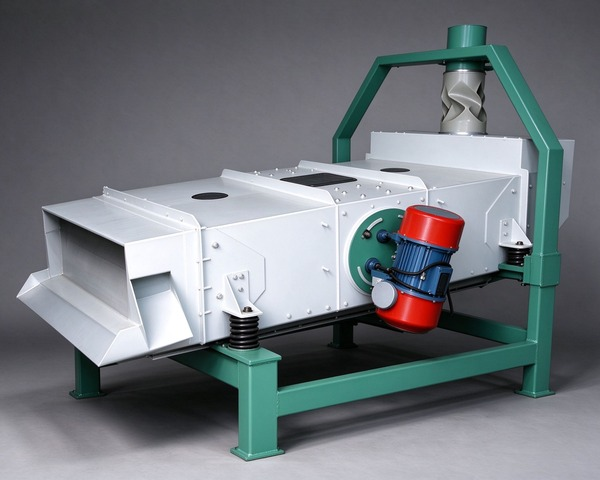
Where Cleaning Sits in the Oil Mill: Not “Housekeeping” but Setting the Material Starting Point for Volumetric Downstream Processes
The vibrating screen separator is often treated as auxiliary equipment on an oil mill’s pretreatment line: remove straw, stones, metal and dust, and let the material entering pressing or extraction be “a little cleaner.” That is not wrong, but it does not answer a more fundamental question: why must cleaning sit before flaking and extraction in the process sequence, rather than simply serving as a hygiene step before raw material enters storage?
AOCS’s Seed Preparation chapter gives an answer that most equipment pages overlook. Cleaning serves two purposes: the first is removal of impurities, and the second is regulation of bulk density. Because preparation processes are based on volumetric quantities, the second purpose is especially important for the flaking operation. A flaker presses oilseed into thin flakes; an extractor loads material by bed volume — and the roll gap, bed depth and residence time of both processes are set by volumetric flow. If the bulk density of incoming material fluctuates, the mass flow corresponding to the same volumetric flow fluctuates with it, and flake thickness and extraction permeability change accordingly.
In other words, the core output of a vibrating screen separator is not “clean material” but a predictable bulk density range, so that downstream equipment designed on a volumetric basis can run at its design parameters. Removing impurities certainly matters, but part of its economic value is delivered through “density stability” rather than through “less dirt” in itself. KMEC has over two decades of experience configuring oilseed pretreatment and pressing equipment. The sections below examine the bulk-density transmission chain, the quantified damage from impurities, the specificity of parameters, and the configuration logic.
1. The Bulk Density Transmission Chain: Why “Volumetric” Makes Cleaning Necessary
1.1 The Mismatch Between Volumetric and Mass Flow
A flaker’s roll gap sets a volumetric throughput. If bulk density falls from 0.65 t/m³ to 0.55 t/m³, the mass passing through the same roll gap per hour drops from 6.5 tonnes to 5.5 tonnes — flakes get thinner and throughput falls. If density rises, flakes may become too thick or the rolls may overload.
The extractor’s problem is subtler. Solvent percolation through the bed depends on bed voidage and permeability. Bulk density fluctuation means voidage fluctuation, solvent distribution across the bed becomes uneven, part of the material is over-extracted and part under-extracted, and the result shows up as higher residual oil and higher solvent consumption. AOCS ties the density regulation function of cleaning directly to flaking precisely because flaking is the first process whose parameters are set volumetrically — and its output (flake thickness and strength) then propagates into the percolation behaviour of the extraction stage.
1.2 How Impurities Damage the Pressing Stage by “Changing Density”
Part of the damage impurities do to pressing is delivered by altering the physical behaviour of the material, not merely by “wearing equipment.” Guance’s field data gives three concrete transmission paths: 1% stones raise press cake moisture by 0.6%, which in turn raises residual oil in the cake by 1.2%; 1 g of iron per kg of seed reduces blade life by 30%; 0.5% dust raises neutral oil loss in refining by 0.3%.
Stones and dust affect moisture and residual oil not because they are “dirty,” but because they change the friction characteristics, moisture distribution and cake-forming behaviour of the material during pressing. Dust increases the specific surface area and changes the attachment and migration paths of moisture; stones create stress concentrations during pressing and disturb uniform compaction of the cake layer. These effects ultimately show up in cake moisture and residual oil — and those two metrics are the core economics of the pressing stage.
2. Impurity Removal Rate and Oil Loss: Distinguishing Supplier Specifications from Engineering Causality
2.1 Removal Rate Data Must Be Labelled by Source
The impurity removal rate of commercial vibrating screen separators is consistently stated on supplier pages at 98–99% or above, with residual impurities controllable at the 0.5–1% level. These are equipment supplier test or claimed values, not independent industry standards or cross-plant statistical conclusions. In the English version they should be labelled “equipment supplier data” or “manufacturer specifications,” not presented as universal engineering constants. AOCS’s pretreatment chapter offers a more conservative industry reference: average residual impurities after the cleaning section are around 1%.
2.2 Breaking Down the “1.5–3% Oil Loss Reduction”
The “1.5–3% oil loss reduction” figure needs to be broken into two paths. The first is reducing oil lost with the impurities: oil adhering to and entrained by impurity surfaces is removed in the cleaning stage and no longer enters pressing or extraction. The second is improving pressing efficiency: stable bulk density gives uniform flake thickness and consistent extraction percolation, lowering residual oil in the cake. The contribution from the second path is often larger than the first — which is exactly where the value of “density regulation” lies. It does not save oil by “taking the dirt away”; it saves oil by “letting the material run at its design parameters.”
3. Parameter Specificity: Frequency, Airflow and Screens Are Not a Universal Setting
3.1 Two-Stage Cleaning of Small-Seed Oilseeds: Parameters Must Switch by Stage
The Narayanan et al. (2025) study indexed by FAO AGRIS provides evidence of parameter specificity for small-seed cleaning. In two-stage sesame cleaning, stage one targets larger impurities at 6.5–7.0 Hz and 1.25–1.5 m/s, while stage two targets fine impurities at 5.25–5.5 Hz and 1.75–2.0 m/s, reaching 98.5% purity at an output rate of 200.6 g/min (about 12.03 kg/h). Single-stage kalonji cleaning uses 5.5–6.0 Hz and 1.0–1.5 m/s, reaching 97.6% purity at 370.2 g/min (about 22.2 kg/h).
The engineering implication is this: frequency and airflow velocity must be set separately for the particle size of the material, the impurity type and the cleaning stage. Using small-seed parameters to clean large-seed material, or using stage-one parameters to perform stage-two fine cleaning, will cost you in both purity and loss rate. A separator that can only run one fixed frequency and airflow setting cannot achieve its design cleaning efficiency when the oilseed variety changes.
3.2 Industrial Vibration Parameters: Specification Data and Its Applicable Scope
Technical data sheets for industrial vibrating screen separators list vibration amplitude of 5–5.5 mm and a motor speed of about 920 r/min; sieve surface inclination of 6°–12° for pre-cleaning and 6° for the cleaning section; vibration inclination of 25° for pre-cleaning and 20° for cleaning. These are typical values from equipment specification tables, applicable to pre-cleaning and cleaning of large-seed oilseeds (soybean, sunflower, rapeseed), but they cannot be extrapolated directly to fine cleaning of small-seed oilseeds or high-impurity feedstocks. In the English version they should be labelled “typical specifications for industrial pre-cleaning and cleaning duty,” not as universal optimum values across feedstocks.
3.3 Capacity Units: t/d and t/h Cannot Be Used Interchangeably
Technical data sheets give pre-cleaning capacity of 30–100 t/d and cleaning capacity of 8–24 t/d. A separate set of supplier data gives figures in t/h: sunflower 8–12 t/h, soybean 10–15 t/h, rapeseed 5–8 t/h. The two sets use different bases: t/d typically corresponds to the fine throughput of the cleaning section (material after pre-cleaning, run at lower capacity to ensure precision), while t/h typically corresponds to the rated throughput of the pre-cleaning section or of a specific model. At the selection stage, you must confirm whether the supplier’s capacity figure refers to pre-cleaning or cleaning, and to which oilseed at which impurity level — otherwise a “capacity is sufficient” selection may fail on cleaning precision.
4. Configuration Logic: From “Buying a Separator” to “Setting the Material Condition”
4.1 Screens Configured to the Oilseed
Screens are the one component that must be customised to the oilseed. Supplier recommendations are: sunflower 3.5–5 mm, soybean 2.8–4 mm, rapeseed 1.2–2.5 mm. For high-hull oilseeds such as sunflower, the upper screen handles large hull pieces and stems; for small-seed oilseeds such as sesame and rapeseed, the lower screen aperture determines the removal efficiency of fine sand and broken kernels. The goal of screen selection is not “the finer the better,” but a balance between removing the target impurities and avoiding oilseed loss with the undersize.
4.2 Integration with the Pressing Stage: Cleaning Is a Precondition for Stable Press Operation
The material leaving the vibrating screen separator goes directly into the flaking or pressing stage. If separator capacity falls below the press’s feed demand, the press swings between “waiting for material” and “overload.” If cleaning precision is insufficient, impurities entering the pressing stage accelerate wear on the press worm and press rings, and raise residual oil in the cake by altering the material’s moisture and friction behaviour. When configuring a vibrating screen separator, KMEC determines screen layers, apertures and the amplitude–frequency combination from the oilseed type, impurity profile and the feed requirements of the downstream oil press machine, and designs the cleaning section and pressing section as a continuous material-handling chain. The value of the cleaning stage is not in what it produces by itself, but in the predictable, repeatable material starting point it sets for downstream processes that are designed on a volumetric basis.
5. FAQ
Q1: Why does AOCS say the second purpose of cleaning is bulk density regulation?
Because oilseed preparation (flaking, extraction) is based on volumetric quantities. Bulk density fluctuation directly changes the mass flow corresponding to the same volumetric flow, affecting flake thickness and extraction bed permeability. Cleaning stabilises density within a predictable range by removing light and heavy impurities.
Q2: Is there quantified data on how impurities damage the pressing stage?
Guance’s field data gives three paths: 1% stones → cake moisture +0.6% → residual oil +1.2%; 1 g Fe/kg seed → blade life −30%; 0.5% dust → neutral oil loss in refining +0.3%. These come from equipment supplier field observations and serve as engineering references, but should not be presented as cross-plant statistical constants.
Q3: What impurity removal rate does a vibrating screen separator typically achieve?
Supplier data sheets typically state 98–99% or above, with residual impurities of 0.5–1% after cleaning. AOCS gives an industry average residual impurity of about 1%. The two are consistent in magnitude, but the former is a specification value and the latter an industry reference.
Q4: How do cleaning parameters for small-seed oilseeds (sesame) differ from industrial large-seed oilseeds?
Two-stage sesame cleaning uses 6.5–7.0 Hz (stage one) and 5.25–5.5 Hz (stage two), with airflow of 1.25–2.0 m/s, reaching 98.5% purity. Industrial large-seed oilseeds typically use an amplitude of 5–5.5 mm and sieve inclination of 6°–12°. Small-seed oilseeds require more precise frequency–airflow matching rather than borrowed amplitude and inclination settings.
Q5: Why are pre-cleaning and cleaning capacities expressed in different units (t/d vs t/h)?
t/d typically corresponds to the fine throughput of the cleaning section (8–24 t/d) to ensure precision; t/h typically corresponds to the rated throughput of the pre-cleaning section or of a specific model. At selection you must confirm the basis, or you may buy equipment with “sufficient capacity” but inadequate cleaning precision.
Q6: How should screens be selected?
By oilseed particle size and impurity profile. Supplier recommendations: sunflower 3.5–5 mm, soybean 2.8–4 mm, rapeseed 1.2–2.5 mm. The goal is to remove target impurities while avoiding oilseed loss with the undersize.
References
- AOCS Lipid Library, Seed Preparation — cleaning serves two purposes: impurity removal and bulk density regulation; preparation is based on volumetric quantities, making density regulation especially important for flaking.
- Guance Machinery, Oilseed Cleaning Machine — field data: 1% stones → 0.6% extra press cake moisture → 1.2% oil left in cake; 1 g Fe/kg seed → cutter bar life −30%; 0.5% dust → +0.3% neutral oil loss in refining; >98% impurity removal in one pass.
- Narayanan, R., Tram, V.H., Trotter, T. et al., “Adaptation of Grain Cleaning Equipment for Kalonji and Sesame Seeds,” MDPI/AGRIS, 2025 — sesame two-stage cleaning: 6.5–7.0 Hz and 1.25–1.5 m/s (stage 1), 5.25–5.5 Hz and 1.75–2.0 m/s (stage 2), 98.5% purity at 200.6 g/min; kalonji single-stage 5.5–6.0 Hz and 1.0–1.5 m/s, 97.6% purity at 370.2 g/min.
- Oil Mill Plant, Vibrating Separator Technical Data — vibration amplitude 5–5.5 mm, motor 920 r/min; sieve inclination pre-cleaning 6°–12°, cleaning 6°; vibration inclination pre-cleaning 25°, cleaning 20°; capacity pre-cleaning 30–100 t/d, cleaning 8–24 t/d.
- Oil Extraction Plant, High-Capacity Vibrating Screen for Oilseed Pretreatment — sunflower 3.5–5 mm, 8–12 t/h; soybean 2.8–4 mm, 10–15 t/h; rapeseed 1.2–2.5 mm, 5–8 t/h.
For vibrating screen separator selection, oilseed cleaning configuration matched to downstream flaking and pressing requirements, or pretreatment line audits, contact the KMEC engineering team.