
Rice bran oil is known as the “nutritional gold oil,” rich in gamma-oryzanol, phytosterols, vitamin E, squalene, and other natural antioxidants. The global rice bran oil market is growing rapidly – expected to rise from approximately USD 7 billion in 2025 to over USD 10 billion by 2032. However, the rice bran oil industry faces a unique challenge. This challenge does not come from market competition, nor from technological bottlenecks – it comes from an invisible enemy: time.
I. Why Is Rice Bran So Prone to Rancidity? – A “Time Bomb” Hidden Inside the Cells
Rice bran is a byproduct of rice processing. It typically contains 16%–22% fat, about 15% protein, and is rich in vitamins, dietary fibre, and minerals. By all measures, it is a high-quality raw material for oil extraction.
But rice bran has one fatal weakness: it contains extremely high lipase activity.
Lipase is an enzyme that catalyses the hydrolysis of oils. In intact rice grains, lipase and oils are separated by cellular structures and coexist peacefully. Once the rice is milled and the bran is separated, the cellular structure is destroyed, and lipase immediately comes into contact with the oils, rapidly hydrolysing them and producing large amounts of free fatty acids.
How fast does this happen? Within 24 hours of harvest, the acid value of rice bran can spike to an inedible level. Untreated rice bran can reach a free fatty acid content as high as 70%.
II. The Cost of Rancidity: Far More Than Just “Going Bad”
The impact of rancidity on rice bran oil production goes far beyond poor taste:
Lower oil yield: Free fatty acids must be removed during subsequent refining. The higher the acid value, the greater the loss of neutral oil during refining. Oil that could have become saleable product is instead removed as “impurity.”
Nutrient loss: The most valuable nutrients in rice bran – gamma-oryzanol, phytosterols, and others – are largely lost with the soapstock during alkali deacidification. High acid value means harsher refining conditions, which means more nutrients are sacrificed.
Soaring refining costs: High acid value requires more alkali, longer processing time, and higher energy consumption. For every additional percentage point of free fatty acids, refining costs rise accordingly.
Equipment corrosion risk: Free fatty acids are corrosive. High-acid-value oils cause more severe corrosion to refining equipment.
III. The Solution: Hit “Pause” Before Rancidity Begins
Since the root cause of rancidity is lipase, the core solution is to inactivate lipase before it can act. This is rice bran stabilisation.
Option 1: Timely Processing (Ideal, but Hard to Achieve)
In theory, rice bran should be pressed for oil within 24 hours of leaving the grain. In practice, this is nearly impossible – bran needs to be collected, transported, and queued for processing. A 24-hour window is just too short.
Option 2: Rice Bran Extruder (The Most Practical Solution)
The rice bran extruder is currently the most effective industrial equipment for stabilising rice bran. Its principle is simple: fresh rice bran is instantly extruded under high temperature (135–140°C) and high pressure, which inactivates lipase through heat, while simultaneously forming porous expanded pellets.
After extrusion, the shelf life of rice bran extends from 24 hours to 30 days. This gives the oil mill a sufficient time window – bran can be stored, transported, and processed in batches, no longer held hostage by time.
Additional advantages of the rice bran extruder:
– The expanded bran has a porous structure, improving solvent permeability and extraction efficiency
– Lipase inactivation significantly reduces subsequent refining difficulty
– Nutrients (gamma-oryzanol, phytosterols, etc.) are better preserved
Option 3: Other Stabilisation Methods
Beyond extrusion, heat treatment and enzymatic stabilisation methods are also used industrially. Research shows that certain non-thermal methods can achieve up to 78% lipase inactivation while keeping nutrient loss below 5%. However, considering industrial maturity and cost-effectiveness, extrusion remains the preferred method.
IV. From Preservation to Finished Product: The Complete Rice Bran Oil Production Chain
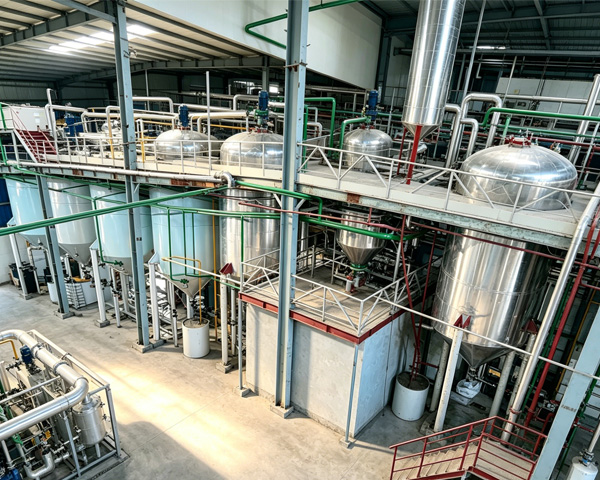
After stabilisation in the extruder, the rice bran enters an extractor for solvent extraction, producing crude rice bran oil. However, the crude oil still contains phospholipids, free fatty acids, pigments, waxes, and odours, and must be processed through refining equipment to become marketable edible oil.
Refining typically includes:
– Degumming: removes phospholipids and other gums (degumming tank, centrifuge separator)
– Deacidification: removes free fatty acids (alkali refining kettle or deacidification tower)
– Bleaching: adsorbs pigments (bleaching tank, activated clay filter)
– Deodorisation: removes odours (deodorizer tower, vacuum system)
– Dewaxing: removes waxes to prevent clouding at low temperatures (dewaxing crystalliser, filter)
Refined rice bran oil has a free fatty acid content of less than 0.3%, is clear and odourless, and ready for bottling and sale.
V. Who Needs to Pay Attention to Rice Bran Preservation?
– Rice mills: A steady stream of rice bran is generated from milling – instead of selling it at low prices to feed mills, why not process it into high-value rice bran oil?
– Oil processing companies: Investors looking to expand into rice bran oil product lines
– Farms and cooperatives: Large-scale rice growers seeking to extend their value chain
VI. How Can We Help You?
We provide complete equipment from rice bran extruders to entire rice bran oil production lines:
– Rice bran extruder: Controls acid value at the source, extending shelf life from 24 hours to 30 days
– Extraction equipment: Extractor, evaporator, condenser, solvent recovery system
– Refining equipment: Degumming tank, alkali refining kettle, bleaching tank, deodorizer tower, dewaxing system, vacuum system
Our engineers can provide complete solutions from extrusion to extraction and refining, tailored to your rice bran volume, budget, and site conditions.
The nutritional value of rice bran oil is beyond question, and market demand continues to grow. But the success of a rice bran oil business does not first depend on how advanced your extraction technology is – it depends on whether you can complete stabilisation before rancidity sets in.
Every minute lost is not just quality slipping away – it is profit slipping away.
If you have a stable source of rice bran, or are considering entering the rice bran oil industry, please contact us. We will provide you with a complete solution and investment analysis – from rice bran extruders to full refining lines.
Contact us today – don’t let time steal the value of your rice bran oil.