
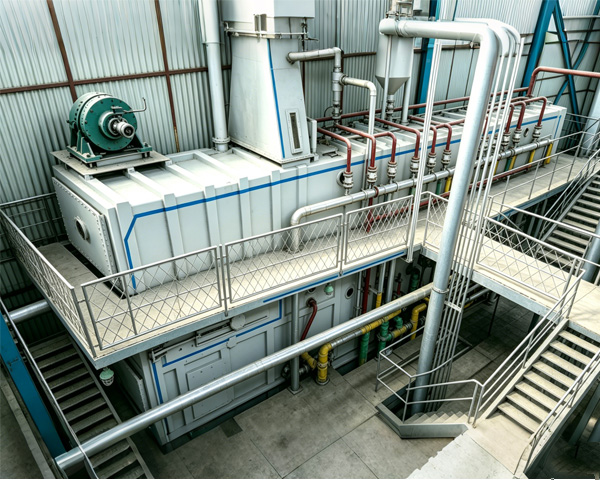
Solvent extraction is one of the most widely used oil extraction processes in the world today. Whether it is direct extraction of soybean or rice bran, or secondary oil recovery from peanut cake or rapeseed cake, the core equipment is the extractor.
However, there are many types of extractors on the market: batch, rotary, loop, drag chain, etc. Different equipment varies greatly in structure, capacity, investment, and operating costs. Choose correctly, and your oil mill runs efficiently; choose wrongly, and you may be plagued by high energy consumption and low efficiency for years.
This article provides a detailed comparison of four mainstream solvent extraction equipment types – batch, rotary, loop, and drag chain – to help you make the best selection decision based on your raw material volume, budget, and site conditions.
I. Batch Extractor: The Entry-Level Choice for Small Batches and Multiple Oil Types
A batch extractor is a cylindrical vessel with a dished head, with a false bottom (composed of two sieve plates with filter cloth between them) at the base to bear the weight of the material and solvent. It consists of 3 to 8 extraction tanks and operates in batch mode.
Key features:
– Simple equipment structure, low investment cost
– Low solvent and energy consumption
– Strong adaptability to different oilseed types, suitable for multi-variety small-batch production
– Relatively small footprint
Suitable for: Small oil mills, operations processing multiple oilseeds (such as cottonseed, rapeseed, peanut, sunflower seed, etc.), and startup investors with limited budgets.
Limitations: Batch operation means lower production efficiency than continuous equipment; limited single-batch capacity, not suitable for large-scale continuous production.
II. Rotary Extractor: The “Classic Model” with the Most Operating Units Worldwide
A rotary extractor mainly consists of an airtight housing, a rotating body, a false bottom, tracks, miscella collection grids, spray devices, feeding and meal discharge devices, and transmission components. The material passes through miscella sprays of different concentrations in the rotating extraction cells, achieving countercurrent extraction.
Key features:
– Simple structure, easy to manufacture, reliable operation
– Low power consumption, low operating cost
– High miscella concentration; the fixed material bed provides good self-filtration, with low meal fines in the miscella
– Combines spraying and soaking for good extraction results
– Wide applicability, can handle various pre-pressed cakes
Suitable for: Medium to large oil mills. It is currently the most widely used extractor type globally. Particularly suitable for operations with moderate budgets that pursue stable operation and low energy consumption.
Limitations: Fixed-grid bottom designs are gradually being replaced by new fixed-bottom designs, and the issue of false-bottom screen wear has been improved.
III. Loop Extractor: The “Workhorse” for Large-Scale Continuous Production
The loop extractor has a loop-shaped appearance, with the entire housing consisting of five sections: feed section, lower bend section, lower horizontal section, upper bend section, and upper horizontal section. The internal moving part is a closed drag chain conveyor belt, with push plates fixed at intervals along the belt. The material completes the entire extraction process on the loop track.
Key features:
– Continuous operation, high processing capacity, suitable for large-scale production
– Downward-section discharge makes wet meal easier to unload
– The material bed flips once during movement, promoting uniform contact of solvent and miscella with the bed
– Continuous and uniform feeding and discharge, helping to stabilise overall pressure
– Short extraction time in the low bed layer, less solvent in wet meal, low residual oil content
Suitable for: Large oil processing plants, continuous production lines with capacities of several hundred tonnes per day or more. Particularly suitable for processing a single oilseed type with stable output.
Limitations: Higher equipment investment, large overall height, requiring significant building space. The loop structure is complex, with relatively high manufacturing and maintenance costs.
IV. Drag Chain Extractor: The “Streamlined Version” of the Loop Extractor
The drag chain extractor, also known as the drag chain scraper extractor, can be seen as a derivative of the loop extractor. It essentially eliminates the bend sections of the loop extractor, merging the upper and lower layers into a unified box-type structure.
Key features:
– Overall height is much lower than the loop extractor, particularly suitable for facilities with height restrictions
– Extraction principle similar to the loop extractor, achieving a residual oil rate of 0.6%–0.8%
– Total equipment weight is only about 75% of the loop extractor
– Eliminates bend sections, resulting in a simpler structure and lower construction cost
– When material falls from the upper to the lower layer, the turning mechanism thoroughly flips the material, ensuring good permeability
Suitable for: Medium to large oil mills with building height restrictions, or customers looking to reduce investment compared to the loop extractor.
Limitations: Slightly lower processing capacity compared to the loop extractor; the polygon effect of chain drive may affect operational smoothness.
V. Comparison Overview of the Four Extractor Types
| Comparison Dimension | Batch | Rotary | Loop | Drag Chain |
|---|---|---|---|---|
| Operation Mode | Batch | Continuous | Continuous | Continuous |
| Suitable Scale | Small | Medium-Large | Large | Medium-Large |
| Equipment Investment | Low | Moderate | High | Moderate-High |
| Structural Complexity | Simple | Moderate | Complex | Relatively Simple |
| Building Height Requirement | Low | Moderate | High | Relatively Low |
| Solvent Consumption | Low | Moderate | Relatively Low | Relatively Low |
| Power Consumption | Low | Low | Relatively High | Moderate |
| Oilseed Adaptability | Strong | Relatively Strong | Single Variety Mostly | Relatively Strong |
| Residual Oil Rate | Moderate | Low | Very Low | 0.6%–0.8% |
VI. How to Choose the Most Suitable Extractor
When selecting solvent extraction equipment, it is recommended to consider the following three dimensions:
1. Production capacity
– Under 50 tonnes/day: A batch extractor or small rotary extractor is sufficient
– 50–200 tonnes/day: A rotary or drag chain extractor offers the best value
– Over 200 tonnes/day: A loop extractor is the optimal choice
2. Oilseed varieties
– Multiple varieties with small batch changes: Batch extractor has the strongest adaptability
– Single variety with stable production: Loop or rotary extractor is more efficient
3. Site and budget
– Limited building height: Prioritise the drag chain extractor
– Limited budget: Batch or rotary extractor requires lower investment
– Pursuing the lowest residual oil rate and maximum output: Loop extractor is the top choice
VII. Our Solvent Extraction Equipment Solutions
We offer a full range of solvent extraction equipment from batch extractors to large loop extractors, and can provide supporting equipment such as evaporators, condensers, and solvent recovery systems for a complete extraction section. Whether you are planning a 30‑tonne‑per‑day small extraction plant or a large extraction mill of several hundred tonnes per day, our engineers can provide the optimal equipment configuration and process design based on your raw material characteristics, capacity goals, and site conditions.
Contact us today for a customised solvent extraction equipment selection plan!