
Palm oil is one of the highest-yielding and most efficient vegetable oils in the world. The yield per hectare of oil palm can be more than ten times that of other oilseeds (such as soybean). In Indonesia, the average yield of the palm oil industry is about 4.14 tonnes of crude palm oil per hectare per year, while soybean yields only about 0.5 tonnes per hectare. So, what is the whole process from fresh fruit bunches in the plantation to refined oil in the refinery? This article will walk you through the complete palm oil production process – from plantation, fresh fruit bunches, sterilization, threshing, pressing to refinery – all in one article.
I. Plantation: Harvesting Fresh Fruit Bunches
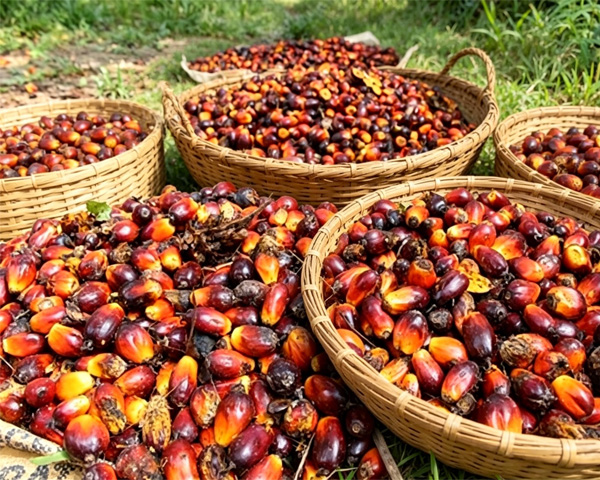
Oil palm trees begin to bear fruit at around 3 years of age and can continue to produce for about 25 years. Typically, 136 trees are planted per hectare, yielding 20–23 tonnes of fresh fruit bunches (FFB) per hectare per year. Each tree produces 15–20 FFB per year, each bunch weighing 10–25 kg and containing 1,000–3,000 palm fruits. Each palm fruit weighs 8–13 grams.
Composition of fresh fruit bunches:
– About 20% can be made into crude palm oil (from the flesh)
– About 2% can be made into crude palm kernel oil (from the seed)
On the plantation, harvesters push a trolley and carry a steel pole weighing about 12 kg with a saw blade attached to one end, walking from tree to tree. They determine which bunches are ready for harvest by observing ripe fruits that have fallen to the ground. They first cut away the surrounding palm fronds, then cut down the bunch weighing about 25 kg. Even individual fruits that have dropped from the bunches are collected – nothing is wasted. The bunches are transported to the roadside, from where trucks take them to the palm oil mill.
II. Fresh Fruit Bunch Reception and Sterilization
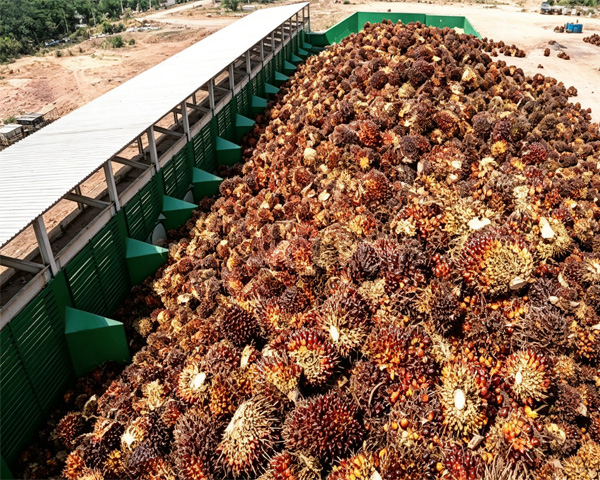
After the trucks bring the fresh fruit bunches to the mill, they are first weighed on a weighbridge and then discharged at the palm fruit reception station. Next, the formal processing begins.
The fresh fruit bunches first enter a sterilizer (vertical or horizontal sterilisation vessel), where they are treated with high‑temperature steam. This step:
– Softens the bunches, making the fruits easier to detach
– Inactivates enzyme activity, preventing oil breakdown
– Prepares the bunches for subsequent threshing
The sterilizer is one of the key pieces of equipment in palm oil processing, ensuring even heating of the bunches.
III. Threshing: Separating Fruits from Empty Bunches
After sterilisation, the bunches have been softened and the fruits are loose. A thresher completes the remaining work, fully separating the fruits from the empty bunches.
– Empty bunches: Sent to the mill’s boiler as fuel to provide power for the mill and the plantation; some can also be used as organic fertiliser.
– Fruits: Move to the next pressing stage.
IV. Pressing: Extracting Crude Palm Oil from the Flesh and Palm Kernel Oil from the Seed
The threshed palm fruits are fed into a screw press (palm oil press), where crude palm oil (CPO) is physically pressed out of the flesh. The fibres and shells produced during pressing are also collected as fuel.
At the same time, the seeds (palm kernels) inside the fruit are separated and processed through another set of pressing or solvent extraction equipment to produce crude palm kernel oil (CPKO).
– Crude palm oil: Mainly used for edible purposes, widely found in biscuits, instant noodles, bread and many other food products.
– Crude palm kernel oil: Mainly used in cosmetics, shampoos and other personal care products.
The crude palm oil obtained from pressing is pumped into trucks or storage tanks, waiting to be sent to the refinery.
V. Refinery: From Crude Oil to RBD Palm Oil
Crude palm oil cannot be stored for long periods and is not suitable for direct consumption. It must be sent to a palm oil refinery for further processing. The refinery typically includes the following steps:
– Refining (degumming & deacidification): Removes free fatty acids, gums and other impurities.
– Bleaching (decolorising): Uses activated clay to adsorb pigments and lighten the oil colour. Core equipment: decoloriser tank / bleaching equipment.
– Deodorisation: Under high temperature and vacuum, steam is passed through the oil to remove odours. Core equipment: deodoriser tower.
After refining, bleaching and deodorisation, we obtain refined, bleached and deodorised palm oil (RBD palm oil), which is the most common finished palm oil on the market. The entire refining process requires refining equipment, including degumming tanks, deacidification towers, bleaching towers, deodorisation towers, vacuum systems, etc.
Workers in the control room monitor and manage the refining process via an automated system to ensure consistent oil quality. Finally, the refined palm oil is pumped back into trucks and transported to warehouses for trading, where buyers further process it into food, cosmetics and biodiesel.
VI. Complete Equipment List for Palm Oil Production
| Stage | Equipment Name | Function |
| Plantation harvesting | Manual/mechanical harvesting tools | Harvest fresh fruit bunches |
| Reception | Weighbridge, FFB reception station | Weighing and temporary storage |
| Sterilisation | Steriliser (vertical/horizontal sterilisation vessel) | Steam softens bunches, inactivates enzymes |
| Threshing | Thresher | Separates fruits from empty bunches |
| Pressing | Screw press | Extracts crude palm oil from the flesh |
| Palm kernel processing | Palm kernel crusher, extraction equipment | Extracts crude palm kernel oil |
| Refining | Degumming tank, deacidification tower, bleaching tower, deodorisation tower, vacuum system | Converts crude oil to RBD palm oil |
| By‑product utilisation | Boiler, power generation system | Uses empty bunches, fibres, shells as fuel |
From fresh fruit bunches in the plantation to sterilisation, threshing, pressing, and then bleaching and deodorisation in the refinery, the complete palm oil production process is an efficient and integrated value chain. Every step relies on professional palm oil processing equipment. If you are planning to build or upgrade a palm oil production line, we can provide complete solutions from single machines to entire plants, including sterilizers, threshers, screw presses, refining equipment and more. Our engineers can customise solutions according to your capacity and process requirements.
Please feel free to contact us for more technical information and equipment quotations.