
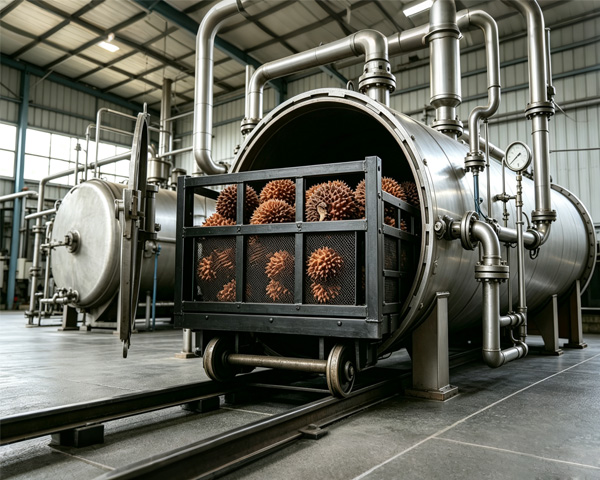
Palm oil is the world’s most consumed vegetable oil, accounting for nearly 45% of the global edible oil market. From the fresh fruit bunches (FFB) harvested from oil palm trees to the cooking oil on your table, the journey involves a series of precise processing steps. Whether you are planning to build a new palm oil processing plant or optimise an existing line, understanding the 4 key stages of palm oil processing is essential.
Stage 1: FFB Pre-Treatment – Sterilization and Threshing
Pre-treatment is the foundation of the entire palm oil processing operation, directly determining the oil yield and final oil quality in subsequent stages.
1. Reception and Weighing
Fresh fruit bunches arrive at the palm oil mill and are first received and weighed. To ensure oil quality, FFB must be processed within 48 hours of harvesting to prevent free fatty acid (FFA) levels from spiking. FFB maturity also directly affects oil yield – only fully ripe fruit produces palm oil of the best quality.
2. Sterilization
The fruit bunches are then loaded into the palm fruit sterilizer, where they are cooked with high-temperature, high-pressure steam at 130–145°C for 60–90 minutes. Sterilization serves three critical purposes:
- Inactivating lipase enzymes – preventing FFA formation and safeguarding oil quality
- Softening the fruit – making it easier to detach from the bunches for subsequent threshing
- Sanitising – reducing microbial content to ensure food safety
3. Threshing
After sterilization, the bunches are fed into a palm fruit thresher (typically a drum-type thresher), which mechanically separates the fruit from the empty fruit bunches. The separated fruit moves to the next stage, while the empty bunches are recovered – typically used as boiler fuel or compost material. A high-efficiency palm fruit thresher significantly improves fruit separation efficiency and reduces labour costs.
Core equipment: Palm fruit sterilizer, palm fruit thresher
Stage 2: Fruit Pressing – Digestion, Pressing, and Clarification
This is the core stage of palm oil extraction, where the palm oil press plays a critical role.
4. Digestion
The threshed fruit enters the digester, where heating and mechanical stirring break down the fruit cell structure to form a uniform mash. The digestion process releases oil from the cells, preparing it for pressing. This stage has a significant impact on final oil yield – the more thorough the digestion, the easier the oil is extracted during pressing.
5. Pressing
The digested mash is fed into the core piece of equipment – the twin-screw palm oil press. This machine uses powerful mechanical pressure to extract oil from the fruit pulp. The press’s oil yield directly determines the profitability of the entire mill.
After pressing, what emerges is a mixture of oil, water, and solids, along with a press cake. The press cake still contains palm kernels, which can be sent to the palm kernel recovery system for further processing.
6. Clarification and Purification
The mixture from the press needs to be purified through the palm oil clarification system:
- Settling and screening: The crude oil first passes through clarification tanks and vibrating screens to remove coarse fibres and large solids
- Filtration: It then goes through a plate filter to remove fine impurities
- Vacuum drying: Finally, a vacuum dryer reduces moisture content to below 0.2%, producing stable, storable crude palm oil (CPO)
Core equipment: Digester, twin-screw palm oil press, clarification tank, plate filter, vacuum dryer
Stage 3: Palm Oil Refining – From Crude Oil to Edible Oil
While crude palm oil (CPO) can be stored and sold, it is dark in colour, contains free fatty acids and impurities, and cannot be used directly as cooking oil. To produce refined palm oil that meets international standards, the crude oil must undergo deep processing in refining equipment.
Palm oil refining typically consists of four stages:
1. Degumming – Removes phospholipids, proteins, and gums from the crude oil. Phosphoric or citric acid is added to coagulate the gums, which are then separated.
2. Deacidification (Neutralisation) – Removes free fatty acids. Alkali (such as sodium hydroxide) is added to neutralise the free fatty acids, forming soapstock which is then separated. Deacidification is typically carried out at 70–95°C for 30 minutes to 1 hour.
3. Bleaching – Uses adsorbents such as activated bleaching earth to remove pigments and residual impurities, lightening the oil’s colour.
4. Deodorisation – Under high temperature and high vacuum (180–240°C, 200–600 Pa), steam distillation removes odours and volatile compounds.
After these four refining stages, the resulting refined, bleached, and deodorised palm oil (RBD palm oil) is clear, neutral in flavour, and ready for cooking, food processing, or bottling.
Core equipment: Degumming tank, alkali refining kettle/deacidification tower, bleaching tank, deodoriser tower, vacuum system
Stage 4: Palm Kernel Recovery – Turning Byproducts into Profit
The press cake produced after pressing still contains palm kernels – the source of palm kernel oil. A complete palm oil processing plant typically includes a palm kernel recovery system, turning byproducts into additional profit.
The palm kernel recovery process includes:
- Fibre-kernel separation: The press cake first passes through a heated conveyor to separate fibre from kernels
- Air classification: The fibre is blown into a cyclone separator (typically used as boiler fuel), while the kernels fall into a collection system
- Kernel crushing and pressing: The kernels are crushed and then fed into a palm kernel oil press to extract palm kernel oil
Palm kernel oil can be further refined for use in cosmetics, soaps, and other daily chemical products, while the remaining palm kernel cake is a protein-rich, high-quality animal feed ingredient. The palm kernel oil extraction rate is approximately 45%–50%.
Core equipment: Fibre-kernel separator, palm kernel crusher, palm kernel oil press
Complete Equipment Configuration Overview
| Processing Stage | Core Equipment | Primary Function |
|---|---|---|
| FFB Pre-Treatment | Reception system, palm fruit sterilizer, palm fruit thresher | Sterilisation, threshing – separating fruit from empty bunches |
| Fruit Pressing | Digester, twin-screw palm oil press, clarification tank, plate filter, vacuum dryer | Extracting crude palm oil (CPO) |
| Palm Oil Refining | Degumming tank, alkali refining kettle/deacidification tower, bleaching tank, deodoriser tower, vacuum system | Producing RBD refined palm oil |
| Palm Kernel Recovery | Fibre-kernel separator, palm kernel crusher, palm kernel oil press | Extracting palm kernel oil, producing feed ingredients |
From fresh fruit bunches to crude palm oil, and then to refined palm oil and palm kernel oil, palm oil processing is an integrated value chain. Sterilisation, threshing, pressing, and clarification – every stage relies on professional palm oil processing equipment. Choosing an efficient, stable, and capacity-matched palm oil processing line directly determines your mill’s oil yield, product quality, and long-term profitability.
We offer complete palm oil processing equipment solutions – from palm fruit sterilizers, threshers, twin-screw presses, and clarification systems to refining equipment and palm kernel recovery systems. Our engineers can provide the optimal equipment configuration based on your FFB processing capacity, budget, and site conditions.
Contact us today for a customised palm oil mill equipment solution and quotation!