
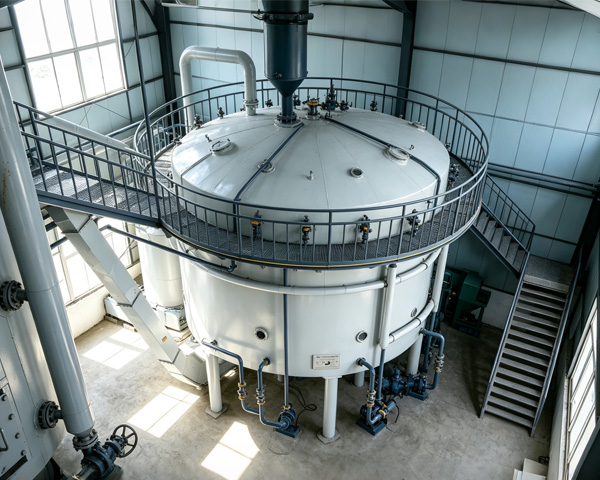
Soybean meal is the primary byproduct of soybean oil processing, but it still contains a significant amount of residual oil. Selling the meal directly means leaving profit behind in the cake.
To extract this residual oil from soybean meal, the most effective method is solvent extraction. Unlike mechanical pressing, solvent can penetrate the microscopic pores that pressing cannot reach, “washing out” the trapped oil. Modern solvent extraction plants can reduce the residual oil content in soybean meal to below 1% – which means you can extract several extra kilograms of oil from the same amount of raw material.
So how does solvent extraction actually work? From meal intake to crude oil output, the entire process consists of four core stages, requiring multiple pieces of solvent extraction equipment working together. This article breaks down each step for you.
Stage 1: Solvent Extraction – “Washing Out” the Oil
It all starts with the extractor.
Prepared soybean meal (typically after cleaning, crushing, dehulling, flaking, and other pre-treatment steps) is fed into the extractor. Here, hexane solvent is brought into thorough contact with the meal through continuous countercurrent washing. Because oil and solvent are miscible, the hexane dissolves the oil from the meal, forming a mixture called miscella (oil + solvent).
Countercurrent design is the key – fresh solvent flows in one direction while the meal moves in the opposite direction, ensuring that every particle of meal comes into contact with the highest possible solvent concentration.
Products at this stage:
- Miscella (oil dissolved in solvent) → sent to the next stage
- Wet meal (solid residue containing 20%–40% solvent) → sent to the desolventizing stage
Core equipment: Extractor (common types include Rotocel extractor, loop extractor, etc.), solvent spray system, feed conveyor.
Stage 2: Miscella Evaporation and Stripping – Separating Oil from Solvent
The miscella leaving the extractor is a mixture of crude soybean oil and hexane. To obtain pure crude oil, the solvent must be separated out.
This stage is divided into two steps:
Step 1 – Evaporation: The miscella is heated with indirect steam in an evaporator. Hexane has a much lower boiling point (approx. 69°C) than oil, so it vaporises first and is collected and sent to the solvent recovery system. The remaining oil-solvent mixture becomes significantly more concentrated.
Step 2 – Stripping: To completely remove the last traces of solvent, direct steam is injected into the concentrated miscella in a stripping column. The steam “carries away” the residual hexane, producing crude soybean oil with minimal solvent residue.
Core equipment: Evaporator (rising film or falling film type), stripping column (packed or tray type), condenser, vacuum system.
Stage 3: Wet Meal Desolventizing – Recovering Solvent from the Meal
After extraction, the wet meal discharged from the extractor still contains 20%–40% solvent. This solvent must be recovered – not only because solvent is expensive, but also because residual solvent poses a safety risk for subsequent feed production.
The desolventizing process is carried out in a Desolventizer-Toaster (DT) and is typically divided into three stages:
1. Pre-desolventizing: The wet meal is preheated in the pre-desolventizing layer to reduce its solvent content. This step aims to reduce subsequent steam consumption and minimise moisture condensation in the meal.
2. Direct steam desolventizing: Superheated steam passes directly through the material bed, causing the residual solvent to boil and vaporise, and is then drawn off.
3. Drying and cooling: The hot desolventized meal still contains moisture (from the direct steam). It needs to be dried to the appropriate humidity level and then cooled to a safe storage temperature.
Modern plants typically use DTDC (Desolventizer-Toaster-Dryer-Cooler), which integrates all three steps into a single unit.
Desolventizing and toasting also serve another important purpose – inactivating anti-nutritional factors (such as trypsin inhibitors), enhancing the nutritional value of soybean meal as animal feed.
The final output – defatted soybean meal – has a residual oil content as low as 0.5%–1%, with high protein content and stable quality, making it an excellent animal feed ingredient.
Core equipment: Desolventizer-Toaster (DT) or DTDC (integrated desolventizing-toasting-drying-cooling), vapour scrubber, condenser.
Stage 4: Solvent Recovery – Closed-Loop Circulation, No Drop Wasted
Throughout the entire process – miscella evaporation, stripping, and meal desolventizing – large volumes of solvent are converted to vapour. These solvent vapours are collected, condensed back into liquid form, and recycled.
The condensed solvent contains some water (from direct steam injection). Water and hexane have different densities, so they are naturally separated by gravity in a solvent-water separator. The recovered pure hexane is returned to the extractor for reuse.
Modern solvent extraction plants use a closed-loop circulation system, achieving extremely high solvent recovery rates with minimal losses.
Core equipment: Condenser (shell-and-tube type), solvent-water separator, solvent storage tank, vapour scrubber, mineral oil absorption system (for treating trace solvent in exhaust gas).
Complete Process Equipment Overview
| Stage | Core Equipment | Function |
|---|---|---|
| Solvent Extraction | Extractor (Rotocel/Loop type) | Countercurrent contact between solvent and meal to dissolve oil |
| Evaporation & Stripping | Evaporator, Stripping Column, Vacuum System | Separate solvent from crude oil in miscella |
| Wet Meal Desolventizing | DT/DTDC (Desolventizer-Toaster-Dryer-Cooler) | Remove solvent from wet meal; inactivate anti-nutritional factors |
| Solvent Recovery | Condenser, Solvent-Water Separator | Recover and recycle solvent |
Why Choose Solvent Extraction?
Compared to mechanical pressing, solvent extraction offers clear advantages:
| Comparison | Mechanical Pressing | Solvent Extraction |
|---|---|---|
| Residual Oil in Meal | 5%–8% | 0.5%–1.5% |
| Oil Yield | Approx. 65%–70% | Over 97% |
| Scalability | Limited | Thousands of tonnes per day |
In simple terms: Pressing is like wringing out a wet towel – no matter how hard you squeeze, it stays damp. Solvent extraction is like using detergent to wash it – it thoroughly dissolves the deep-down residue. Those extra kilograms of oil are pure profit.
Our Solvent Extraction Equipment Solutions
We provide complete soybean solvent extraction equipment, covering the entire process from extraction to refining:
- Extractors (Rotocel, loop, and chain types) – high-efficiency countercurrent extraction
- Evaporators and Stripping Columns – miscella processing
- DT/DTDC – integrated wet meal desolventizing, toasting, drying, and cooling
- Condensers, Solvent-Water Separators, and Recovery Systems – closed-loop solvent circulation
- Complete turnkey extraction plants – customised to your capacity requirements
Whether you are planning to build a new soybean meal extraction plant or upgrade an existing line, our engineers can provide the optimal equipment configuration based on your material characteristics, capacity targets, and budget.
Contact us today for a free consultation and customised soybean solvent extraction equipment quotation.