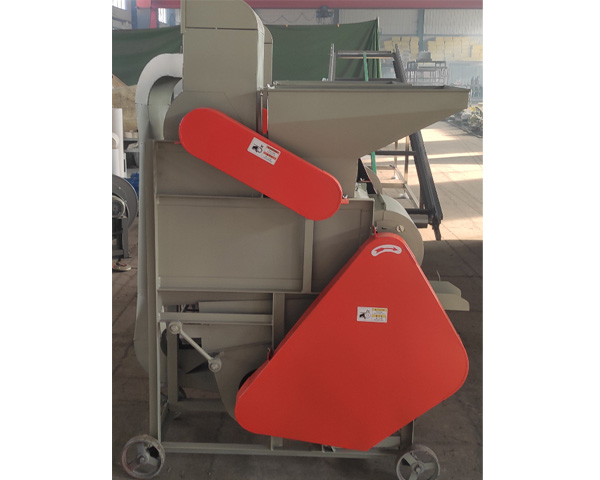
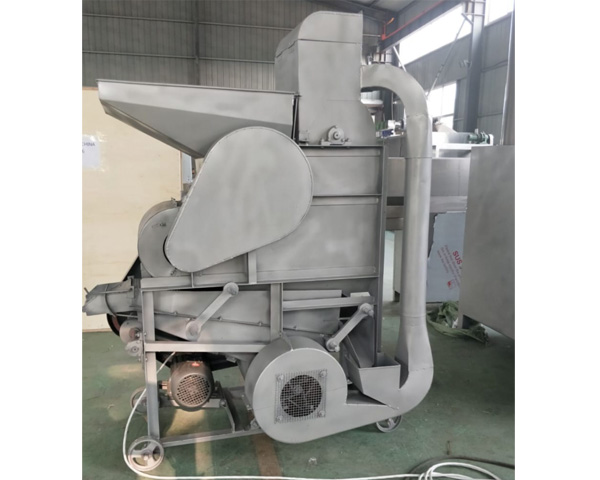
The peanut shelling machine is critical equipment in the pretreatment process before peanut oil extraction. Its performance directly impacts subsequent oil extraction efficiency and the quality of the peanut kernels. Leveraging years of manufacturing experience, KMEC has developed a high-efficiency peanut shelling machine that integrates shelling, cleaning, and sorting. It is suitable for oil plants, food factories, and individual processors. The equipment boasts a shelling rate of over 98% and a damage rate below 4%, ensuring whole, impurity-free peanut kernels that can be used directly for oil extraction or food processing.
Working Principle of Peanut Shelling Machine
The peanut shelling machine operates on a principle combining impact, friction, collision, and air selection:
- Uniform Feeding: Peanuts enter the shelling chamber quantitatively and uniformly via the hopper, preventing clogging or idling.
- Shelling Process: Under the repeated impact and friction of the high-speed rotating rotor (or blades), the peanut shells crack. Some unbroken peanuts are crushed again by the rotor and screen during falling, ensuring complete shell breakage.
- Screening Separation: The mixture of broken kernels and shells passes through a screen with specific apertures. The screens come in coarse and fine mesh sizes, used for initial and secondary shelling respectively, ensuring efficient kernel-shell separation.
- Air Cleaning: A built-in fan generates a controlled airflow, blowing the lighter peanut shells out of the machine, while the plump kernels fall onto a vibrating screen. The vibrating screen further removes fine shell fragments and shriveled kernels, resulting in clean peanut kernels.
- Product Collection: The cleaned peanut kernels are discharged from the outlet, and shell fragments are collected via the impurity discharge port, achieving fully automated operation.
| Component | Function Description |
| Frame | Supports the entire equipment, made of high-strength steel for stability. |
| Motor | Provides power, optional single-phase or three-phase motors to suit different voltages. |
| Rotor/Blade | Rotates at high speed to generate impact force for crushing peanut shells. |
| Screen | Controls the separation size of kernels and shells; aperture is replaceable. |
| Fan | Generates airflow to achieve air separation of kernels and shells. |
| Vibrating Screen | Further removes impurities through vibration, improving cleanliness. |
| Hopper | Stores peanuts, ensuring continuous and uniform feeding. |
| V-belt Drive | Transmits power smoothly, reducing noise. |
Advantages of Peanut Shlling Machine
- High Efficiency & Energy Saving: Shelling rate ≥98%, damage rate ≤4%, high production efficiency, low energy consumption.
- Multi-functional Integration: Integrates shelling, air selection, and screening, eliminating the need for additional cleaning equipment.
- Strong Adaptability: Suitable for various peanut types (e.g., red skin, white sand peanuts) and works efficiently after moisture adjustment.
- Compact Structure: Small footprint, easy to move, suitable for workshop layouts.
- Simple Operation: One-button start, automatic operation; ordinary workers can operate after brief training.
- Easy Maintenance: Easy disassembly and assembly of wear parts like screens and rotors, reducing downtime.
- Optional Materials: Can be manufactured in stainless steel (food grade) or carbon steel (economical) based on customer requirements.
- Environmentally Friendly Design: Good sealing, minimal dust leakage, ensuring a clean working environment.
Details of Blade-Type Peanut Shelling Machine (Cage Type)
- Structure: Composed of a blade rotor and a round steel bar cage, utilizing extrusion and impact for shelling.
- Principle: Peanuts entering the shelling chamber are repeatedly hammered by the high-speed rotating blades and simultaneously squeezed by the cage, causing the shells to break. As the broken mixture falls, a fan blows out the light shells, while the peanut kernels fall vertically, achieving separation.
- Advantages: Simple structure, low maintenance cost; strong adaptability to moisture changes; suitable for large-scale continuous operation.
User Guide and Precautions
Peanut Moisture Adjustment
Peanuts that are too dry or too wet can affect shelling efficiency. Recommended adjustment methods are as follows:
- Winter Treatment: Evenly spray approximately 10 kg of warm water onto 50 kg of peanuts, cover with plastic film to dampen for 10 hours, then sun-dry for 1 hour until the skins are slightly dry but kernels are moist, before starting shelling.
- Other Seasons: Reduce the dampening time to 6 hours; other steps remain the same.
- Quick Method: Soak dry peanuts in a water tank, remove, cover with plastic film to dampen for 1 day, then sun-dry until the surface is dry before shelling.
Voltage and Working Environment
- The motor needs to operate at its rated voltage; voltage fluctuation should not exceed ±5%.
- The equipment should be placed on a flat, well-ventilated, sheltered area, away from flammable and explosive materials.
Operation and Maintenance
- Before starting, check that all connections are secure and the V-belt tension is appropriate.
- Avoid overloading during operation; feed materials uniformly.
- Clean residues from the screen, fan, and vibrating screen after each shift.
- Regularly check the wear of the rotor and blades; replace wear parts promptly.
| Model | KMBK-300 | KMBK-70 | KMBK-150 | KMBK-4500 |
| Capacity | 100–150KG/H | 500-700 kg/hr | 1-1.5T/hr | 4500kg/h |
| Shelling Ratio: | ≥95% | ≥98% | ≥98% | ≥98% |
| Crushing Ratio: | ≤5% | ≤4% | ≤4% | ≤4% |
| Cleaning Degree: | ≥95.5% | ≥97.5% | ≥97.5% | ≥97.5% |
| Power: | 2.2KW | 3KW | 4KW | 11+11+4KW+5.5+4KW |
| Dimension | 630*600*930mm | 1350*700*1700mm | 1450*800*1850 | Main part size:3100x5050x3400mm Attached part size: 2100x1100x2050mm |
| Weight | 40KG | 240KG | 350kg | 2090kg |
After-Sales Service
- Technical Consultation: Free equipment selection guidance, layout design, and operation training.
- Warranty Service: One-year warranty for the whole machine; lifelong spare parts supply.
- Quick Response: Solutions provided within 24 hours of receiving a repair request.