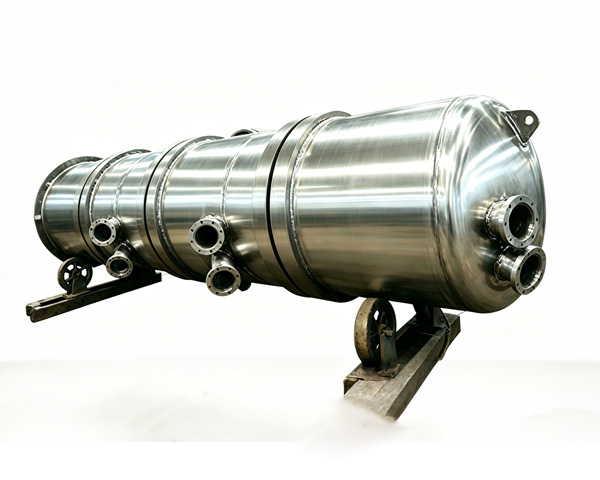
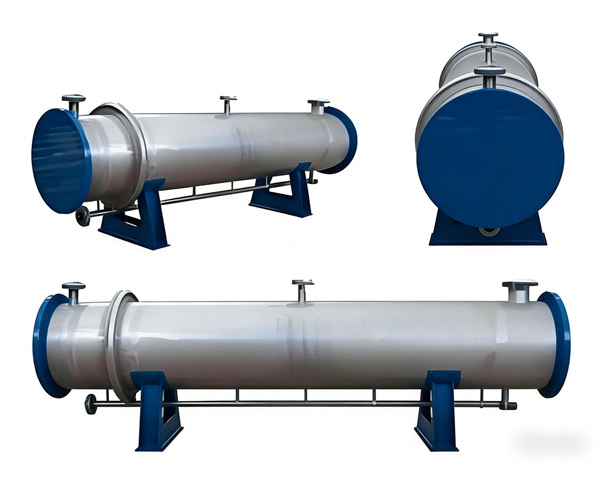
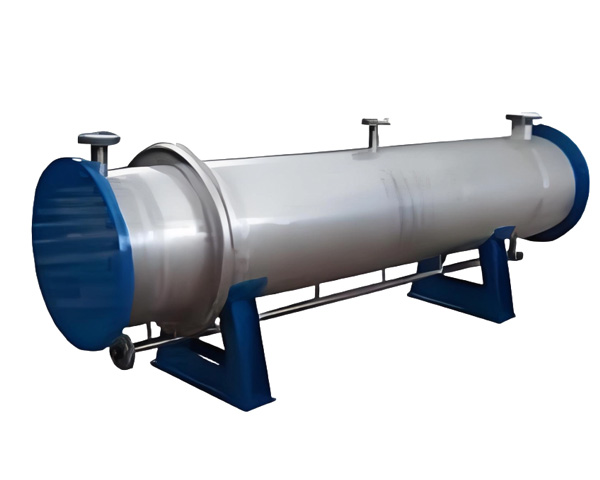
The tube condenser is one of the important equipment in the solvent recovery system of vegetable oil solvent extraction production lines. It undertakes the critical task of rapidly condensing solvent vapor volatilized from various equipment in the extraction process into liquid solvent. Its performance directly determines the solvent recovery rate, production cost control, and environmental compliance.
In the oil extraction process, the solvent vapor (mainly n-hexane) generated after miscella evaporation must be efficiently recovered for reuse and to reduce operating costs. The tube condenser utilizes the heat exchange principle , leveraging the temperature difference between a cooling medium (such as deep well water, seawater, etc.) and the high-temperature solvent vapor to rapidly cool and condense the solvent vapor into liquid, which is then collected in a solvent tank for reuse.
The core heat exchange components of this equipment are made of high-quality stainless steel tubes with smooth inner walls, ensuring smooth material flow while providing excellent corrosion resistance, effectively extending the equipment’s service life.
The tube condenser can adapt to various cooling media – well water, river water, and seawater can all be used, among which deep well water provides the best condensation effect due to its low temperature and large temperature difference . The equipment enables countercurrent exchange (cooling medium flows opposite to solvent vapor), further enhancing heat transfer efficiency. Additionally, it supports vacuum condensation , accelerating solvent vapor liquefaction under negative pressure conditions to improve recovery rates.
Working Principle of tube condenser
The tube condenser is equipment that utilizes the heat exchange principle to condense solvent vapor into liquid. In the oil extraction process, it receives solvent-containing vapor discharged from equipment such as evaporators, stripping towers, and desolventizers, removes heat through the cooling medium, lowers the solvent vapor temperature below its boiling point, and liquefies it for recovery.
Working Process :
- Vapor Inlet : High-temperature solvent vapor enters the tube side or shell side from the top or one end of the condenser.
- Heat Exchange : The cooling medium (water) flows in from the opposite end, forming countercurrent exchange with the vapor, efficiently removing heat.
- Condensation and Liquefaction : The solvent vapor temperature drops, condensing into liquid solvent on the tube wall surface.
- Liquid Collection : The condensed liquid solvent flows out from the bottom of the condenser and enters the solvent tank for reuse.
- Non-Condensable Gas Venting : A small amount of non-condensable gas is discharged through the vent or enters further recovery devices.
Features and Advantages
– High Heat Transfer Efficiency, Fast Condensation Speed:Smooth inner walls of stainless steel tubes + countercurrent exchange design provide high heat transfer coefficients, enabling rapid liquefaction of solvent vapor.
– Significant Energy Saving, Low Operating Cost:Optimized heat exchange path significantly reduces cooling medium consumption, lowering comprehensive energy consumption by over 30% .
– Environmentally Compliant, Reduced Solvent Emissions:Efficient condensation recovery greatly reduces solvent vapor emissions into the atmosphere, meeting environmental standards.
– Compact Structure, Space Saving:Vertical structure has a small footprint; horizontal structure offers flexible layout, adapting to different plant conditions.
– Superior Material, Long Service Life with Corrosion Resistance: Heat exchange tubes are made of stainless steel, resistant to solvent corrosion, smooth, not prone to scaling, and easy to clean and maintain.
– Countercurrent Exchange Capability, Enhanced Heat Transfer: The two heat transfer media can achieve countercurrent exchange, fully utilizing temperature differences to improve condensation efficiency.
– Vacuum Condensation Capability: Supports operation under negative pressure conditions, further accelerating solvent liquefaction and improving recovery rates.
– Continuous Production, Stable and Reliable:Designed to meet the requirements of 24-hour continuous operation, adapting to industrial large-scale production.
– Easy Cleaning and Maintenance: Tube bundle structure facilitates disassembly and cleaning, making routine maintenance convenient and quick.
– Strong Cooling Medium Adaptability: Can use various water sources such as well water, river water, and seawater, with deep well water providing the best effect.
– Flexible Customization:Heat exchange area, interface methods, cooling medium type, and structural form can all be customized according to customer site conditions.
Application Scenarios
- Soybean Extraction Plants : Recovering solvent vapor volatilized during the soybean extraction process.
- Rapeseed Extraction Production Lines : Used in solvent recovery systems for rapeseed/canola.
- Peanut/Cottonseed/Sunflower Seed Extraction : Applicable for the extraction process of various oilseeds.
- Rice Bran Oil Extraction : Solvent condensation and recovery in rice bran extraction production lines.
- Integration with Oil Refineries : Working in coordination with equipment such as evaporators and stripping towers.
- Biodiesel Production : Solvent recovery during the oil extraction process from oilseeds.
- Energy-Saving Retrofits of Existing Extraction Systems : Replacing old condensers to improve recovery efficiency and reduce energy consumption.
Comparison with Traditional Condensers
| Item | KMEC Tube Condenser | Other Condensers |
| Heat Exchange Efficiency | High (Countercurrent Exchange) | Average |
| Energy Consumption | Low (over 30% Energy Saving) | High |
| Material | Carbon Steel / Aluminum Alloy Steel | Primarily Ordinary Carbon Steel |
| Corrosion Resistance | Excellent (Stainless Steel optional) | Average |
| Condensation Effect | Stable and Efficient | Average |
| Environmental Emissions | Low Emissions | Prone to Exceeding Standards |
| Cleaning and Maintenance | Easy to Disassemble and Clean | More Difficult |
| Customization Flexibility | High (Area/Interface/Medium) | Low |