Introduction to Walnut Oil Production Line
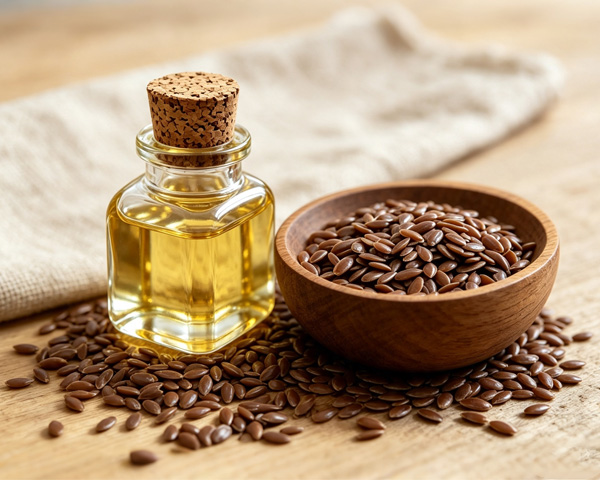
Walnut oil is highly favored in both domestic and international markets due to its rich nutritional composition and unique flavor. Whether used as a high-end cooking oil or a nutritional supplement, walnut oil maintains a stable consumer base. For enterprises planning to invest in walnut oil processing, selecting the appropriate production process and equipment is crucial for ensuring product quality and enhancing profitability.
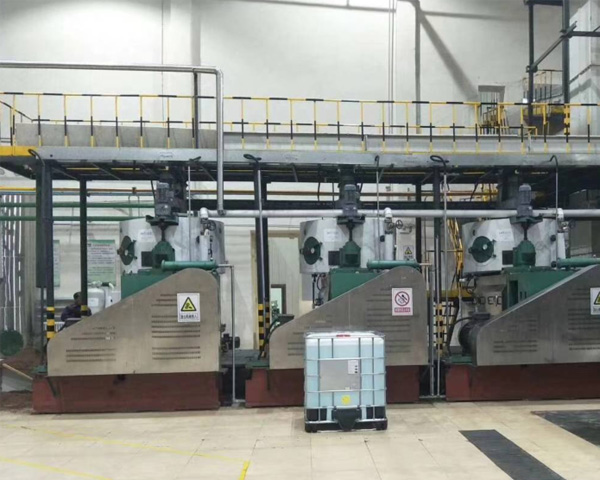
We offer walnut oil production lines with capacities ranging from 1 ton/day to 500 tons/day, covering two mainstream processes: cold press and hot press. Customized turnkey projects can be tailored to meet client requirements. Our equipment is renowned for high oil yield, low energy consumption, and strong durability, helping clients produce high-quality walnut oil that retains its natural flavor and nutrition.
Walnut Oil Processing Line
Phase 1: Pretreatment – The Foundation of Walnut Oil Quality
Pretreatment is the first step in walnut oil extraction and a critical factor determining oil yield and product quality. Through systematic processes including cleaning, grading, shelling, separation, conditioning, and flaking, impurities are removed and material condition is optimized to create optimal conditions for subsequent pressing. We provide complete walnut pretreatment equipment to ensure pure raw materials and stable processes.
1.Cleaning and Grading
Raw walnuts often contain impurities such as stones, metals, branches, leaves, and soil clods, which must be thoroughly removed to prevent equipment damage and ensure oil quality.
- Vibrating Cleaning Screen: Removes large and small impurities through screens of different apertures while separating some dust.
- Magnetic Separator: Uses strong permanent magnets or electromagnets to adsorb metal impurities like iron nails and filings, protecting downstream equipment.
- Destoner: Utilizes specific gravity differences to separate stones from walnuts.
- Air Classification System: Removes lightweight impurities such as broken leaves and stems.
2.Shelling and Kernel-Shell Separation
Walnut shells are hard and contain no oil, making their removal essential. Shelling requires high cracking rates, minimal kernel damage, and low kernel content in shells.
- Walnut Sheller: Employs extrusion, shearing, or impact principles, automatically adjusting gaps based on walnut size to achieve efficient cracking.
- Kernel-Shell Separation System: The cracked mixture enters air classification or specific gravity separation equipment. Utilizing the characteristic that shells are light and kernels are heavy, airflow and vibration are adjusted to completely separate kernels from shells, with kernel content in shells controlled below 1%.
3.Kernel Sorting
Even after kernel-shell separation, walnut kernels may still contain fine shell fragments, moldy kernels, shriveled kernels, etc., requiring further selection.
- Color Sorter: Uses high-resolution cameras and high-speed air valves to automatically reject discolored particles (moldy, oxidized) and shell fragments based on color differences, ensuring pure, plump kernels enter pressing.
- Manual Sorting Belt: Serves as auxiliary inspection, allowing manual sorting at key points to further enhance raw material quality.
4. Conditioning
Walnut kernels have a brittle texture; direct flaking easily produces powder and fails to adequately disrupt oil cell walls, affecting oil yield. Conditioning adjusts moisture and temperature to improve flexibility.
- Conditioning Kettle: Heats walnut kernels to 60–70°C while adjusting moisture to 8%–12% through spraying or steam. Under these temperature and humidity conditions, proteins undergo moderate denaturation, cell structure relaxes, and oil releases more easily.
- Conditioning Tower: Suitable for continuous production, achieving uniform conditioning and moisture balance through multi-layer residence and hot air circulation.
Conditioning time, temperature, and moisture must be precisely controlled based on raw material variety and subsequent processes. Excessive conditions cause premature oil release or excessive protein denaturation, while insufficient conditions fail to achieve the desired effect.
5. Flaking
Flaking conditioned walnut kernels into thin sheets significantly increases surface area, disrupts cell walls, and shortens the oil flow path during pressing.
- Double Roll Flaking Mill: Consists of two counter-rotating rolls; by adjusting the roll gap, walnut kernels are pressed into thin sheets approximately 0.3–0.5 mm thick. Requirements include uniform flaking, low powder content, and no oil leakage.
- Crusher + Flaking Mill Combination: For large walnut kernels, crushing into 4–6 pieces before flaking improves flaking efficiency and uniformity.
The flaked material is called “germ.” For hot pressing, it enters the cooking kettle; for cold pressing, it goes directly or after brief temperature recovery into the oil press.
Phase 2: Pressing
Walnut oil production mainly consists of three major stages: pretreatment, pressing, and refining. Based on target market positioning, either cold press or hot press technology can be selected.
Cold Press Process
Cold pressing is conducted at temperatures below 60°C, without high-temperature treatment, maximizing the retention of natural walnut flavor, vitamins, unsaturated fatty acids, and other heat-sensitive nutrients. Cold-pressed walnut oil has light color, few impurities, and a fresh taste, making it suitable for the high-end health food market.
Cold Press Process Flow:
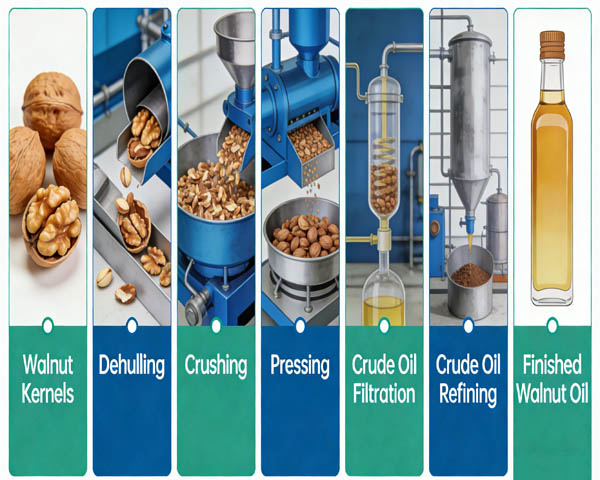
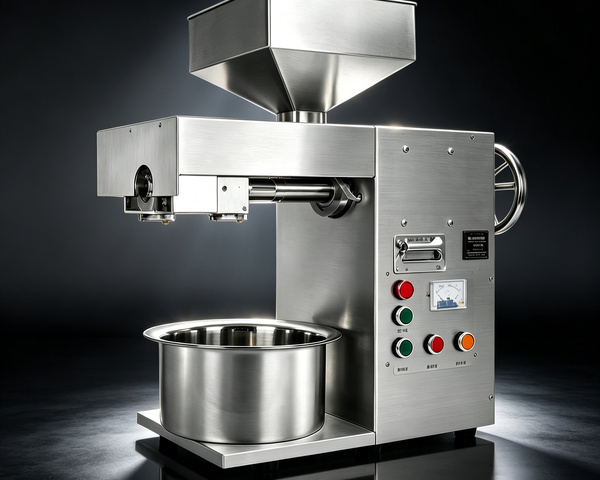
Cold pressing yields relatively lower oil output and higher production costs, but the product has high added value. We recommend using hydraulic presses for cold pressing, as their static pressing method effectively controls temperature and protects oil quality.
Hot Press Process
Hot pressing involves high-temperature cooking of walnut kernels before pressing, causing oil cell rupture and reduced oil viscosity, thereby increasing oil yield and production efficiency. Hot-pressed walnut oil has rich aroma, darker color, and better meets traditional consumer preferences for fragrant edible oils, making it suitable for the mass market.
Hot Press Process Flow:
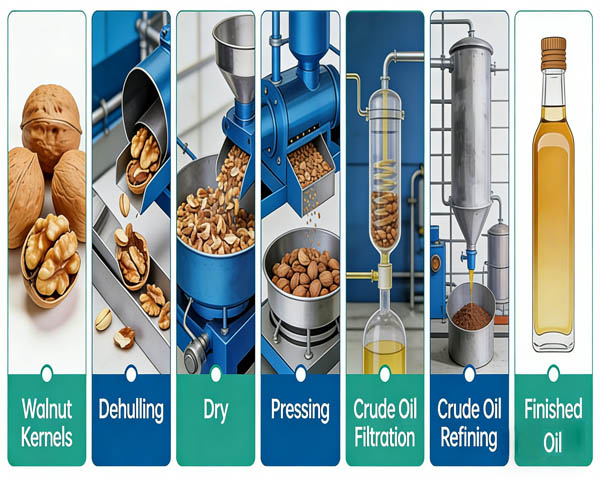
Hot pressing typically uses screw presses, whose continuous, automated operation suits large-scale production, with low residual oil in cake and significant economic benefits.
Phase 3: Crude Oil Refining
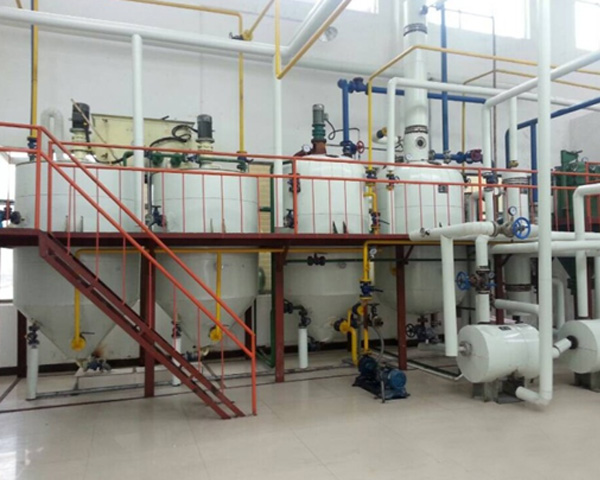
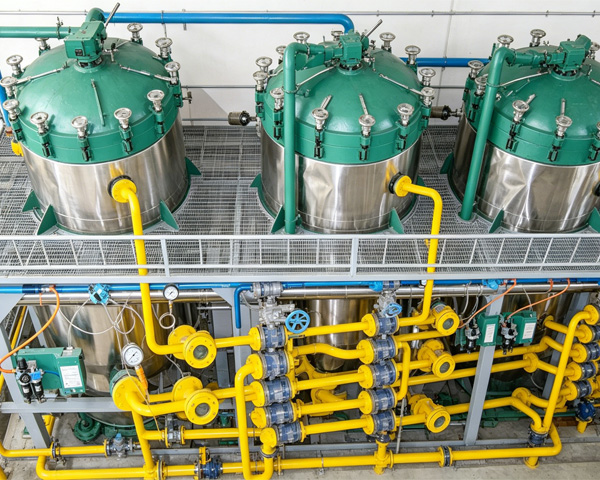
Whether from cold pressing or hot pressing, the obtained crude oil contains impurities such as phospholipids, free fatty acids, and pigments, requiring refining to become finished oil meeting national standards.
- Sedimentation and Filtration: Removes most solid suspended matter through natural sedimentation, centrifugal separation, or plate and frame filtration.
- Degumming: Adds water or phosphoric acid to hydrate and aggregate phospholipids and other gum-soluble impurities for separation.
- Deacidification: Uses alkali to neutralize free fatty acids, forming soap stock that is removed by centrifugal separation.
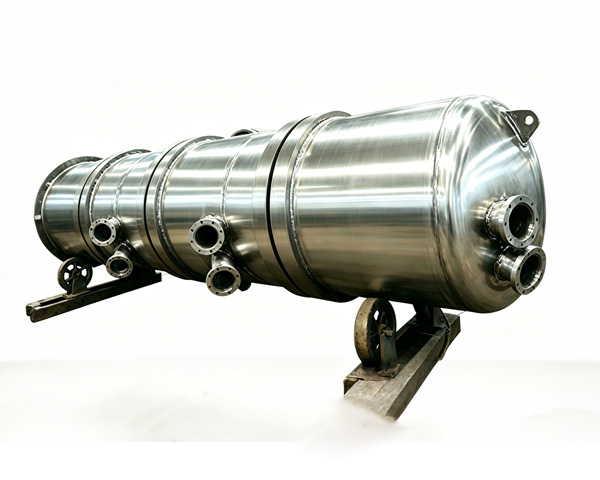
- Bleaching: Adds adsorbents such as activated clay or activated carbon under vacuum conditions, then filters to remove adsorbents, eliminating pigments, residual gums, trace metals, and soap stock.
- Deodorization: Conducts steam distillation under high temperature (220-260°C) and high vacuum to remove volatile compounds causing undesirable odors.
Why Choose Our Walnut Oil Production Line?
- High Oil Yield, Low Residual Oil: Optimized process parameters and advanced pressing equipment ensure minimal residual oil in cake.
- Energy-Efficient Design: Heat transfer systems employ efficient heat exchange technology, reducing energy consumption and operating costs.
- Robust and Durable: Core components use stainless steel and wear-resistant materials, extending equipment life and minimizing maintenance.
- Flexible Customization: From small pilot lines to large industrial plants, we provide personalized configuration solutions.
- Comprehensive Technical Support: We offer one-stop service from plant layout, equipment installation, and commissioning to operator training.