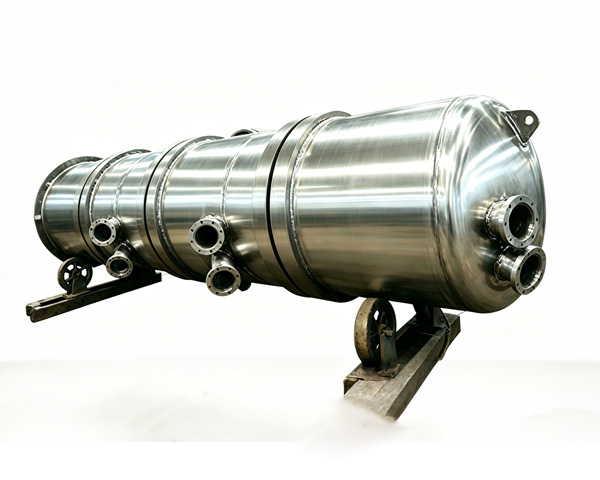
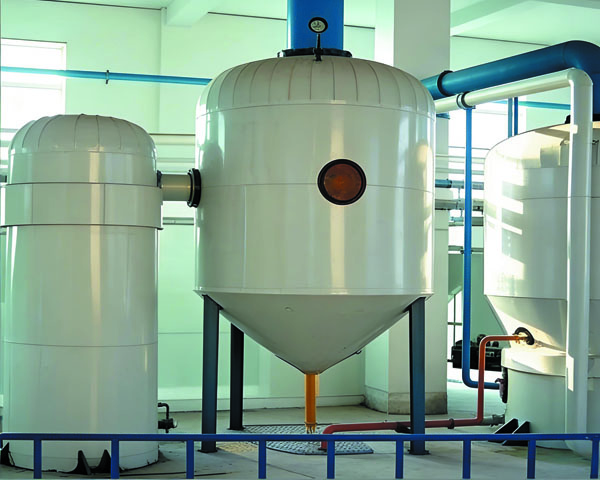
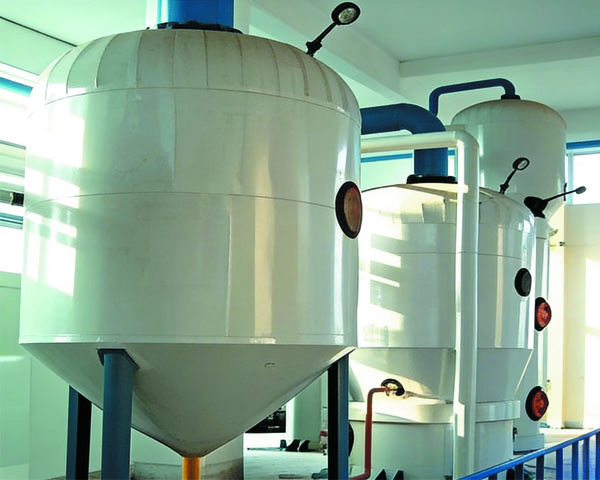
The solvent evaporator is the core downstream equipment of the oil extraction production line. Located at the end of the solvent evaporation system, it undertakes the critical task of efficiently separating solvent from miscella (a mixture of oil and solvent). Its performance directly affects the quality of the final crude oil, the solvent recovery rate, and the energy consumption level of the entire production line.
This equipment adopts advanced rising film evaporation technology (also known as long-tube evaporator). Its core structure consists of multiple stainless steel long tubes. Preheated miscella enters from the bottom of the heating tubes. Heated by steam outside the tubes, the miscella inside the tubes rapidly boils, generating a large number of bubbles. These bubbles, during their ascent, drive the miscella to form an extremely thin liquid film along the tube walls, greatly increasing the evaporation surface area. In this liquid film state, heat transfer efficiency is extremely high, allowing the solvent to evaporate quickly and thoroughly, thereby significantly increasing the oil concentration in the miscella.
We have innovatively introduced micro-vacuum evaporation technology into the solvent evaporation system. By lowering the boiling point of the solvent under vacuum conditions, the miscella can complete evaporation and separation at lower temperatures.
All pipelines in contact with materials are made of high-quality stainless steel with smooth inner walls, ensuring smooth flow of miscella. This not only facilitates heat exchange efficiency but also guarantees the equipment’s corrosion resistance and long-term stable operation. The matching multi-tube condenser is made of stainless steel, features a compact structure, and ensures high solvent recovery rates, effectively saving plant space.
The solvent evaporator is also equipped with a PLC automatic control system, which can monitor key parameters such as temperature, pressure, and liquid level in real-time, enabling automatic equipment operation and fault alarms, ensuring long-term stable and efficient production line operation. Whether processing soybeans, rapeseed, peanuts, or cottonseed, sunflower seeds, this equipment perfectly adapt to various oilseed extraction processes, making it an ideal choice for modern oil processing plants to enhance benefits, reduce energy consumption, and ensure oil quality.
Working Principle and Process Flow of the Solvent Evaporator
- Preheating: Miscella first enters the preheater, utilizing high-temperature oil from the oil stripping tower for preheating and recovering waste heat.
- Rising Film Evaporation: The preheated miscella enters the bottom of the long-tube evaporator. Heated by steam outside the tubes, it rapidly boils, forming a rising liquid film along the inner tube walls, with the solvent continuously evaporating.
- Gas-Liquid Separation: Solvent vapor and concentrated miscella enter the separation chamber. The vapor is drawn off for condensation and recovery, while the concentrated oil enters the next stage evaporator or stripping tower.
- Multi-Stage Evaporation: A two-stage evaporation design is typically used to gradually increase the oil concentration, ultimately minimizing residual solvent.
Core Features and Advantages
– Micro-Vacuum Evaporation Technology, Improved Oil Quality
Low-temperature evaporation under vacuum conditions effectively prevents high-temperature oxidation and discoloration of oil, resulting in light-colored, high-quality crude oil with minimal residual solvent.
– Rising Film Evaporation Design, Extremely High Heat Transfer Efficiency
Long-tube structure combined with film evaporation provides high heat transfer coefficients and fast evaporation rates, resulting in compact equipment size and large processing capacity.
– Significant Energy Saving Effect, 30% Reduction in Steam Consumption
The negative pressure evaporation system fully utilizes secondary steam waste heat; steam ejectors use waste steam, reducing fresh steam consumption.
– Waste Heat Recovery System, Further Reducing Energy Consumption
The feed for the first-stage evaporator uses high-temperature oil from the oil stripping tower for preheating, significantly increasing feed temperature and reducing overall heating requirements.
– Stainless Steel Material, Corrosion Resistant with Long Life
Key components such as evaporation tubes, condensers, and separation chambers are made of high-quality stainless steel. Smooth inner walls resist scaling, making cleaning and maintenance easy.
-Multi-Tube Condenser, High Solvent Recovery Rate
Stainless steel multi-tube structure provides large heat exchange area and high condensation efficiency, saving space and reducing solvent loss and production costs.
– PLC Automatic Control, Stable and Reliable Operation
Fully automatic control system monitors operating parameters in real-time, enabling long-term continuous stable operation and reducing manual intervention.
– Compact Structure, Small Footprint
Integrated equipment design with reasonable layout saves plant space and reduces civil construction investment.
– Wide Range of Applicable Raw Materials
Adaptable to extraction production lines for various oilseeds including soybeans, rapeseed, peanuts, cottonseed, sunflower seeds, and rice bran.
Technical Parameters
| Item | Description |
| Evaporation Capacity | 0.5 ton/hour – 100 ton/hour (Customizable according to production capacity) |
| Evaporation Type | Rising Film Evaporation (Long-Tube Evaporator) |
| Working Pressure | Micro-Vacuum (Negative Pressure Evaporation) |
| Heating Medium | Steam (allows secondary steam waste heat utilization) |
| Material | Stainless steel for all parts in contact with materials |
| Condenser | Stainless Steel Multi-Tube Condenser |
| Control System | PLC Automatic Control |
| Operating Cost | 1/8 to 1/2 of traditional evaporators |
| Applicable Raw Materials | Soybeans, Rapeseed, Peanuts, Cottonseed, Sunflower seeds, Rice bran, etc. |
Energy Saving Principle of the Solvent Evaporator
- Negative Pressure Evaporation Technology: Utilizes vacuum to lower the solvent boiling point, allowing evaporation at lower temperatures and reducing heating steam consumption.
- Secondary Steam Waste Heat Utilization: Secondary steam generated by the first-stage evaporator, after being pressurized by a steam ejector, can be used as a heat source without requiring fresh steam supplementation.
- High-Temperature Oil Preheating Feed: High-temperature oil (approx. 100-120℃) from the oil stripping tower is used to preheat the miscella entering the first-stage evaporator, significantly reducing its heat load.
- Efficient Condensation Recovery: The stainless steel multi-tube condenser has high heat exchange efficiency, ensuring thorough solvent recovery and reducing solvent loss and replenishment costs.
Application Scenarios
– Soybean Extraction Plants: Processing soybean miscella to extract crude soybean oil.
– Rapeseed Extraction Production Lines: Suitable for solvent separation from rapeseed/canola.
– Peanut Pressing and Extraction Integration: Supporting peanut pre-pressing processes to increase total oil yield.
– Cottonseed/Sunflower Seed/Rice Bran Extraction: Applicable for the extraction of various oil-bearing crops.
– Pre-Treatment for Oil Refineries: Providing concentrated miscella for subsequent refining processes.
– Biodiesel Production Lines: Extracting oil from oilseeds for biodiesel production.