
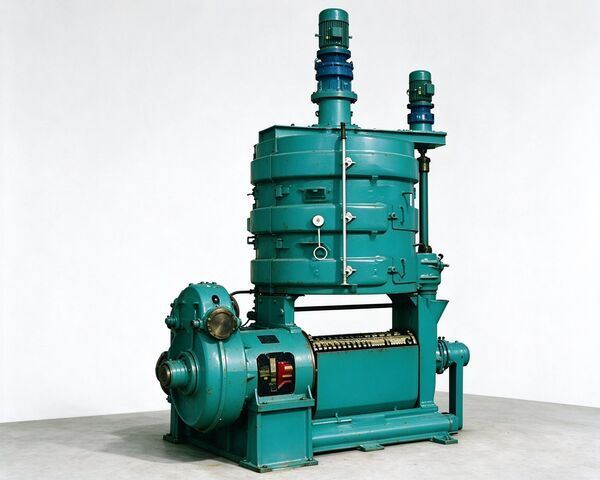
Screw Pressing Is Not “Squeezing Toothpaste” — It’s a Precisely Engineered Dynamic Physical Process
Many people understand how an oil expeller works as simply “squeezing oil out of seeds.” That understanding overlooks the physical mechanisms that actually determine what happens inside the press.
Inside the barrel of a screw press, material doesn’t experience a smooth, gradual pressure increase during its brief residence time. Instead, the pressure fluctuates periodically, in sync with screw rotation. A 2025 instrumented study published in OCL used high-frequency sensors — pressure, torque, and cage strain — to record real-time dynamics inside the press barrel during sunflower and rapeseed pressing. The research found that internal pressure and cage deformation exhibit significant periodic fluctuations, tightly coupled to screw rotation. The study explicitly states: conventional steady-state models cannot accurately describe what actually happens inside the press barrel — dynamic methods are required to capture how the oilseed matrix truly responds during pressing.
A separate 2026 study systematically tested how screw geometry parameters affect compression ratio and oil yield. Using a screw press with 200 kg/h capacity, the researchers varied pitch (40–140 mm), segment length (40–200 mm), and inner diameter (82–132 mm). The experiments confirmed: at a compression ratio of 13.6, oil yield reaches its maximum of 37% under single-stage cold pressing conditions. Pushing compression ratio to 14.6 does not improve yield further — instead, it produces more broken cake and reduces overall process efficiency.
Together, these two studies reveal a core fact: screw pressing is a dynamic, periodic physical system deeply coupled to screw geometry and rotational speed. For equipment buyers and processors, understanding this physical mechanism means recognizing that the parameters you focus on when selecting an oil press machine — screw speed, compression ratio, choke setting — each directly determines oil yield and oil quality. KMEC has over two decades of experience in oil processing equipment. This article builds an engineering-level understanding of screw pressing across four dimensions: the physical mechanism, key parameter effects, operating window optimization, and equipment selection.
1. The Core Physics of Screw Pressing
1.1 Compression Ratio: The First Parameter That Sets the Yield Ceiling
The core structure of a screw press is a helical shaft rotating inside a slotted cage. Material enters at the feed end, and as the screw advances, the effective volume inside the barrel gradually decreases, continuously compressing the material.
Compression ratio is the ratio of material volume at the barrel inlet to volume at the outlet. The 2026 study systematically adjusted compression ratio by changing screw pitch, segment length, and inner diameter. The conclusion: the reasonable compression ratio range is 13.6–14.6, with 13.6 being the optimal value, at which oil yield reaches 37%.
The study also found that compression ratio affects not just the magnitude of pressure, but also the location of the maximum pressure zone within the barrel. When pitch decreases to 40–56 mm and inner diameter increases to 128–132 mm, the maximum pressure zone shifts toward the discharge end. This means: changing screw geometry parameters is effectively redesigning the pressure distribution curve inside the barrel.
Equipment procurement implication: A qualified screw press must have screw geometry designed to achieve a reasonable compression ratio. If a supplier cannot provide compression ratio parameters or the design basis for screw geometry during your evaluation, that itself is a warning sign.
1.2 Dynamic Pressure Pulsation: The Overlooked “Hidden Variable”
This is the most easily overlooked — yet potentially most influential — factor in screw pressing physics.
The 2025 instrumented study used high-frequency sensors to record real-time pressure changes inside the barrel during operation. The results showed that pressure does not stabilize at a fixed value. Instead, it fluctuates periodically in sync with screw rotation. Cage deformation exhibits the same periodic pattern, and cage deformation correlates significantly with torque variation — a finding that indicates structural rigidity is a key factor in optimizing pressing performance and energy efficiency.
The study further found that the amplitude and frequency of these dynamic pressure fluctuations are directly related to screw speed. At high screw speeds, material residence time inside the barrel shortens, and significant backflow occurs — some already-compressed material flows backward under the pressure gradient.
Engineering implication: Screw press performance cannot be described by “average pressure” alone. If a machine is poorly designed for dynamic pressure management, actual oil yield may fall short even when static parameters look reasonable. Cage structural rigidity — the ability to resist periodic deformation — is a key factor affecting energy efficiency and oil yield.
2. Screw Speed and Oil Yield: A Misunderstood Core Parameter
2.1 The Relationship Between Speed and Pressure
Screw speed is the most frequently adjusted parameter in screw press operation, but its relationship with oil yield requires more precise understanding.
An experiment on mustard seed and sunflower pressing provides precise data: at 30 rpm screw speed, barrel-end pressure was 6.51×10⁵ Pa for mustard seed and 6.25×10⁵ Pa for sunflower. When speed increased to 48 rpm, mustard seed pressure rose to 10.57×10⁵ Pa and sunflower to 9.47×10⁵ Pa. Theoretical calculations matched experimental measurements within 1.56%–7.78% error, validating the model’s accuracy.
This data shows: within the lower speed range, increasing screw speed does raise pressure inside the barrel. The reason is that higher speed increases material advance rate and compression rate, building higher back pressure at the barrel end.
But this trend changes at higher speeds. The research explicitly states: “Lower screw speeds generate less heat and achieve higher oil recovery.”
2.2 The Trade-Off Between Speed and Throughput
The relationship between screw speed and throughput is more direct. Experimental data shows that when screw speed increases from 30 rpm to 90 rpm, oil production rate increases from 12.56 kg/h to 15.45 kg/h. Higher speed does deliver higher throughput.
But the research also found that “increasing screw speed enhances the press’s processing capacity and shortens material transit time, but reduces extraction rate.”
This creates a key operational trade-off: high speed → high throughput + low oil yield; low speed → low throughput + high oil yield.
The optimal operating point depends on your commercial objective. If you’re pursuing maximum throughput (abundant feedstock, volume-based strategy), higher screw speed is more appropriate. If you’re pursuing maximum oil yield (high feedstock cost, high oil price), lower screw speed with appropriate preheating is the better choice.
When configuring oil press machines for clients, KMEC provides recommended screw speed ranges based on feedstock characteristics and commercial objectives. A qualified machine should have a variable-speed screw drive system to accommodate different oilseeds and production goals.
2.3 Backflow and Screw Design
Another problem with high screw speeds is backflow. The instrumented study used residence time distribution measurements to identify significant backflow at higher screw speeds, requiring hybrid modeling approaches to capture complex material flow patterns.
Backflow means some material doesn’t move unidirectionally forward inside the barrel — it flows backward under the pressure gradient. Backflow not only wastes energy but also reduces oil yield, because some material is repeatedly compressed without effective oil drainage.
Screw geometry design — especially the pitch variation pattern — directly affects backflow magnitude. One study used a continuous spiral with decreasing pitch to optimize flow field and pressure distribution, achieving maximum pressure of 9–10.57×10⁵ Pa at the screw end at 48 rpm, with theoretical pressures matching experimental data from rapeseed and sunflower pressing.
3. Choke Setting and the Operating Window
3.1 Choke Setting: The Core Means of Back Pressure Control
In practice, operators control barrel back pressure by adjusting the choke setting (discharge gap). An experiment systematically studied how choke setting affects oil extraction efficiency, producing precise data: at 1 mm choke setting, 1 mm screw clearance, and 70 rpm screw speed, maximum oil extraction efficiency reached 83.96%. At 3 mm choke setting, 3 mm screw clearance, and 50 rpm screw speed, minimum efficiency dropped to 66.42%.
The experiment also found that when choke setting increases from 0.5 mm to 1.4 mm, oil production rate increases from 11.94 kg/h to 13.17 kg/h. This means: increasing choke setting raises throughput but reduces oil extraction efficiency.
This creates a key operational trade-off: smaller choke setting → higher barrel pressure → higher oil yield → but lower throughput and higher energy consumption.
3.2 Temperature and Feedstock Pretreatment
Temperature has a dual effect on screw pressing. On one hand, higher temperature reduces oil viscosity, making it easier for oil to flow out of the material. On the other hand, temperature also changes the cellular structure of the material (the “cooking” effect), affecting compression and filtration behavior.
Preheating is a critical step before pressing. Without preheating, “press blockage” occurs — material cannot advance normally through the barrel.
Equipment procurement implication: If you plan to produce cold pressed oil (pressing temperature below 49°C), the equipment must have an effective cooling system to counteract heat generated by pressing friction. If you produce hot pressed oil, the temperature interface between the cooking equipment and the oil press is critical.
4. Equipment Selection: From Physical Understanding to Engineering Decisions
4.1 Key Selection Parameters
Based on the physical mechanism analysis above, evaluating a screw press should focus on the following parameters:
| Parameter | Why It Matters | Qualification Standard |
|---|---|---|
| Compression ratio | Sets the oil yield ceiling | Should be within 13.6–14.6, with design verification data available |
| Screw speed range | Determines operational flexibility | Should be variable-speed; minimum speed must meet cold pressing requirements |
| Choke setting adjustment range | Determines back pressure control precision | Should be precisely adjustable, minimum gap ≤1 mm |
| Cage structural rigidity | Determines dynamic pressure management capability | Should resist periodic deformation |
| Temperature control precision | Determines oil quality and consistency | Cold pressing must maintain temperature below 49°C |
| Screw and cage material | Determines service life | Should use surface hardening treatment (e.g., carburizing) |
4.2 Design of Wear Parts
The most wear-prone components in a screw press include screw segments, press rings, discharge cones, and cage bars. These parts endure continuous friction and high pressure, making wear unavoidable.
In industry practice, screws and press rings typically use carburizing surface hardening to extend service life. Research compared the wear resistance of different surface treatment processes: in comparative tests on cage blades of sunflower oil presses, cobalt-based hardfacing layers containing chromium and tungsten carbide particles (welding layer B) provided the highest wear resistance. Carburized surfaces achieve hardness up to HRC 59 with an effective hardened layer depth of 1.2 mm.
The negative impact of wear on oil yield is cumulative. Once press worm outer diameter wear exceeds a certain threshold, oil yield drops significantly and cake residual oil rises. Regular inspection and replacement of wear parts is therefore essential for maintaining stable oil yield.
4.3 Phased Equipment Configuration
For processing enterprises of different scales, screw press configuration strategies differ:
Small-scale processing (1–5 TPD): Single-screw press with basic cleaning and filtration equipment. Focus on speed adjustability and temperature control precision to accommodate multi-product rotation.
Medium-scale processing (5–20 TPD): Twin-screw or pre-pressing + solvent extraction combination. Pre-pressing reduces cake residual oil to 15%–18%, then solvent extraction recovers remaining oil.
Large-scale processing (20+ TPD): Complete pretreatment–pre-pressing–extraction–refining production line. KMEC’s oilseed pretreatment equipment and oil press machines use unified modular design standards, supporting seamless integration from pressing to refining.
5. FAQ
Q1: What is the optimal compression ratio for a screw press?
Research shows that under single-stage cold pressing conditions, oil yield reaches its maximum of 37% at a compression ratio of 13.6. Beyond 14.6, yield does not improve further — instead, more broken cake forms and overall efficiency drops. However, optimal compression ratio varies by oilseed type and equipment design.
Q2: How does screw speed affect oil yield?
Within the lower speed range (30–48 rpm), increasing screw speed raises barrel-end pressure. But lower screw speeds generate less heat and achieve higher oil recovery. Higher speeds increase throughput but shorten material residence time and reduce extraction rate. Operators must find the balance between throughput and oil yield.
Q3: How does choke setting affect pressing performance?
Smaller choke settings create higher barrel back pressure and higher oil extraction efficiency, but lower throughput. Experimental data shows maximum oil extraction efficiency of 83.96% at 1 mm choke setting, dropping to 66.42% at 3 mm. When choke setting increases from 0.5 mm to 1.4 mm, throughput rises from 11.94 kg/h to 13.17 kg/h.
Q4: Why is preheating required before screw pressing?
Preheating reduces oil viscosity, making it easier for oil to flow out, while also changing the cellular structure of the material. Pressing without preheating causes “press blockage” — material cannot advance normally through the barrel.
Q5: What are the wear parts of a screw press?
The main wear parts include screw segments, press rings, discharge cones, and cage bars. These components typically use carburizing surface hardening, achieving surface hardness up to HRC 59 after treatment. Hardfacing layers containing chromium and tungsten carbide particles provide the highest wear resistance.
Q6: How do I choose a screw press that fits my scale?
For 1–5 TPD small-scale processing, a single-screw press is suitable. For 5–20 TPD, a twin-screw or pre-pressing + solvent extraction combination works best. For 20+ TPD, configure a complete pretreatment–pre-pressing–extraction–refining production line. KMEC can provide customized configuration plans based on feedstock characteristics and commercial objectives.
References
- Carré, P., Rousseau, F., Gouyo, T. & Savoire, R. Insights from an Instrumented Screw Press: Investigating pressure, torque, cage strain and flows dynamic. OCL — Oilseeds, Crops, Fats & Lipids, 2025.
- Hudzenko, M., Sarana, V., Bandura, V. et al. Modeling the influence of screw shaft geometric parameters on the compression ratio of raw material and oil yield in a single-screw press. Technology Audit and Production Reserves, 2026. DOI: 10.15587/2706-5448.2026.364575.
- Jain, D. & Jain, S. Performance evaluation of screw-press oil expeller using a continuous spiral and decreasing length of pitch of screw. Agricultural Engineering International: CIGR Journal, Vol. 17, No. 1, 2015.
- Effect of expeller press parameters on oil extraction rate. ICSET 2022 Conference Proceedings, RK University, India.
- Marušič, V. et al. An investigation of the economics of using welded layers for the wearing parts of oil mill presses. Materials and Technology, Vol. 43, No. 2, 2009.
For screw press selection advice, screw parameter optimization, or project feasibility assessment, contact the KMEC engineering team.