
A Paradox: Exporting World-Class Raw Material While Importing Cooking Oil
Ethiopia is the world’s fourth-largest sesame producer and the second-largest sesame exporter globally. In 2024, the country earned $298 million from sesame exports, a 26.8% year-on-year increase, with major destinations including Israel, the UAE, Vietnam, and China.
But during the same period, Ethiopia’s edible oil supply gap exceeded 300,000 tonnes, forcing the country to spend approximately $650 million annually on imported cooking oil. More than 95% of Ethiopian sesame leaves the country as raw seed, without any domestic processing.
The core of this paradox: Ethiopia has world-class sesame raw material but lacks the domestic processing capacity to convert that material into finished oil. For equipment buyers, this represents a clear entry point — not competing with existing sesame exporters in raw commodity trade, but using processing equipment to fill the domestic edible oil supply gap.
KMEC has over two decades of experience in oil processing equipment. This article examines Ethiopia’s sesame oil opportunity through four lenses: raw material advantages, processing technology thresholds, export-grade quality standards, and an equipment selection framework.
1. Raw Material Advantage: Why Ethiopian Sesame Is Worth Processing
Production Regions and Varieties
Ethiopian sesame cultivation is concentrated in the northern and northwestern lowlands. The main varieties include Humera, Gondar, Metema, and Wollega. The Humera variety is known for its high oil content and superior color, commanding a premium in international markets.
Ethiopian sesame has an oil content of 52%–54%, placing it among the highest globally. Higher oil content means more finished oil per tonne of raw material, directly improving the economics of the processing stage.
Production Scale and Export Landscape
Ethiopia’s annual sesame production exceeds 400,000 tonnes, with over 70% exported to premium markets including China, Japan, Israel, and the Middle East. Sesame accounts for approximately 30% of Ethiopia’s total oilseed production, with cultivated area exceeding 1 million hectares.
However, export volume trends deserve attention. Sesame exports declined from 359,000 tonnes five years ago to 210,000 tonnes in 2025 — a drop of over 40%. The decline is not due to reduced production, but rather a misalignment between domestic and international prices, leading exporters to hold inventory rather than sell at a loss.
This market dynamic sends a signal to processors: when the economics of raw commodity export weaken, the relative attractiveness of domestic processing rises.
2. Processing Technology: From Humera Seed to Export-Grade Sesame Oil
Cleaning and Pretreatment
Sesame raw material often contains sand, straw, and metal fragments. The sand content in Ethiopian sesame deserves particular attention — this is a factor that must be specifically considered in equipment selection.
The cleaning process typically includes vibrating screen pre-cleaning, destoning, and magnetic separation. For export-grade oil production, a two-stage cleaning system is recommended to improve raw material adaptability. If raw material cleanliness already meets standards, the cleaning step can be simplified — but for Ethiopian sesame, the destoning process cannot be omitted.
Roasting and Pressing
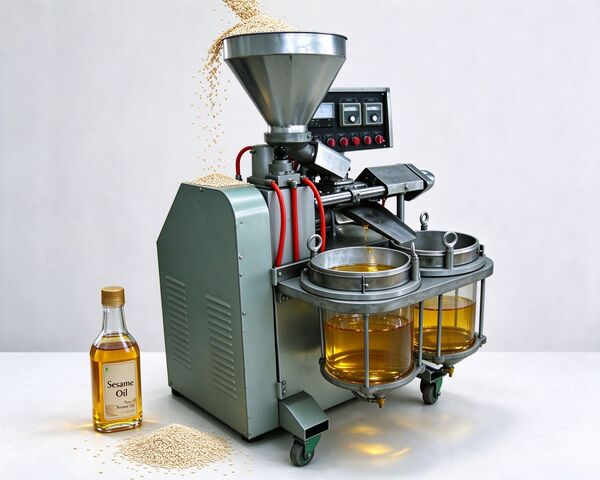
The distinctive flavor of sesame oil comes primarily from the roasting process. Roasting temperature and duration directly affect the color, aroma, and antioxidant properties of the finished oil. For cold pressed sesame oil, roasting can be omitted or replaced with low-temperature conditioning; for traditional fragrant sesame oil, roasting is the core flavor-forming step.
Equipment selection for the pressing stage depends on target product positioning. Demand for cold pressed sesame oil is growing in the Ethiopian market, as cold pressing preserves the natural flavor and active compounds such as sesamin.
The screw speed of a screw press is the most important parameter affecting oil yield. Lower screw speeds combined with appropriate preheating achieve higher oil yield and better oil quality. For Ethiopia’s high-oil-content sesame varieties, a twin-screw low-temperature pressing system can maintain pressing temperature below 60°C while achieving low residual oil content.
Test data from Ethiopian white sesame (52%–54% oil content) shows that through two-stage cleaning and precise moisture control, residual oil content can be reduced to below 5.8%, with oil yield reaching 46.5% — 6–8 percentage points above industry average. This means approximately 30–40 kg of additional sesame oil per tonne of raw material. For a 10 TPD plant, the annual additional revenue is significant.
Refining and Filtration
For export-grade sesame oil, refining is necessary. Crude sesame oil may have acid values exceeding standard limits. Locally produced sesame oil in Ethiopia has shown acid values as high as 1.78 mg KOH/g, far exceeding the national standard upper limit of 0.6 mg KOH/g.
A complete refining line should include four processes: degumming, deacidification, bleaching, and deodorization. During refining, deodorization temperature and vacuum control are critical — excessive temperature destroys sesamin and tocopherols, while insufficient temperature fails to remove off-flavor compounds.
For cold pressed sesame oil, filtration is a more appropriate choice than refining. Plate-and-frame filtration or vacuum filtration removes suspended impurities while preserving the natural active compounds in sesame oil.
3. Export-Grade Quality: What Standards Ethiopian Sesame Oil Must Meet
Acid Value and Free Fatty Acids
Acid value is a core indicator of sesame oil quality. The Ethiopian national standard sets the upper limit for edible oil acid value at 0.6 mg KOH/g. Crude sesame oil typically cannot meet this standard and must undergo refining or caustic refining treatment.
A study on sesame oil from the Tigray region of western Ethiopia showed that cold pressed crude sesame oil had an acid value of 1.59 mg KOH/g, making it unsuitable for direct consumption and requiring further refining to reach consumption standards.
Color and Sensory Quality
The Ethiopian market has clear grading requirements for sesame oil color. Light yellow typically corresponds to refined or cold pressed oil, while dark yellow or brownish-yellow corresponds to unrefined traditional pressed oil. Sesame oil exported to European and North American markets generally requires light yellow to golden yellow, with the refining process status clearly labeled.
Oxidative Stability and Shelf Life
Unrefined cold pressed sesame oil has a relatively short shelf life. Research shows that crude sesame oil lacking refining processes has a shelf life not exceeding two months based on available data. For export products requiring long-distance transport and extended storage, refining or natural antioxidant addition is necessary.
4. Equipment Selection Framework: Matching Processing Solutions to Business Models
Two Distinct Equipment Configuration Routes
Ethiopia’s sesame processing equipment procurement splits into two very different routes.
Route 1: Export-Grade Cleaning and Grading Line. For exporters and cooperatives, equipment includes pre-cleaners, destoners, magnetic separators, grading screens, color sorters, and packaging equipment. Color sorting is the highest-value step in this line, directly determining whether export batches meet buyer specifications for color and purity.
Route 2: Oil Extraction and Refining Line. For domestic processing enterprises, equipment includes roasters, oil presses (or solvent extraction lines), refining equipment, and filling lines. This route directly serves the market need to fill the 300,000-tonne edible oil gap.
The two routes share almost no equipment beyond feed conveying. Before procurement, clarify your business positioning.
Phased Investment Framework
For investors with limited capital or unproven markets, phased investment is an effective risk-reduction strategy.
Stage 1: Pressing and Filtration (1–5 TPD). Configure cleaning, roasting, screw press, and filtration equipment. Products are supplied to local markets as crude or filtered sesame oil. Equipment investment threshold is low; the core goal is validating the raw material supply chain and sales channels.
Stage 2: Refining Capacity Addition (5–20 TPD). Add a refining module on top of the pressing line. Products upgrade to refined sesame oil, entering retail channels and export markets. At this stage, acid value and color control become the core of quality management.
Stage 3: Scale Expansion and Solvent Extraction (20+ TPD). For large-scale processors, solvent extraction lines significantly improve oil recovery rates. Ethiopia has a reference case: SAMANU’s 200 TPD solvent extraction line in Dukem processes locally sourced sesame, sunflower, and soybean to produce Tena brand refined edible oil. The project received $21 million in growth capital investment from Norfund and a 54 Capital consortium.
Equipment Procurement Checklist
- Confirm the screw press’s adjustable screw speed range to accommodate different sesame varieties
- For cold pressing, confirm temperature control precision can consistently stay below 60°C
- Confirm destoning capability in the cleaning line — Ethiopian sesame has high sand content
- Confirm the refining line’s deodorization step has precise temperature and vacuum control
- Verify all oil-contact components meet food-grade material standards
- Evaluate equipment protection against voltage fluctuations — Ethiopia’s power supply can be unstable
- Confirm supplier can provide remote diagnostic interfaces to reduce downtime risk
5. FAQ
Q1: What is the oil content of Ethiopian sesame?
Ethiopian sesame typically has an oil content of 52%–54%. Main varieties include Humera, Gondar, Metema, and Wollega. The Humera variety is known for high oil content and superior color.
Q2: How large is Ethiopia’s edible oil supply gap?
Ethiopia’s domestic edible oil demand exceeds 850,000 tonnes, with a supply gap exceeding 300,000 tonnes. The country spends approximately $650 million annually on imported edible oil.
Q3: What quality standards must Ethiopian sesame oil meet?
The national standard sets the upper limit for edible oil acid value at 0.6 mg KOH/g. Crude sesame oil typically has an acid value of 1.5–1.8 mg KOH/g and must be refined to meet standards.
Q4: What is the market outlook for cold pressed vs hot pressed sesame oil in Ethiopia?
Cold pressed sesame oil is growing in demand internationally due to its retention of natural flavor and active compounds such as sesamin. Ethiopian investors are increasingly looking toward deeper processing of sesame oil to enhance the value chain of local agriculture.
Q5: What is the equipment investment threshold for building a sesame oil plant in Ethiopia?
For a 1–5 TPD small pressing line, equipment investment is approximately $7,000–$25,000. For a 5–20 TPD refining line, equipment investment ranges from $50,000 to $150,000. Solvent extraction lines require higher investment. Phased investment is an effective strategy to reduce initial capital pressure.
Q6: What are the two equipment procurement routes for sesame processing in Ethiopia?
Route 1: Export-grade cleaning and grading line, for exporters and cooperatives, with core equipment including color sorters and grading screens. Route 2: Oil extraction and refining line, for domestic processors, with core equipment including oil presses and refining equipment. The two routes share almost no equipment.
References
- World Sesame & Peanut Conference. Sesame Trade & Market Outlook: Tanzania & Ethiopia. August 2026.
- China Research and Intelligence. Ethiopia Sesame Export Research Report 2025-2034. Market Publishers, May 2025.
- PapaverAI. Sesame Seed Processing Equipment in Ethiopia (2026). 2026.
- PapaverAI. Ethiopia Agro-Processing: Procurement Guide (2026). 2026.
- QIE Group. Ethiopia Sesame Oil Cold Press Machine. 2025.
- Addis Fortune. Ethiopia’s Oilseed Exporters Face Off with State Over Hoarding Clampdown. 2026.
- Ethiopian Public Health Institute. Ethiopian Journal of Public Health and Nutrition. 2021.
- Wallaga University. Extraction, Optimization and Characterization of Oil from Improved Sesame Varieties. 2023.
- Tridge. Sesame Oil Ethiopia Prices & Trade Data — Market Overview 2026. 2026.
- Wageningen University. Post-harvest Value Creation: A Fundamental Challenge for the Ethiopian Sesame Sector.
- Norfund. Norfund Invests in SAMANU to Increase Production of Edible Oils in Ethiopia. 2024.
For sesame oil production line equipment selection, capacity configuration planning, or project feasibility assessment in Ethiopia, contact the KMEC engineering team.