
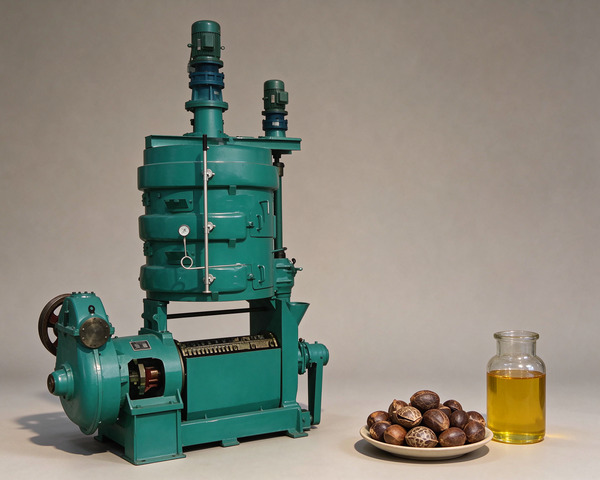
Rubber plantations have historically been valued for one product: latex. The seed fraction — roughly 136 to 2,000 kg per hectare per year, depending on clone and tree age — is mostly discarded, with only about a quarter retained for nursery replanting. Yet the kernel’s dry matter carries 40–50% oil, and the cake left after oil removal contains 20–28% protein. That composition makes rubber seed a dense but structurally awkward feedstock.
The instinctive first question for a processor is: how much oil can I recover? It sounds logical. It usually leads to the wrong plant design. In rubber seed oil extraction, the more consequential decision is how the oil separation step affects the value of everything left behind. Get that sequence wrong, and a 95% recovery figure can coexist with a project that never services its capital cost. The biorefinery literature on rubber seed is explicit on this point: valorising oil alone may not be economically feasible, and separating the oil while preserving the cake for protein recovery is the structure that captures both fractions.
The chemistry that opens outlets beyond biodiesel
Rubber seed oil is not a generic non-edible oil. In a characterisation study of RSO as a drying oil, the oil was 89.92% unsaturated fatty acids, with linoleic acid at 40.24%, oleic acid at 32.16% and linolenic acid at 17.52%. Iodine values reported across the physicochemical literature typically fall in the 113–146 g I2/100 g band, placing RSO firmly in drying-to-semi-drying territory.
That drying behaviour has been tested at the formulation level, not just inferred from fatty acid tables. When RSO was used in varnish formulations, the RSO-containing systems dried faster than a commercial lacquer and showed higher gloss values. As a finishing oil, RSO formulations dried faster than a commercial finishing oil reference. This is the chemical basis for RSO’s relevance in alkyd resins, protective coatings and bio-based lubricant precursors — outlets where unsaturation is an asset rather than a defect to be managed around.
The same unsaturation creates a constraint. RSO has lower oxidative stability than commodity edible oils, and market assessments consistently flag this as a handling and formulation issue rather than a disqualifier. Biodiesel remains a large-volume outlet, but treating it as the only outlet unnecessarily narrows the revenue base — especially because the cake, not the oil, is where the second revenue line sits.
The cyanide gate that decides whether the plant has one product or two
Any serious rubber seed oil extraction project has to confront what equipment brochures rarely mention: rubber seed carries cyanogenic glycosides, and the cake after oil removal is not automatically feed-safe. The meal is a rich protein source, but its hydrogen cyanide content is the primary barrier to using it as an animal feed ingredient.
That single constraint reframes the extraction decision. If the cake cannot be detoxified economically, the protein co-product line disappears, and the project is left selling oil alone — the exact configuration the biorefinery research describes as potentially uneconomical. Detoxification is not an afterthought. It is the gate that determines the plant’s product slate.
The gate is passable, and the methods have been compared side by side. In a broiler study testing soaked, boiled, toasted and fermented rubber seed meal, boiling and fermentation were the most efficient at lowering cyanide levels, followed by toasting, with soaking the least effective. Blood parameters in birds fed boiled and fermented meal were also closer to the control group than those fed soaked or toasted meal. A goat feeding trial using processed rubber seed meal found residual hydrogen cyanide below detectable limits across all processing methods tested, including boiling with and without decanting, soaking, and fermentation. Fermentation adds a protein benefit on top of detoxification: treatment of rubber cake with Pleurotus tuberregium mycelium has been shown to reduce cyanogens sharply while raising crude protein content.
The engineering implication is direct: the extraction line and the detoxification line are not independent modules. The physical form in which cake leaves oil separation — flaky versus powdery, low-temperature versus high-temperature — determines how easily and economically it can be pushed through a boiling, toasting or fermentation step. That is a plant-design question, not a machine-specification question.
Why the expeller is not simply a “lower-recovery” solvent alternative
In controlled screw-press trials on rubber seed kernels, the highest mechanical pressing recovery was 69.01%, achieved after pre-drying kernels at 105°C and pressing at 100°C. Solvent extraction with n-hexane on similarly pre-dried material reached 95.12%, a gap of more than 26 percentage points.
Read in isolation, that gap looks like a straightforward case for solvent extraction. Read alongside protein recovery data, the picture changes. In the same experimental series, protein recovery from press cakes was consistently more efficient than from solvent-extracted meals. The reason is physical: during solvent extraction, meal particles become drier and more compact, which lowers protein recovery, and the resulting powdery residue is harder to separate than the flaky cakes pressing produces. Pressing at 60°C yielded protein recovery 9.12–11.53% higher than pressing at 100°C, an effect attributed to reduced protein denaturation at the lower temperature.
This is the professional insight a recovery-rate-first framework obscures: mechanical pressing’s competitive advantage is not oil recovery — it is the condition of the cake it leaves behind. If the business model includes a protein co-product, the expeller is not a compromise. It is the front-end that preserves the cake’s option value. The correct comparison is not “69% versus 95%” in isolation, but “69% oil recovery plus a flaky, low-denaturation cake” versus “95% oil recovery plus a compact, powdery meal with lower protein recovery.”
The pre-drying variable that sits above both routes
Fresh rubber seed kernels carry enough moisture that pre-drying is not optional for either route. What matters for plant design is that pre-drying temperature changes the physical availability of the oil, not merely its water content.
When pre-drying temperature rose from 60°C to 105°C, screw-press oil recovery improved by 1.54–7.79%, while solvent extraction recovery improved by 2.66%. The mechanism proposed by the researchers is structural: high-temperature pre-drying disrupts the cells and the protein associated with the oil, allowing more oil to be expelled from the kernel matrix. The pre-drier is doing something more consequential than removing water — it is altering the seed’s resistance to oil release.
For a rubber seed plant, this is a design warning. Plantation-collected seed arrives with variable moisture, variable shell content and variable storage history. A oilseed pre-treatment equipment section sized and controlled only for “drying” — without the ability to hold a consistent thermal history — will transmit that variability directly into the recovery performance of whichever extraction route follows. The front end is not auxiliary. It is where the recovery rate is actually made.
The sequence that reconciles both routes
The practical resolution is not to choose one route and defend it, but to use them in a deliberate order. The biorefinery literature on rubber seed points toward oil separation followed by protein extraction from the cakes as the optimal structure for capturing both fractions. In industrial oilseed processing more broadly, pre-pressing ahead of solvent extraction is a standard configuration for high-oil seeds, with the solvent stage recovering residual oil from the press cake. Press cake from a pre-press typically carries less than 0.5% residual oil after solvent extraction, which is the benchmark a well-configured two-stage line is designed to hit.
Applied to rubber seed, this translates into a press-first, solvent-second architecture: the rubber seed oil expeller removes the bulk of the oil under conditions that keep the cake flaky and the protein relatively low-denatured; the solvent plant then processes the press cake to recover residual oil, accepting that the final meal will be more compact and that protein recovery from that meal will be lower than from press cake alone. The net effect is higher overall oil yield than pressing alone, a more valuable cake fraction than solvent extraction alone, and a detoxification step positioned where the cake’s physical form is still workable.
KMEC’s role in this configuration is at the whole-plant level rather than the single-machine level. The company’s scope covers solvent extraction plants and turnkey complete oil mill plant configurations, including pre-treatment, pressing, extraction and refining stages, with project delivery across multiple oilseed types and export markets. For rubber seed specifically, the value of that scope is the ability to align pre-drying and pressing with the downstream solvent and detoxification stages, rather than selling an expeller and a solvent plant as two unconnected capital items.
What the market data does and does not tell you
The global rubber seed oil market was estimated at USD 1,313.35 million in 2025, with projections near USD 2,020.04 million by 2034 and a CAGR of 4.9% over 2026–2034. Demand drivers cited in the market assessment include biodiesel as a non-food feedstock, drying-oil applications in alkyd resins and coatings, and biolubricants and bio-based surfactants.
Those figures establish that rubber seed oil is not a speculative niche. They do not tell a project developer whether a given plant will be profitable. The same assessment identifies the operational risks clearly: uneven seed gathering, seasonal availability, and oxidative stability below that of edible oils. A 4.9% market growth rate does not compensate for a rubber seed oil processing plant that cannot handle variable feedstock, cannot stabilise its pre-treatment, or cannot move its cake into a detoxification pathway. The market sets the ceiling. The plant configuration determines whether a given operation gets anywhere near it.
The judgment that should precede equipment selection
Rubber seed oil extraction rewards a systems-first logic. The oil’s drying chemistry opens coating and oleochemical outlets beyond biodiesel, but only if the oil is separated without unnecessarily degrading the co-product stream. The cake’s protein content is meaningful, but only if cyanide reduction is engineered into the process rather than bolted on afterward. The expeller and the solvent plant are not competing answers to the same question — they are sequential tools for extracting different kinds of value from the same seed.
For a processor evaluating this feedstock, the first question is not “what recovery rate can I achieve?” It is: what do I intend to sell, in what form, and does my process sequence preserve the quality of every stream I am selling? Answer that first. The equipment specification — expeller capacity, pre-drier control, solvent plant configuration, detoxification interface — follows from the revenue model rather than preceding it.
References
Composition and drying-oil performance
[1] Bato, R.C. (2002). Characterization and evaluation of rubber (Hevea brasiliensis) seed oil as drying oil in varnish and finishing oil. University of the Philippines Los Baños. FAO AGRIS record.
Supports: the 89.92% unsaturated fatty acid figure and the linoleic (40.24%), oleic (32.16%) and linolenic (17.52%) shares; the formulation-level finding that RSO varnish systems dried faster than a commercial lacquer and showed higher gloss; the finding that RSO finishing-oil formulations dried faster than a commercial finishing oil reference; the iodine value range of 113–146 g I2/100 g oil as reported across independent physicochemical characterisations.
Extraction process, recovery and protein data
[2] Yang, M., Zhu, W., & Cao, H. (2021). Biorefinery methods for extraction of oil and protein from rubber seed. Bioresources and Bioprocessing, 8(1), 45.
Supports: the 69.01% screw-press recovery at 105°C pre-drying and 100°C pressing; the 95.12% n-hexane recovery; the 1.54–7.79% and 2.66% recovery improvements when pre-drying moved from 60°C to 105°C; the structural mechanism of cell and protein disruption at higher pre-drying temperature; the finding that protein recovery from press cakes exceeded that from solvent-extracted meals; the 9.12–11.53% protein recovery advantage of 60°C pressing over 100°C; the proposition that oil-alone valorisation may not be economically feasible and that oil separation followed by protein extraction from cakes is the optimal structure; the 136–2,000 kg/hectare seed yield and the 25% nursery / 75% waste split; the 40–50% kernel oil content and 20–28% cake protein content.
Cyanide detoxification
[3] Aguihe, P.C., Kehinde, A.S., Ospina-Rojas, I.C., & Murakami, A.E. (2017). Comparative effect of different detoxified rubber seed meal on haematological and serum biochemical indices of broilers. Journal of Animal Health and Production, 5(2), 50–57.
Supports: the ranking of detoxification methods (boiling and fermentation most effective, followed by toasting, with soaking least effective); the finding that blood parameters in birds fed boiled and fermented meal were closer to the control group than those fed soaked or toasted meal.
[4] Balaji, J., Prabhu, T.M., Madhusudhan, H.S., Suresh, B.N., Patil, V.M., Siddalingamurthy, H.K., & Deepak, B.S. (2025). Effect of feeding rubber (Hevea brasiliensis) seed meal based diets on intake, nutrient digestibility and growth performance in goats. Indian Journal of Animal Nutrition.
Supports: the finding that residual hydrogen cyanide fell below detectable levels across all processing methods tested, including boiling with and without decanting, soaking, and fermentation.
[5] Ukpebor, J.E., Akpaja, E.O., Ukpebor, E.E., Egharevba, O., & Efedue, E. (2007). Effect of the edible mushroom, Pleurotus tuberregium on the cyanide level and nutritional contents of rubber seed cake. Pakistan Journal of Nutrition, 6(6), 534–537.
Supports: the finding that fermentation with P. tuberregium mycelium reduces cyanogens sharply while raising crude protein content in rubber cake.
Market size and demand drivers
[6] IMARC Group. (2025). Rubber Seed Oil Cost Model: From Agro-Waste to Industrial Value.
Supports: the USD 1,313.35 million 2025 market size; the USD 2,020.04 million 2034 projection; the 4.9% CAGR for 2026–2034; the demand drivers including biodiesel as a non-food feedstock, alkyd resins and coatings, and biolubricants; the operational challenges of uneven seed gathering, seasonal availability, and lower oxidative stability than edible oils.
Pre-press / solvent extraction configuration
[7] UNIDO technical documentation on prepress-solvent and direct-solvent extraction plant configurations.
Supports: the characterisation of pre-pressing followed by solvent extraction as a standard industrial configuration for high-oil seeds; the benchmark of less than 0.5% residual oil in press cake after solvent extraction in a properly configured prepress-solvent line.