
Introduction to Flaxseed Oil Processing Line
Flaxseed oil is rich in alpha-linolenic acid (ALA), with a linoleic acid to linolenic acid ratio of approximately 1:4 – a proportion highly beneficial to human health. With the global flaxseed oil market growing from$5.54 billion in 2024 to a projected $7.3 billion by 2032, more and more investors are turning their attention to flaxseed oil processing.
However, linolenic acid is highly sensitive to heat and prone to oxidation – once the temperature exceeds a critical threshold, its activity begins to degrade. Therefore, choosing the right flaxseed oil processing equipment and process route directly determines your product quality and market positioning.
This article introduces three flaxseed oil production process routes – cold press, hot press, and solvent extraction – along with the corresponding flaxseed oil processing equipment configurations for each route.
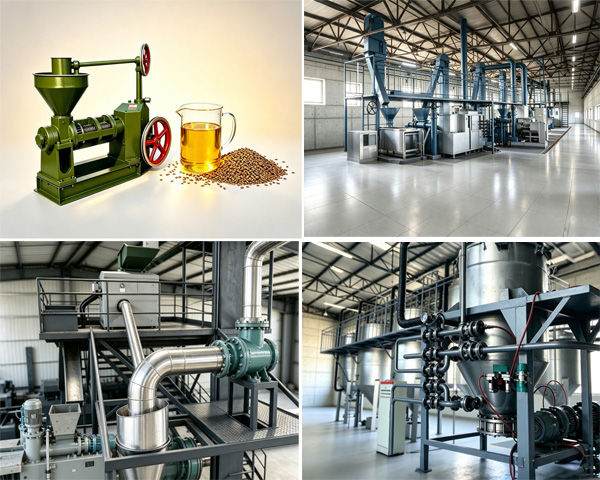
I. Core Equipment Configuration by Process Route
| Process Type | Core Equipment | Key Parameters / Features | Oil Yield | Refining Requirement | Suitable Scale |
|---|---|---|---|---|---|
| Cold Press | Cleaning equipment, crusher, soaking tank, hydraulic oil press, plate and frame filter press / vacuum oil filter | Temperature below 60°C; slow low-temperature pressing; preserves all nutrients | 22%–28% | No chemical refining required | Small to medium |
| Hot Press | Cleaning equipment, drum seed roaster, flaking mill, screw oil press, centrifugal oil filter, stainless steel storage tank | Temperature 65–100°C; continuous high-volume production; imparts nutty roasted aroma | 35%–40% | Optional | Medium to large |
| Solvent Extraction | Pre-treatment equipment, extractor, evaporator, stripping column, solvent recovery system, complete refining equipment | No.6 solvent (hexane) soaking; high-temperature extraction; recovers nearly all oil | Highest | Full refining required | Large industrial |
II. Cold Press – The “Quality Choice” for Preserving Nutrition
Cold pressing refers to extracting oil from flaxseed under low-temperature conditions (typically below 60°C) using high mechanical pressure. In this process, the flaxseed is not subjected to traditional high-temperature roasting or cooking, so the oil remains within unaltered protein cells, preserving the natural nutritional components of the seed.
Core equipment configuration:
- Cleaning equipment: Multi-stage vibrating screen, gravity destoner, powerful magnetic separator – removes impurities
- Crushing equipment: Crusher – breaks flaxseed for easier pressing
- Soaking equipment: Soaking tank – temperature controlled at approximately 40°C for 20–30 minutes to improve oil yield
- Core pressing equipment: Hydraulic oil press – slow low-temperature pressing with precise temperature control for maximum Omega-3 retention
- Filtration equipment: Plate and frame filter press or vacuum oil filter – removes impurities while preserving natural flavour
Cold press process features:
- ✅ Avoids harmful substances generated by high-temperature pressing
- ✅ Prevents darkening of oil colour and burnt flavour
- ✅ Retains nearly all nutrients with a refreshing, clean taste
- ✅ No chemical refining required – only physical processes such as hydration degumming, activated carbon deodorisation, cooling, filtration, and dewaxing
- ❌ Lower oil yield (approximately 22%–28%), relatively higher cost
Best for: Premium health food market, boutique oil mills, farmers’ markets, export markets
III. Hot Press – The “Balanced Choice” for Yield and Flavour
The hot press process builds on traditional flaxseed roasting methods, combining advanced production technology with the accumulated experience of producing high-flavoured oils such as peanut and sesame oils. After high-temperature roasting, the oil flows more freely, achieving higher yields while imparting a distinctive nutty roasted flavour to the final product.
Core equipment configuration:
- Cleaning equipment: Multi-stage vibrating screen, gravity destoner, magnetic separator – removes impurities
- Roasting equipment: Drum seed roaster – temperature controlled at 65–100°C, imparts unique aroma to seeds
- Flaking equipment: Flaking mill – flattens roasted seeds into flakes for improved oil extraction efficiency
- Core pressing equipment: Screw oil press – continuous high-volume pressing, highly automated
- Filtration equipment: Centrifugal oil filter or plate and frame filter press
- Oil storage equipment: Volumetric food-grade stainless steel oil storage tank
Hot press process features:
- ✅ Higher oil yield (approximately 35%–40%), improved economic returns
- ✅ Enhanced flavour and rich nutty roasted aroma
- ✅ Simple, mature process with relatively low investment
- ✅ Continuous high-volume production capability
- ❌ Some heat-sensitive nutrients are lost
Best for: Mainstream edible oil market, supermarket channels, wholesale distribution
IV. Solvent Extraction – The “Industrial Choice” for Maximum Yield
The solvent extraction method uses No.6 solvent (hexane) to soak flaxseed raw material, extracting oil at high temperature. The initially extracted oil is a mixture of solvent and oil, which cannot be consumed directly and must undergo a series of refining processes before it is edible.
Core equipment configuration:
- Pre-treatment equipment: Complete cleaning, crushing, and flaking systems
- Extraction equipment: Extractor – solvent soaking to extract oil
- Evaporation equipment: Evaporator, stripping column – separates solvent from oil
- Solvent recovery system: Condenser, solvent-water separator
- Refining equipment: Complete refining equipment for dewaxing, degumming, deodorising, deacidifying, bleaching, and more
Extraction process features:
- ✅ Recovers nearly all oil from flaxseed – high economic returns
- ✅ Highest oil yield, suitable for large-scale industrial production
- ✅ Lowest cost – the most widely used method in the modern oil industry
- ❌ Almost all nutrients are destroyed
- ❌ Traces of organic solvent residue remain
- ❌ Requires complex chemical refining processes
Best for: Large-scale industrial production, export markets, food ingredient supply
V. Comparison of Three Process Routes
| Comparison Dimension | Cold Press | Hot Press | Solvent Extraction |
|---|---|---|---|
| Oil Yield | 22%–28% | 35%–40% | Highest |
| Nutrient Retention | Nearly all preserved | Partially lost | Almost completely lost |
| Oil Flavour | Natural, fresh | Rich roasted aroma | Neutral or no distinct odour |
| Equipment Investment | Medium | Lower | Highest |
| Refining Requirement | No chemical refining required | Optional | Full refining required |
| Suitable Scale | Small to medium | Medium to large | Large industrial |
| Target Market | Premium health foods | Mainstream edible oil | Food industry ingredients |
Nutritional composition of flaxseed oil:
The fatty acid profile of flaxseed oil:
- Saturated fatty acids: approximately 9%
- Oleic acid: approximately 17%
- Alpha-linolenic acid (Omega-3): approximately 57%
- Linoleic acid (Omega-6): approximately 16%
VI. Flaxseed Oil Processing Equipment Capacity Configuration Reference
| Capacity Level | Daily Processing Capacity | Recommended Process | Key Equipment Configuration | Suitable Customer Type |
|---|---|---|---|---|
| Micro / Artisan Oil Mill | 50–200 kg | Cold press | Hydraulic oil press + plate and frame filter press + manual filling | Farmers’ markets, high-end restaurants, boutique retail |
| Small Oil Mill | 200kg – 1 ton | Cold press / Hot press | Hydraulic or screw oil press + roaster + filtration equipment + oil storage tank | Regional brands, wholesale distribution |
| Medium Oil Mill | 1–5 tons | Hot press / Cold press | Screw oil press + drum seed roaster + centrifugal filter + stainless steel oil storage tank | Supermarket channels, regional chains |
| Large Industrial | 5+ tons | Hot press / Solvent extraction | Complete pre-treatment + screw oil press or extractor + refining equipment + automatic filling line | Export markets, large food companies |
VII. Why Choose Our Flaxseed Oil Processing Equipment?
1. Complete Processes, Flexible Configuration
From raw material cleaning, roasting, and pressing to filtration, refining, and packaging – we provide complete flaxseed oil processing equipment solutions. Whether it’s a small hydraulic oil press or a large extractor, we can customise based on your capacity needs and oil quality requirements.
2. Three Processes, One-Stop Solution
Whether you choose cold press, hot press, or solvent extraction, we have mature equipment configurations. We can recommend the most suitable process route based on your raw material characteristics and target market.
3. High-Quality Core Equipment
- Hydraulic oil press: Precise temperature control – ideal for high-value cold-pressed oil production
- Screw oil press: Continuous high-volume pressing, highly automated – ideal for large-scale production
- Drum seed roaster: Precise temperature control – imparts unique aroma to seeds
- Plate and frame filter press: High-precision filtration – ideal for premium cold-pressed oils
- Extractor, evaporator, solvent recovery system: High-efficiency extraction with low solvent loss
- Refining equipment: Complete systems for dewaxing, degumming, deodorising, deacidifying, bleaching, and more
4. Turnkey Solutions
We provide full-service support from equipment selection, plant layout, installation and commissioning to operator training – ensuring a smooth start to production. With decades of industry experience, our equipment has been exported to numerous countries and regions worldwide.
VIII. Your Next Step
In flaxseed oil processing, choosing the right process and oil processing equipment is key. Whether you want to produce cold-pressed premium health oils, hot-pressed mainstream edible oils, or solvent-extracted industrial oils, we can provide complete flaxseed oil processing equipment solutions.
Contact us today for a customised flaxseed oil processing equipment solution and quotation!