
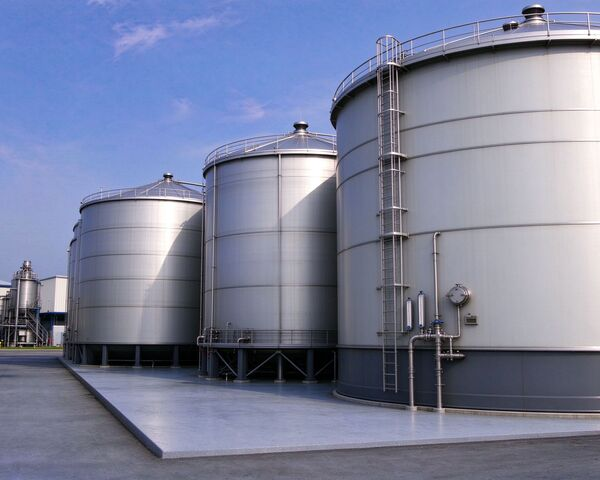
Here’s a fact that surprises a lot of processors: oil doesn’t degrade only because of what happens during pressing or refining. It degrades sitting in the tank.
Every hour oil spends in storage, it’s either being protected or quietly oxidizing. The gap between a tank that holds quality for 12 months and one that cuts shelf life to 3 months comes down to three things — the right steel, the right atmosphere, and the right surface finish.
Industry audits consistently show that a meaningful share of rejected edible oil shipments trace back to storage infrastructure: material leaching, biofilm growth, oxidative degradation. If you’re running oil press machines and refining equipment upstream, a tank failure wipes out every quality control decision you made before that oil ever left the press.
KMEC builds stainless steel edible oil storage tanks as part of complete processing lines — from 1-ton (1,000 L) units to 200-ton (200,000 L) terminals.
304 or 316L? The Answer Comes Down to Two Numbers
Why Carbon Steel Is Off the Table
Plant oils contain free fatty acids and unsaturated fats. These react with metal ions. Iron ions — even at trace levels — act as pro-oxidants that accelerate rancidity. Bare carbon steel is a non-starter for direct oil contact.
Carbon steel can work with a certified food-contact lining (epoxy phenolic, pure epoxy, or solvent-free polyurethane), but every weld must be continuously lined and verified by holiday spark testing. Miss one pinhole, and you’ve got a corrosion cell.
The Decision Framework
The 304 vs 316L question isn’t about which is “better.” It’s about two thresholds:
- Chloride in cleaning water exceeds 200 ppm
- Operating temperature exceeds 65°C
Cross either one, and 304 carries real pitting and stress corrosion cracking risk. Switch to 316L.
This isn’t theoretical. A 140,000 m³ edible oil reserve tank project applied exactly this rule. Another engineering reference puts the temperature threshold even lower — 60°C with stagnant spots — for 304 in chloride-containing service.
Why 316L wins under these conditions: It contains 2–3% molybdenum, which dramatically improves resistance to chloride pitting. The “L” means low carbon, which prevents chromium carbide precipitation at weld heat-affected zones. That last part matters — without it, the weld itself becomes the weak point.
KMEC rule of thumb: Cleaning water above 200 ppm chloride, or tank temperature above 65°C (routine for palm oil), means 316L. The 25–35% cost premium pays for itself in avoided recalls and longer service life.
| Parameter | SS304/304L | SS316/316L |
|---|---|---|
| Chloride tolerance (ambient) | ~100–200 ppm | ~1,000+ ppm |
| Mo content | None | 2–3% |
| Weld sensitization risk | Moderate | Low (L grade) |
| Best application | Refined oil, indoor, low-FFA | Palm oil, coastal sites, chlorinated CIP water, high-FFA crude |
Nitrogen Blanketing: Why the Old Methods Fall Short
The Oxygen Problem
Dissolved oxygen in edible oil can reach 15–150% of oil volume. Nitrogen blanketing displaces it. The effect is measurable — nitrogen-flushed rapeseed oil showed peroxide values 4× lower than control after 20 days at 63°C, and 2.3–2.8× lower after 6 months at 20°C with light exposure.
Three Conventional Approaches — and Their Limits
- Top-space blanketing: nitrogen escapes through breathing valves during temperature swings
- Bottom injection: large bubbles, poor oil-nitrogen contact, and tank agitation that pulls in new oxygen
- Dissolved-gas pump: fine microbubbles (20–30 μm), but high energy cost and long cycle times on large tanks
None of these protect the oil during filling and discharging. They only treat the headspace.
The Titanium Rod Micropore Solution
A newer system takes a different approach. Instead of blanketing the tank, it treats the oil itself.
The core component is a straight-tube mixing chamber that combines an oil distribution plate with a 1 μm titanium rod microporous filter element. Oil and nitrogen are forced through the titanium rod’s micron-scale pores under pressure, creating intimate gas-liquid contact before the mixture enters the tank.
The result: dynamic nitrogen protection across all operating conditions — filling, storage, and discharge. Not just the headspace.
This technology is documented in a DOAJ-indexed study and associated invention patent (ZL 2022 1 0991258.7). It represents a real shift in how edible oil storage is engineered.
Thermal Management: Keep the Heat In, Keep the Chloride Out
High-melting-point oils need active heating. Palm oil solidifies at room temperature — it has to stay between 35–55°C for pumping and homogeneity.
The standard setup:
- Dimple jackets or internal coils: laser-welded dimple jackets or internal hot water/steam coils hold oil in the right viscosity range
- Insulation: 100 mm polyurethane foam with vapor barrier on walls, 150 mm on roofs
One detail that gets overlooked: chloride-free insulation. Chloride-containing insulation can leach chloride ions under moisture exposure, initiating pitting corrosion on the external stainless surface. It’s a common failure mode in coastal installations — and entirely avoidable.
If you’re running oil filtration equipment downstream, temperature stability directly affects filtration efficiency and final product clarity.
Hygienic Design: Surface Finish, Weld Quality, and Why Water CIP Is Wrong
Surface Roughness
EHEDG recommends stainless steel food-contact surfaces achieve Ra ≤ 0.8 μm. For edible oil tanks, industry practice goes further: internal welds are ground flush and polished to Ra < 0.4 μm.
Why? Biofilm prevention. Surface defects — pores, crevices, weld discontinuities — create niches where oil residue oxidizes and microorganisms grow. A 0.4 μm finish eliminates those micro-traps.
Weld Quality and Passivation
All stainless welds should use argon backing on the first pass, followed by pulsed TIG fill and cap. After welding, surfaces get pickled and passivated to restore the chromium oxide layer.
API 650 Appendix S sets rinse water limits for stainless tank cleaning:
- Below 40°C: chloride ≤ 200 ppm
- 40–65°C: chloride ≤ 100 ppm
Exceed these, and the cleaning process itself causes chloride pitting.
The Water CIP Mistake
Here’s where edible oil tanks diverge sharply from dairy or beverage tanks: water-based CIP is not recommended.
Water trapped in pipe dead legs and tank crevices becomes a growth medium for bacteria. Industry practice — reinforced by NSF/ANSI 18 — specifies that oil distribution systems circulating only fresh edible oil do not require conventional in-place cleaning. The documented food-safe method is to purge oil-only systems with oil only.
A 2024 Food Control study validated this: flushing contaminated tubing with fresh canola oil at 60°C for >5.4 minutes reduced surface contamination to <1.3 log CFU/cm². A two-step oil flush and acidified water-in-oil emulsion treatment achieved undetectable levels of Salmonella surrogates.
Design implication: CIP circuits must be planned at the design stage — spray coverage of all product-contact surfaces, no dead legs, fully drainable bottoms. The cleaning medium is oil, not water.
Capacity and Structure: Matching Tank to Operation
| Capacity Range | Recommended Structure | Fabrication | Typical Application |
|---|---|---|---|
| <3,000 L | Cubical tank | Factory pre-fabricated | Lab, small oil mill |
| 3,000–25,000 L | Horizontal cylindrical | Factory pre-fabricated | Small-medium processor |
| 25,000–200,000 L | Vertical cylindrical | Site-fabricated and installed | Large refinery, port terminal |
Vertical tanks dominate large-capacity installations because site fabrication avoids transport size constraints. If you’re running oilseed pretreatment equipment and storage in the same facility, KMEC recommends total storage capacity of at least 3× daily throughput — that buffers production fluctuations and holiday shutdowns.
One more thing on vertical tanks: diameter-to-height ratio matters. Taller tanks are more material-efficient for a given volume, but high-viscosity oils (palm, coconut) need careful heating design to avoid temperature stratification in tall columns.
FAQ
Q1: Can edible oil storage tanks store crude oil?
Yes. Stainless steel handles both crude and refined oils. Crude oil with high FFA content benefits from SS316L and more frequent cleaning cycles.
Q2: How much more does SS316L cost compared to SS304?
Material cost premium is typically 25–35%. For high-FFA oils or coastal environments, that premium is recovered through longer service life and reduced maintenance.
Q3: How often should an edible oil storage tank be cleaned?
For continuous same-product storage, a full cleaning every 3–6 months is typical. Product changeover requires complete cleaning. The cleaning method should be oil flush, not water CIP.
Q4: What chloride level in rinse water is acceptable for stainless tank passivation?
API 650 Appendix S specifies ≤200 ppm chloride below 40°C and ≤100 ppm between 40–65°C.
Q5: What size storage tank does a small oil mill need?
For 1 ton/day seed processing at 33% oil yield, daily crude oil output is approximately 330 L. A minimum configuration would be 1,000 L crude oil tank and 500 L finished oil tank, sized for 3 days of production.
Q6: Is nitrogen blanketing cost-effective for small tanks?
For tanks under 5,000 L, simple top-space nitrogen purging may suffice. Titanium rod micropore systems are most beneficial for tanks above 20,000 L, where nitrogen utilization efficiency and full-condition protection justify the investment.
References
- Doi, S. et al. “Design on high-efficiency nitrogen-charged storage tank system for edible vegetable oil based on titanium rod micropore distribution technology.” DOAJ-indexed, 2026. Patent ZL 2022 1 0991258.7.
- Zhongneng Huajian. “Inside Zhongneng Huajian’s 140,000 M³ Edible Oil Reserve Tank Project: Food-Grade Welding, 304/316L Selection and Cold-Chain Viscosity Control.” znmetalstructure.com, 2026.
- Zhongneng Huajian. “Storage Tank Material Selection: Carbon Steel, 304, 316L, FRP or Rubber-Lined — Matched to Medium, Temperature and Chloride.” znmetalstructure.com, 2026.
- API Standard 650, Appendix S — Austenitic Stainless Steel Storage Tanks, Section S.4.9 (Rinsing), S.4.10 (Hydrostatic Testing).
- EHEDG Guideline Document No. 8. “Hygienic Design Principles,” Section 6.2 — Surfaces and Geometry.
- Ocieczek, A. et al. “The Dynamic of Oxidative Changes in Rapeseed Oil During Maritime Transport Determined by Storage Conditions.” TransNav, Vol. 14, No. 1, 2020. DOI: 10.12716/1001.14.01.12.
- “Effect of oil flushing with nitrogen on the quality and oxidative stability of cold-pressed rapeseed and sunflower oils.” Acta Alimentaria Polonica, 2016.
- “Clean-in-place (CIP) validation of oil-based cleaning and sanitization for Salmonella-contaminated tubing: Evaluation of Enterococcus faecium as a surrogate.” Food Control, Vol. 161, July 2024, 110392.
- NSF/ANSI 18 — Manual Food and Beverage Dispensing Equipment, Section 5.1.4.
- ManXing Machinery. “Edible Oil Storage Tanks and Silos: Food Safety Compliance.” manxingsilo.com, 2026.
For edible oil storage tank design, capacity calculation, or integration with KMEC oil press and refining lines, contact our engineering team.