
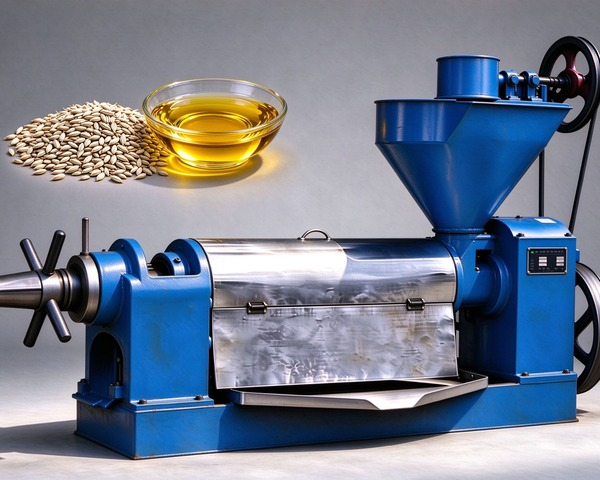
Why a 20% Cold Press Yield Can Cost Less Per Kilogram Than 35% Solvent Extraction
The most frequently misread comparison in safflower oil production is the yield gap between cold pressing and solvent extraction: cold pressing typically lands in the 17–33% range, while n-hexane Soxhlet extraction reaches 35%. On that number alone, cold pressing looks “inefficient.” But a 2026 economic analysis of Egyptian safflower oil extraction, published in Scientific Reports, delivers a counterintuitive result: screw pressing costs 1,218 EGP per kilogram of oil, while n-hexane Soxhlet costs 3,142 EGP — the lower-yield process costs less than 40% as much per kilogram.
The reason is not in the yield figure itself, but in the ledger around it. Solvent extraction’s high yield comes with 720 Wh of energy, a four-hour extraction time and 650 EGP in solvent cost. Screw pressing consumes 2.5–4 Wh, runs in 28–56 seconds, and uses no solvent. The same study states directly that screw pressing proved to be “the most energy-efficient and time-saving method, owing to the elimination of solvent use and its lower operational costs”.
These data expose a premise that safflower oil equipment decisions routinely ignore: the “low yield” of cold pressing is not a defect the equipment needs to “fix,” but a deliberate trade of yield for cost structure, quality positioning and clean-label eligibility. Screw speed, diaphragm gap and feed temperature are not parameters for “approaching solvent-extraction yield.” They are parameters for moving the balance point between yield, quality and operating cost.
KMEC has over two decades of experience configuring cold press equipment and oil extraction processes. The sections below examine the economics of cold-press yield, the empirical effects of equipment parameters, the market pull from high-oleic varieties, and a phased configuration logic.
1. Reframing Cold-Press Yield: Yield Is a Variable in Cost, Not the Other Way Around
1.1 Two Sets of Numbers from the Same Study
The Scientific Reports study measured yield, energy, time and unit cost across four extraction routes. n-Hexane Soxhlet delivered the highest yield (35–31.5%) but the highest cost per kilogram, at 3,142 EGP. Ethanol Soxhlet yielded 28–22.4% at an even higher cost of 3,621 EGP. Screw pressing yielded 9.17–20.85% at 1,218 EGP. Hydraulic pressing yielded 10–11% at 2,272 EGP.
The engineering implication is direct: the “benefit” of each additional percentage point of yield must be netted against the energy, solvent, labour and time required to obtain it. Solvent extraction spends four hours and 720 Wh to recover roughly 14–15 additional percentage points; on a unit-cost basis, that advantage is fully erased. For a safflower oil project positioned on cold pressing, the equipment objective is not to “push yield from 20% to 35%,” but to hold unit cost at a competitive level within an acceptable yield band.
1.2 The Empirical Yield Range and the Variety Effect
Cold-press yield is not a fixed constant. A cold-press optimisation study on safflower varieties recorded yields of 22.07–33.48%. Work on Mexican safflower varieties shows that high-oleic types yield roughly 14% less oil than high-linoleic types, while the cold-press method itself reduces yield by up to 50% compared with Soxhlet extraction.
These two “losses” must be distinguished: 14% is a variety effect (high-oleic vs high-linoleic), while 50% is a method effect (cold press vs solvent). The former is a raw-material choice; the latter is a process-positioning choice. Equipment parameters can optimise yield within the method effect, but cannot eliminate the biological difference between varieties. Recognising this is what prevents “high-oleic varieties naturally yield less” from being misdiagnosed as inadequate equipment performance.
2. Equipment Parameters: How Screw Speed and Diaphragm Gap Shape Yield and Cost
2.1 Screw Speed: A Triple Constraint of Yield, Cake Temperature and the “Cold Press” Label
The UC Davis press study recorded a clear direction: as screw speed increased, safflower oil yield decreased from 27.26 ± 0.33% to 25.34 ± 0.39%. Higher speed shortens residence time in the barrel, so compression is incomplete. The same study found that widening the restriction die from 6 mm to 10 mm reduced yield from 27.26% to 23.57%, because internal pressing pressure fell.
But speed affects more than yield. A separate study recorded cake temperature rising with speed: 93–106°C at 30 rpm, 95–107°C at 120 rpm, and 108°C at 250 rpm. For safflower oil positioned as “cold pressed,” this reveals an easily overlooked fact: even at the low speed of 30 rpm, cake temperature already sits far above the 49–50°C threshold commonly cited for cold-press labelling. In practice, “cold press” depends more on feed temperature control, barrel cooling and process design than on low speed alone. Equipment selection that focuses only on rpm while ignoring barrel heat dissipation and precise feed-temperature control can produce oil that does not qualify as “cold pressed” in a labelling sense.
2.2 Diaphragm Gap: What the Divergent “Optimal Values” Actually Mean
The diaphragm gap is the core geometric parameter controlling back pressure and compression. But the “optimal value” in the literature is not consistent. A 2024 study in Foods (Kakimov et al.) optimised pressure distribution within the screw and found the best combination at diaphragm gap δ = 5 mm and screw angular velocity ω = 6.2 rad/s. A 2023 mathematical modelling study (Mursalykova et al.) pointed to δ = 0.1 mm and ω = 6.2 rad/s.
These differences are not a matter of “who is right.” They reflect differences in press geometry, feedstock variety and the definition of “optimal.” A 5 mm gap may correspond to a configuration balancing throughput and energy; a 0.1 mm gap may correspond to a laboratory condition pursuing maximum compression. For equipment buyers, the real implication is that no universal optimal gap exists across machines. The equipment must offer precisely adjustable gap control, and the supplier should provide a validated adjustment range for the target feedstock’s oil content, hull content and product positioning — not a fixed “best gap” claim.
2.3 Hull Content: The Underestimated Yield Lever
The role of safflower hull in pressing is more complex than for most oilseeds. Hull has higher mechanical strength than the kernel, so direct pressing accelerates wear. Yet a certain proportion of hull in the kernel reduces material plasticity, improves structure and acts as a drainage aid in oil separation, helping lower residual oil in the cake. When hull content is excessive, however, the hull’s high porosity absorbs and strongly retains oil, increasing losses.
This means hull content is itself a yield lever, and its effect is non-linear: too low and the material becomes too plastic for efficient drainage; too high and the hull absorbs oil and raises residual content. Equipment configuration must be linked to the hull-content control capability of the cleaning/dehulling section, rather than treating the press as an isolated “oil output unit.”
3. Market Pull from High-Oleic Varieties: Why a Lower-Yielding Variety Still Justifies Equipment Investment
3.1 Oxidative Stability and Clean-Label Positioning
High-oleic safflower oil contains approximately 79% oleic acid and 338 mg/kg of tocopherols, delivering oxidative stability comparable to olive oil at lower cost. The global high-oleic oils market was valued at USD 9.9 billion in 2025 and is projected to reach USD 15.3 billion by 2032, a CAGR of 6.3%. The core driver is clean-label and clean-health positioning: high-oleic oils support “non-GMO,” “heart-healthy” and “naturally stable” claims, while their resistance to oxidation and heat degradation allows them to replace hydrogenated oils in frying, baking and snack production — avoiding trans fats.
The safflower oil market itself is also growing, at a CAGR of 4.61% (2026–2032). Within it, expeller-pressed and organic grades support premium and clean-label positioning, while agricultural yield variability and limited cultivation scale constrain availability.
3.2 The Reverse Requirement for Equipment Selection
The market signal for equipment configuration is specific: if the target market for high-oleic safflower oil is foodservice, clean-label retail or organic channels, then the priority for a safflower oil press machine is temperature-control precision (can it hold feed temperature and barrel heat dissipation to protect tocopherols and oxidative stability?) and compression ratio / diaphragm gap adjustability (can it adapt to the physical characteristics of high-oleic varieties?) — not “maximum throughput” or “maximum yield.” High-oleic varieties already yield roughly 14% less than high-linoleic types. If that gap is “compensated” by raising speed or tightening the gap, cake temperature rises and tocopherols degrade, and the product loses the stability basis that justifies its premium. A few percentage points recovered in yield can cost more in quality than they return.
4. Phased Configuration Logic: From Economic Validation to Quality Closure
4.1 Phase One: Use Unit Cost, Not Yield, as the Equipment Baseline
Before selecting equipment, establish a production cost baseline per kilogram of oil, not a yield target. Following the Scientific Reports framework, include energy, labour, consumables/solvent, extraction time and maintenance. For a cold-press route, the energy and solvent advantages are structural; equipment selection should ensure these advantages are not eroded by energy spikes from excessive screw speed or rework caused by improper gap settings. KMEC’s cold press expeller configurations, such as the LYZX18 low-temperature screw press, are sized for oilseeds including safflower, with capacities in the 6–12 t/day range and low residual oil in cake; the configuration premise is controllable unit cost, not a single yield metric.
4.2 Phase Two: Lock the Speed–Gap–Hull-Content Operating Window
After the baseline is validated, lock the combination of screw speed, diaphragm gap and feed hull content. If the objective is strict cold-press / clean-label positioning, speed selection should be premised on cake temperature not exceeding the threshold permitted by the product label, and the gap adjustment range should cover the interval from “low back pressure, low friction heat, lower yield” to “high back pressure, higher yield, rising temperature risk.” Hull-content control should be linked to the cleaning section to find the window that “reduces plasticity enough without absorbing oil excessively.”
4.3 Phase Three: Integrate Pressing with Downstream Quality Protection
The vitamin E and oxidative-stability advantages of cold-pressed safflower oil must also be protected during storage and filling. If the press preserves tocopherols but finished-oil storage lacks light protection or low-oxygen conditions, the precision achieved at the press is consumed downstream. When configuring equipment for safflower oil extraction, KMEC treats press-parameter control and downstream storage conditions as a continuous quality chain, rather than treating the press as an isolated oil-output device.
5. FAQ
Q1: What is the typical cold press yield for safflower oil?
Empirical studies record cold-press yields of roughly 17–33%, depending on variety, hull content, moisture and equipment parameters. High-oleic varieties typically yield about 14% less than high-linoleic types. Cold-press yield is markedly lower than n-hexane Soxhlet extraction (about 35%), but unit production cost is also lower.
Q2: Why does lower cold-press yield translate into lower unit cost?
Because yield is not the only cost variable. The 2026 Scientific Reports study shows screw pressing at 1,218 EGP/kg versus n-hexane Soxhlet at 3,142 EGP/kg. Solvent extraction’s higher yield comes with 720 Wh of energy, four hours of extraction time and 650 EGP in solvent cost; screw pressing uses only 2.5–4 Wh, runs in 28–56 seconds, and uses no solvent.
Q3: How does screw speed affect safflower cold pressing?
Higher speed shortens residence time, reducing yield from 27.26% to 25.34% (UC Davis data). Cake temperature also rises with speed, reaching 108°C at 250 rpm. For cold-press positioning, speed should be selected so that cake temperature stays within the label-permitted threshold, not for maximum throughput or yield.
Q4: What is the optimal diaphragm gap?
The literature is not consistent: one study points to 5 mm at ω = 6.2 rad/s, while a modelling study points to 0.1 mm or 1.0 mm at the same angular velocity. The differences reflect press geometry, feedstock variety and the definition of “optimal.” Equipment should offer precisely adjustable gap control, and the supplier should provide a validated range for the target feedstock — not a universal “best gap.”
Q5: High-oleic safflower yields less — why invest in it?
High-oleic safflower oil contains approximately 79% oleic acid and 338 mg/kg tocopherols, with oxidative stability comparable to olive oil at lower cost, supporting clean-label and health positioning. The global high-oleic oils market is growing at 6.3% CAGR, and expeller-pressed and organic grades support premiums. The yield loss is compensated by quality positioning and market price.
Q6: How are the quality advantages of cold-pressed safflower oil protected at the equipment level?
Beyond press-side temperature control and parameter locking (speed, gap, hull content), light protection, nitrogen blanketing or low-oxygen conditions during downstream storage are equally critical. Cold-pressed oil contains no synthetic antioxidants; if the vitamin E and oxidative stability preserved at the press are eroded by oxygen downstream, the precision of the front-end process loses its commercial meaning.
References
- Kamel, M.A., Zahran, M.K., El-Sherbiny, S. et al., “Chemical and mechanical extraction for Egyptian safflower bio-oil with a performance and economic analysis for renewable fuel applications,” Scientific Reports, 2026 — screw press cost 1,218 EGP/kg vs hexane Soxhlet 3,142 EGP/kg; screw press energy 2.5–4 Wh, time 28–56 s, yield 9.17–20.85%; Soxhlet 720 Wh, 4 h, 650 EGP solvent, yield 35–31.5%.
- Kakimov, M., Mursalykova, M., Gajdzik, B. et al., “Optimal Ways of Safflower Oil Production with Improvement of Press Equipment,” Foods, 2024 — optimal diaphragm gap δ = 5 mm at ω = 6.2 rad/s.
- Mursalykova, M., Kakimov, M., Kassenov, A. et al., “Mathematical Modeling of Screw Press Configuration for Processing Safflower Oil,” Applied Sciences, 2023, 13, 3057 — highest oil yield at δ = 0.1 mm and ω = 6.2 rad/s.
- Teh, H.F., Atungulu, G.G., German, J.B. & Pan, Z., “Effects of Press Speed, Restriction Die Size, and Moisture Content on Safflower Oil Yield and Process Optimization,” UC Davis — yield decreased from 27.26% to 25.34% as screw speed increased; die opening increase reduced yield.
- Abdilova, G. et al., “Innovative Resource-Saving Equipment for Safflower Processing to Improve Oil Quality,” PMC, 2025 — cake temperature 93–106°C at 30 rpm, 95–107°C at 120 rpm, 108°C at 250 rpm.
- “Characteristics and antioxidant properties of cold pressed high oleic and linoleic oils from Mexican safflower varieties,” ProQuest — high-oleic yield ~14% lower than linoleic; cold press yield reduction up to 50% vs Soxhlet.
- Research and Markets, High Oleic Oils — Global Strategic Business Report, October 2026 — market USD 9.9 billion (2025) to USD 15.3 billion (2032), CAGR 6.3%; clean-label, non-GMO, heart-healthy positioning; thermal stability for frying, baking and snacks.
- VPA Research, Safflower Oil Market Size, Share & Growth Report, H2-2026 — market CAGR 4.61% (2026–2032); expeller-pressed and organic grades support premium and clean-label positioning; high-oleic grades valued for oxidative stability.
- KMEC, Cold Press Expeller — LYZX18 — low-temperature screw expeller suitable for oilseeds including safflower; capacity 6–12 t/day; low residual oil in cake.
For safflower oil cold press equipment parameter configuration, unit cost baseline validation, or phased planning for high-oleic specialty oil lines, contact the KMEC engineering team.