
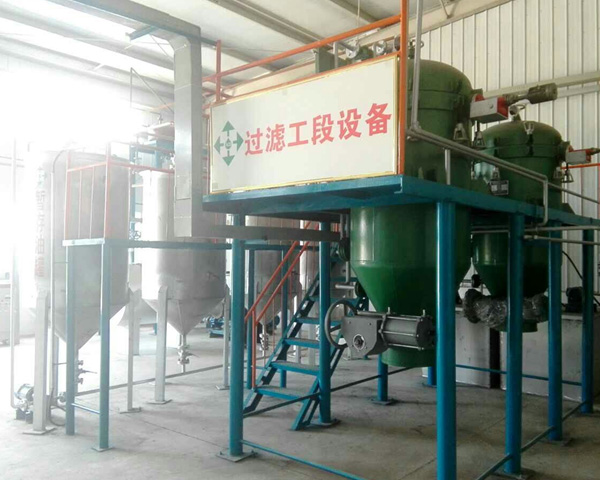
In edible oil processing, the refining stage is a critical step for improving oil quality and removing impurities, but it also inevitably results in oil losses. The extent of oil loss directly impacts a manufacturer’s production costs and economic efficiency. Therefore, accurately calculating oil loss at each stage of the refining process and mastering scientific control methods are crucial for edible oil processing enterprises. Selecting high-quality edible oil refining equipment can effectively reduce losses at every stage, and when combined with professional equipment commissioning and operation, oil loss can be controlled within a reasonable range.
Edible oil refining is a multi-stage, coordinated process primarily comprising three core operations: alkali refining, decoloration, and deodorization. When combined with operational and equipment-related losses during production, these four components constitute the main sources of refining oil loss. Since the causes of loss vary by process stage, so do the calculation methods. Below, drawing on practical industry experience, we will break down the oil loss calculation methods for each stage one by one, while incorporating corresponding equipment optimization recommendations to help enterprises precisely control losses.
I. Oil Losses During Alkali Refining and Calculation Methods
Alkali refining is the foundational process in edible oil refining, primarily aimed at removing harmful components such as colloids, free fatty acids, moisture, and impurities from crude oil to enhance the oil’s stability. However, during this process, certain oil losses occur due to impurity removal, saponification of neutral oil, and emulsification. This is one of the primary sources of oil loss in the refining process.
There are two primary sources of oil loss during alkali refining: first, the inevitable carryover of some oil during the removal of colloids, free fatty acids, moisture, and impurities from crude oil; second, the saponification and emulsification of neutral oil during the alkali refining reaction, which renders some oil unrecoverable.
To reduce oil loss in the alkali refining stage, in addition to strictly controlling process parameters, selecting high-performance alkali refining equipment is crucial. Our edible oil refining equipment employs an advanced alkali refining process design and is equipped with a precise parameter control system. This system allows for accurate control of alkali solution dosage and reaction temperature, effectively reducing the saponification and emulsification of neutral oil. At the same time, it efficiently separates impurities from the oil, minimizing oil loss caused by impurities. Compared to traditional equipment, this system can reduce alkali refining oil loss by 10%–15%.
Theoretical formula for calculating alkali refining oil loss (industry standard):
Alkali refining loss = 0.2 + 1.25 × (free fatty acid content % + phospholipid content % + moisture content % + impurity content % + 0.3%)
Example: If a batch of crude oil has a free fatty acid content of 1.2%, a phospholipid content of 0.8%, a moisture content of 0.3%, and the impurity content is 0.2%, then the alkali refining loss = 0.2 + 1.25 × (1.2 + 0.8 + 0.3 + 0.2 + 0.3) = 0.2 + 1.25 × 2.8 = 3.7%, meaning that for every 100 kg of crude oil, 3.7 kg of oil is lost during the alkali refining process.
II. Oil Loss During Decoloration and Calculation Methods
The core of the decoloration process is to remove pigments, trace impurities, and odor precursors from edible oil, resulting in a clearer color and more stable quality. The commonly used method is adsorption decoloration, which utilizes adsorbents such as spent white clay to adsorb impurities from the oil. During this process, the spent white clay adsorbs a portion of the oil, thereby causing oil loss.
The key factor influencing oil loss during decoloration is the oil content of the spent white clay; the higher the oil content, the greater the oil loss. Therefore, the key to reducing oil loss during decoloration lies in controlling the oil content of the spent white clay, and high-quality decoloration equipment can effectively achieve this goal. The decoloring units integrated with our edible oil refining equipment utilize a high-efficiency filtration system that thoroughly squeezes out oil from the spent white clay, keeping its dry-basis oil content at a minimum. Simultaneously, we optimize the dosage of adsorbents to minimize adsorption losses, further reducing oil loss during the decoloring stage.
Theoretical formula for calculating decoloring oil loss:
Decoloring loss = Waste white mud × Oil content of waste white mud (dry basis)
Example: If 5 kg of waste white mud is generated during the decoloring process and the oil content of the waste white mud is 8% (dry basis), then the decoloring loss = 5 × 8% = 0.4 kg. This means that for every 100 kg of crude oil (corresponding to 5 kg of waste white mud), 0.4 kg of oil is lost during the decoloring stage. It should be noted that the type and dosage of the adsorbent also affect decoloration losses. We recommend selecting an appropriate adsorbent based on the oil type and using it in conjunction with our decoloration equipment to further optimize losses.
III. Oil Loss During Deodorization and Calculation Methods
Deodorization is a critical step in edible oil refining. It primarily involves high-temperature distillation to remove unsaponifiables (such as sterols and vitamin E) and triglycerides from the oil, along with fatty acids, small-molecule aldehydes, and ketones. Simultaneously, it eliminates off-flavors to enhance the oil’s taste and shelf life. Additionally, oil splashing during the stripping process also results in some oil loss, which is a significant source of loss that cannot be overlooked in the deodorization stage.
Oil loss during deodorization is influenced by factors such as distillation temperature, stripping rate, and equipment sealing, among which equipment performance plays a decisive role. The deodorization tower in our edible oil refining equipment features a fully sealed design and is equipped with a high-efficiency stripping unit. It enables precise control of distillation temperature and stripping rate, reducing oil splashing and volatilization while maximizing the retention of beneficial components in the oil and minimizing distillation losses. Compared to traditional deodorization equipment, our system can limit deodorized oil loss to within 0.2%–0.4%, significantly improving economic efficiency for enterprises.
Theoretical formula for deodorization consumption (i.e., deodorized oil loss):
Deodorization consumption = 0.2 + 1.1 × (free fatty acid content % entering the deodorization tower + hydrogen peroxide content / 80 + water content %)
Example: If the oil entering the deodorization tower has a free fatty acid content of 0.3%, a hydrogen peroxide content of 8 mg/kg, and the water content is 0.1%, then the deodorization loss = 0.2 + 1.1 × (0.3 + 8/80 + 0.1) = 0.2 + 1.1 × 0.5 = 0.75%, meaning that for every 100 kg of oil entering the deodorization tower, 0.75 kg is lost during the deodorization process.
IV. Oil Losses During Production and Control Methods
In addition to the three core processes mentioned above, issues such as improper operation, equipment malfunctions, and pipeline leaks during production can also lead to losses due to dripping or leakage of oil. Although these losses are not fixed, they can have a significant impact on a company’s production costs when accumulated over time; therefore, they require special attention.
To prevent oil loss during production, it is necessary to strengthen professional training for operators and standardize operating procedures. Additionally, selecting reliable, high-quality edible oil refining equipment with excellent sealing performance is essential to minimize equipment failures and leaks. Our edible oil refining equipment is constructed from premium food-grade stainless steel, featuring sealed pipe connections that effectively prevent oil dripping. The equipment operates stably with a low failure rate, and when paired with professional installation and commissioning services, it minimizes oil loss during production to the greatest extent possible.
Furthermore, the initial stages of oil processing also impact subsequent refining losses. High-quality oil extraction equipment improves the quality of crude oil and reduces the content of impurities, thereby minimizing oil loss during the refining process from the source. Our oil pressing equipment utilizes fully automated screw pressing technology, offering high pressing efficiency, high crude oil extraction rates, and low impurity levels. When used in conjunction with our edible oil refining equipment, it forms an integrated “pressing-refining” production line that comprehensively controls oil loss and enhances production efficiency, making it the preferred combination for oil processing enterprises.
V. Reference Values for Soybean Oil Refining Losses and Total Loss Calculation
Refining losses vary by oil type. As a common edible oil, soybean oil serves as a useful reference for refining losses. Based on industry operational data, the reference values for oil losses in each soybean oil refining process are as follows (for reference only; actual losses may vary depending on production conditions):
- Degumming: Removes 1.5 times the amount of phospholipids, accounting for approximately 1.65%–5.25% of the oil;
- Neutralization: Removes 1.05–1.2 times the amount of free fatty acids, accounting for approximately 2.1%–2.4% of the oil;
- Deodorization: Removes 0.2%–0.4% of the oil (can be controlled to around 0.2% using our refining equipment);
- Decolorization: Removes 0.15%–0.75% of the oil (depends on the adsorbent; can be reduced to 0.15%–0.3% when used with our decolorization equipment).
A simple calculation method for total oil loss during soybean oil refining: Total oil loss = Alkali refining loss + 0.6% (0.6% is a reference value for combined losses from decoloration, deodorization, and the production process). It should be noted that actual total losses must be calculated comprehensively, taking into account factors such as crude oil quality, process parameters, and equipment performance. We recommend that companies accurately calculate oil losses based on their specific production conditions and with technical support from equipment manufacturers.
VI. Selecting the Right Refining Equipment, Accurately Calculating Losses, and Reducing Production Costs
Oil loss during the edible oil refining process is inevitable. However, by accurately calculating losses at each stage, understanding loss patterns, selecting high-quality edible oil refining equipment, and standardizing operating procedures, oil loss can be controlled within a reasonable range. This reduces production costs for enterprises and enhances product competitiveness. Our edible oil refining equipment integrates processes such as alkali refining, decoloration, and deodorization. Utilizing advanced process design and precise parameter control, it effectively reduces oil loss at every stage. When paired with high-quality oil pressing equipment, it forms a comprehensive production solution, providing oil processing enterprises with all-around technical support and equipment assurance.
If you are building an edible oil refining plant or need to upgrade your existing refining or oil pressing equipment, and wish to precisely control oil loss and improve production efficiency, please contact us. With extensive experience in equipment installation and commissioning, we have provided professional production solutions to oil and fat enterprises in multiple countries and regions, helping them achieve efficient, low-loss production.