
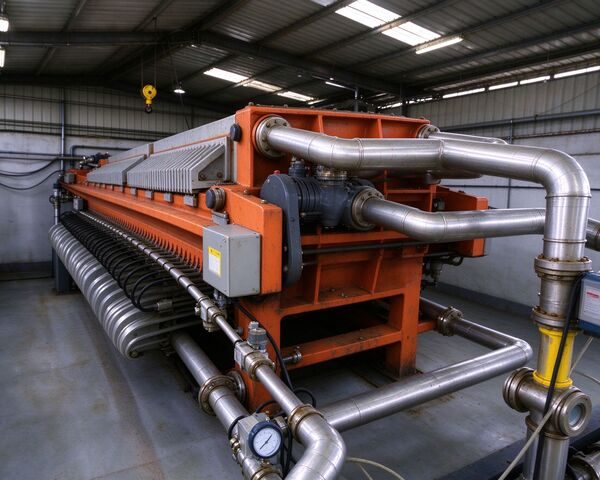
Two Filter Presses with Identical Nameplate Specs — Why Can Entrainment Differ by 15 Percentage Points?
When evaluating a palm oil dry fractionation project, the membrane filter press spec sheets from different suppliers often look remarkably similar: same filtration area, comparable plate dimensions, both labeled “high-pressure membrane squeezing.” But industrial operating data tells a different story.
MPOB’s compiled data on industrial fractionation over half a century shows that the evolution of separation equipment directly changed the level of olein entrainment in stearin. Dry fractionation plants using drum or belt filters in the 1970s ran entrainment rates of 60%–73%. By the 2000s, configurations using membrane filter presses with 25 mm chamber width and 30 bar squeezing pressure brought entrainment down to approximately 30%. The span from 70% to 30% was not achieved by the single variable of “having a membrane filter press” — it was achieved by matching chamber geometry with squeezing pressure.
This points to a core question that often gets blurred in equipment selection: the yield of dry fractionation depends not primarily on whether you bought a “membrane filter press” as a category, but on whether the chamber depth of that press is matched to its squeezing pressure, and whether the crystallization stage can produce uniform crystals capable of withstanding that pressure. KMEC has over two decades of experience in oil processing and fractionation equipment. This article breaks down the equipment and process decisions in palm oil dry fractionation along the causal chain of “crystal quality — filtration geometry — entrainment loss — yield.”
1. Crystallization Stage: Crystal Uniformity Matters More Than Crystal Size
1.1 The Problem with Conventional Cooling Curves Isn’t “Not Cold Enough” — It’s “Not Uniform Enough”
During cooling, palm oil’s triglycerides crystallize in sequence according to their melting points. High-melting fractions form the crystal skeleton first, while low-melting fractions remain liquid. If the cooling rate doesn’t match the crystal growth rate, the crystal size distribution becomes very broad: some crystals grow large enough, while others remain fine and irregular.
The direct consequence of this broad distribution shows up in the filtration stage. Fine crystals fill the gaps between larger crystals, blocking the drainage channels for olein. Irregular crystals create an uneven pore structure in the filter cake, and the squeezing pressure cannot be effectively transmitted into the interior of the cake layer. The result: olein gets “locked” in the stearin crystal network and leaves the system with the filter cake. This is entrainment loss.
MPOB research states this explicitly: crystal slurries produced by conventional cooling programs have poor crystal size uniformity and a larger average diameter. Crystals obtained by adjusting the crystallization program, while smaller in average diameter, have a more uniform size distribution. More uniform crystals mean a more regular pore structure in the filter cake and clearer drainage paths for olein.
1.2 “Forced Ostwald Ripening”: The Mechanism Behind MPOB’s Modified Programme
MPOB’s Modified Fractionation Programme inserts additional intermediate steps into the conventional cooling program, subjecting the crystal slurry to a controlled “forced Ostwald ripening.” In conventional Ostwald ripening, small crystals dissolve while large crystals continue to grow, and the system trends toward reduced interfacial energy. MPOB’s programme uses programmed control to narrow the size distribution while maintaining a smaller average crystal diameter, improving uniformity.
The refinery trial results are clear. In a paired comparison of RBD palm oil fractionation, conventional cooling formulations produced olein yields of 69.7% and 68.0%, while the MPOB modified formulations produced 73.0% and 72.2% — an improvement of 3.3 to 4.2 percentage points. MPOB’s summary describes the gain as 4%–5% and emphasizes that the olein’s cloud point and other physicochemical properties were not adversely affected. At laboratory scale, the improvement for RBD fractionation was approximately 3%; after refinery pilot-scale amplification, it reached 4%–5%, indicating the programme is reproducible at industrial scale.
The engineering implication of this data is not simply that “MPOB’s programme is better than conventional.” It is that a 4–5 percentage point yield gain can be achieved by modifying the cooling program without replacing the crystallizer or the main filter press body. The precondition is that the crystallizer’s temperature control system must be capable of executing multi-stage, custom cooling curves. If the control system can only run a single fixed linear cooling curve, the modified programme cannot be implemented.
2. Filtration Stage: Matching Chamber Depth with Squeezing Pressure
2.1 What the Entrainment History Curve Tells Us
MPOB’s industrial data table provides a comparison spanning half a century:
| Period | Separation Method | Entrainment (% of stearin) |
|---|---|---|
| 1970s | Dry crystallization + drum/belt filtration | 60%–73% |
| Late 1980s | Dry crystallization + membrane filter press | 47%–50% |
| 2000s | Dry crystallization + membrane filter press (25 mm chamber, 30 bar) | ~30% |
From drum filtration to early membrane filter presses, entrainment dropped from about 70% to about 50%. From early membrane filter presses to shallow-chamber (25 mm) high-pressure (30 bar) configurations, entrainment fell further to about 30%. The pattern this curve reveals is: the value of a membrane filter press depends on whether the chamber depth is short enough for the squeezing pressure to act effectively across the entire cake thickness.
2.2 Why Only Shallow Chambers with High Pressure Can “Squeeze Dry”
Conventional palm oil filtration uses chamber depths on the order of 40–50 mm. At this thickness, the squeezing pressure decays as it travels from the membrane side toward the center of the cake. At 6–7 bar, the driving force for olein migration in the center of the cake is already insufficient — the central region remains “unsqueezed.”
Reducing chamber depth to 10–30 mm substantially shortens the path for olein to migrate from the crystal network to the drainage channels. Applying 10–60 bar of squeezing pressure on this basis distributes the pressure more evenly across the thin cake layer, effectively driving out the olein. Patent literature explicitly lists 10–60 bar as the operating pressure range for high-pressure membrane filter presses, and MPOB’s validated 25 mm/30 bar configuration is the industrial proof of this principle.
There is an easily overlooked engineering constraint here: shallow chamber and high pressure must be present together — neither alone is sufficient. Applying 30 bar or more to a 40–50 mm deep chamber causes pressure decay through the cake, leaves the central region inadequately de-oiled, and imposes excessive mechanical load on the membrane and plate frame, shortening equipment life. Applying only 6 bar to a 10–30 mm shallow chamber gives uniform pressure transmission but insufficient total driving force, leaving olein incompletely expelled. Chamber depth and pressure rating are a set of parameters that must be designed as a matched pair, not two independently selectable spec items.
3. The Special Challenge of CPO Fractionation: Impurities Are “Uncontrolled Crystal Seeds”
The discussion above focuses primarily on RBD palm oil. Crude palm oil (CPO) dry fractionation faces an additional variable: impurities.
MPOB’s documents describe this directly: impurities in CPO act as crystal seeds during crystallization, affecting nucleation and growth and making the crystallization process harder to control. Impurity levels fluctuate between CPO batches, causing inconsistent stearin crystal morphology and fluctuating separation efficiency during filtration. This is the fundamental reason why CPO fractionation yields (68%–78%) are systematically lower than RBD fractionation yields (78%–82%).
For projects planning to fractionate CPO as feedstock, equipment selection needs to account for two additional factors. First, stability of the pretreatment section directly determines the impurity level entering the crystallizer. The control precision of palm oil press equipment and the refining pretreatment stage propagates through to fractionation yield. Second, the crystallizer’s cooling program needs greater adjustment flexibility to accommodate crystal behavior changes caused by batch-to-batch impurity variation in CPO. If the cooling curve is fixed, yield fluctuation in CPO fractionation will be significantly greater than in RBD.
4. Equipment Selection and Phased Configuration
4.1 Three Must-Check Parameters for the Filter Press
When evaluating the membrane filter press within palm oil fractionation equipment, the “filtration area” and “number of plates” on the spec sheet are not the key determinants of yield. What needs to be confirmed with the supplier is:
First, what is the chamber depth, and can it be configured in the 10–30 mm range? If the spec sheet only gives a standard 40–50 mm chamber, or avoids stating the chamber depth numerically, that itself is a signal worth questioning.
Second, do the nominal and actual achievable squeezing pressures match? A press labeled “high-pressure” needs confirmation that the membrane material, plate frame rigidity, and hydraulic system can sustain 30 bar or more in continuous operation. Short-term peak pressure and sustained working pressure are two different things.
Third, are the feed and squeeze programs programmable? Crystallization batches corresponding to different iodine value targets and different feedstocks (RBD/CPO) require different filtration and squeezing sequences. A press with a fixed program cannot accommodate multi-stage cooling strategies such as MPOB’s modified programme.
4.2 The Crystallizer’s Core Capability: Not “Can It Cool” but “Can It Cool Along a Curve”
Batch crystallizers (such as the Tirtiaux type) derive their advantage in programmed temperature control from the design of their cooling principle. The patented essence of the Tirtiaux process is that the cooling rate is controlled by the temperature of the oil itself, rather than simply using jacket water temperature to “drag” the oil temperature. This design avoids supercooling and local temperature gradients, allowing crystallization latent heat to be removed smoothly.
In selection, the core parameter to confirm is the minimum controllable cooling rate. If the crystallizer’s minimum controllable cooling rate can only reach 3–5°C/h, while the target process requires slow programmed cooling on the order of 1–1.5°C/h, then crystal uniformity cannot reach the level required by the modified programme. The specific optimal cooling rate varies with feedstock and target product, but the equipment must have the capability to “slow down.”
4.3 Phased Investment Logic
Capital deployment for dry fractionation can be staged. The first phase configures a crystallization unit + shallow-chamber high-pressure membrane filter press for single-stage fractionation, producing IV 56–57 olein and stearin. The core objective at this stage is not to chase maximum yield, but to validate the matching of crystallization control with filtration geometry and establish a repeatable operating window.
Once cash flow turns positive, the second phase adds multi-stage fractionation capability. Single-stage olein can be further crystallized and pressed to produce IV 64–66 superolein; stearin can also be further fractionated to obtain mid-melting fractions. The yield structure differs for multi-stage fractionation: producing IV 64–67 olein may yield around 60%, while mid-melting fractions yield around 30%. KMEC’s modular fractionation equipment design allows expansion interfaces and space to be reserved at the initial build stage, avoiding over-investment in phase one.
Upstream integration of the fractionation line also affects yield repeatability. Fluctuations in impurities, moisture, and temperature of the oil entering the crystallizer translate directly into fluctuations in crystal behavior. KMEC applies unified process interface standards across palm oil pressing, refining, and fractionation stages, precisely to keep upstream variables within the range the crystallizer can absorb.
5. FAQ
Q1: What is the typical olein yield in palm oil dry fractionation?
RBD palm oil single-stage fractionation to IV 56 olein typically yields 78%–82%, while CPO fractionation yields 68%–78%. The lower CPO yield is because impurities act as crystal seeds, making crystallization harder to control and stearin crystal morphology inconsistent, leading to more severe olein entrainment during filtration.
Q2: Why does membrane filter press chamber depth directly affect yield?
Chamber depth determines filter cake thickness. A shallow chamber (10–30 mm) allows squeezing pressure to transmit more evenly across the entire cake layer and shortens the migration path for olein from the crystal network. Industrial data shows that a 25 mm chamber with 30 bar squeezing pressure reduces olein entrainment in stearin to about 30%, compared with 47%–50% for earlier deep-chamber low-pressure configurations.
Q3: At what scale was MPOB’s 4%–5% yield gain from the modified fractionation programme validated?
At laboratory scale, the improvement for RBD fractionation was approximately 3%; after refinery pilot-scale amplification, it reached 4%–5%, with no adverse changes to olein cloud point or other physicochemical properties. The core mechanism is achieving “forced Ostwald ripening” through adjusted cooling programs to obtain more uniform crystals and reduce olein entrainment during filtration.
Q4: Why is CPO fractionation yield lower than RBD?
Impurities in CPO act as crystal seeds during crystallization, making the process harder to control. Batch-to-batch variation in CPO impurity levels causes inconsistent stearin crystal morphology and reduced filtration separation efficiency. CPO fractionation therefore places higher demands on pretreatment stability and crystallizer program flexibility.
Q5: What is the squeezing pressure range for high-pressure membrane filter presses? Must shallow chamber and high pressure be present together?
High-pressure membrane filter presses typically operate in the 10–60 bar range; MPOB’s validated configuration uses a 25 mm chamber with 30 bar. Shallow chamber and high pressure must be designed as a matched pair: deep chamber with high pressure causes pressure decay and excessive mechanical load; shallow chamber with low pressure provides insufficient driving force for complete olein expulsion.
Q6: Can a dry fractionation line be invested in phases?
Yes. Phase one configures crystallization and shallow-chamber high-pressure filtration for single-stage fractionation; phase two adds multi-stage fractionation capability to produce superolein or mid-melting fractions. KMEC’s modular design supports reserved expansion interfaces, avoiding over-investment at initial build.
References
- MPOB, Modified Fractionation Programme for Increased Olein Yield — Refinery Plant Trial Results, MPOB TT No. 539.
- Chong, C.L. & Yeoh, C.B., Offer for Technology Adoption of MPOB Modified Fractionation Programme for Increased Olein Yield, MPOB Palm Oil Developments, Vol. 60.
- MPOB, Estimated Entrainment in Palm Stearin from Various Industrial Fractionation Processes, Palm Oil Engineering Bulletin No. 137, Table 3.
- Patent literature on high-pressure membrane filter presses for palm oil fractionation — squeezing pressure range 10–60 bar and reduced chamber depth.
- Tirtiaux fractionation process — patented cooling principle where oil temperature controls the cooling rate.
- Recent developments in the production of Soft-PMF and Superolein, multi-stage dry fractionation yield and iodine value data.
For crystallizer selection, membrane filter press chamber depth and pressure matching design, or multi-stage fractionation line planning for palm oil dry fractionation, contact the KMEC engineering team.