
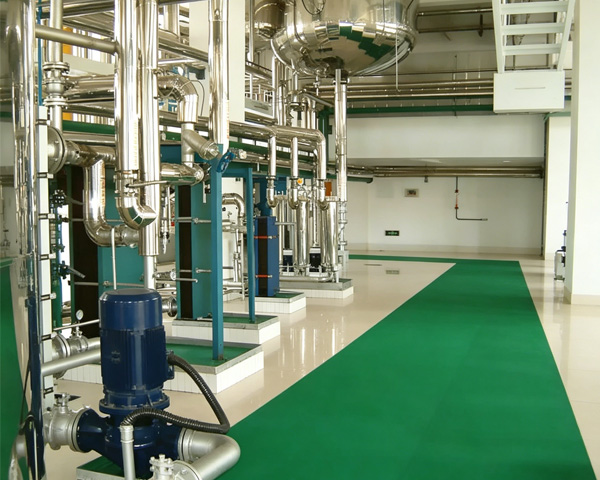
Heat Energy Recovery
- Add one heat exchanger to replace the finished oil final cooler with a crude oil and finished oil heat exchanger for heat recovery. This significantly reduces the steam usage for heating low-temperature crude oil. It has an especially good energy-saving effect for low-temperature crude oil processed in reserve rotation. Taking a 1000 tons/day chemical refining production line as an example, after the modification, steam consumption per ton decreased by about 3 kg/t oil, saving approximately 130 kg/h of steam.
- Utilize the heat exchange cycle between the press steam condensate and the high-pressure boiler flue gas to heat water to approximately 78°C for replenishing the hot water tank. Combined with the steam condensate from the plant, the temperature in the plant’s hot water tank can reach about 86°C, meeting the plant’s requirements for process water temperature and volume, and reducing the steam used for heating the hot water tank by about 120 kg/h.
- Add a heat exchanger before the low-temperature crude oil in the storage area enters the plant\’s crude oil tank to exchange heat with the high-temperature oil from the pressing plant\’s water degumming process (which has not been cooled). This raises the crude oil temperature by about 21°C. Taking a 600 tons/day chemical refining production line as an example, this can save approximately 200 kg/h of steam.
- Use the cooling water from the finished oil final cooler to heat the crude oil entering the refining plant, raising the crude oil temperature and saving 5-6 kg/t of steam.
- Add a wide-gap oil-oil heat exchanger with baffles at the inlet of the soapstock centrifuge to replace the steam heater. This avoids the situation where, when using a low-temperature caustic refining process in the neutralization section, the caustic refining temperature is lowered by reducing the acidification temperature (i.e., crude oil temperature to 70°C) to meet the caustic refining requirements. This change would otherwise increase steam usage for the heater at the soapstock centrifuge separation temperature. Taking a 1000 tons/day chemical refining production line as an example, replacing with a heat exchanger with a heat transfer area of 78.4 m², featuring wide channels and baffles between plates, achieving a temperature exchange range of about 21°C, meets the optimal separation temperature (87-92°C) for the soapstock centrifuge and saves approximately 200 kg/h of steam.
Investigation and Treatment of Leakage Points
- Conduct pressure testing on the deodorizer to identify leaks. This addressed leaks from aging sight glass gaskets and reduced steam consumption for the deodorization vacuum system.
- Inspect and replace old steam valves, using first-tier brand steam valves. Simultaneously, conduct a comprehensive inspection of the plant’s steam valves and steam traps to eliminate steam waste.
Application of New Energy-Saving Technologies
- Use an ethylene glycol-type “dry ice” condensation vacuum system for the deodorization vacuum system.The ethylene glycol-type “dry ice” condensation vacuum system subjects the mixed gas from the deodorizer fatty acid scrubber to indirect deep cooling in an ethylene glycol solution condenser. Steam, fatty acids, and other condensable gases directly sublime and solidify into “dry ice” on the surface of the condenser tubes. Non-condensable gases are extracted by a Roots vacuum pump unit. In contrast, the chilled water vacuum system commonly used in the oil refining industry condenses the mixed gas from the fatty acid scrubber together with the motive steam from the vacuum system in an atmospheric condenser through low-temperature heat exchange with chilled water provided by a chiller, draining the condensate into a hot well, while non-condensable gases are extracted by a vacuum water ring pump.
- Application Results and Economic Benefits
- Application Results
- (1) The chilled water system maintains a vacuum of 200–300 Pa, while the ice condensation system maintains a vacuum below 200 Pa.
- (2) The steam consumption of the ice condensation vacuum system depends on the deodorization vacuum, generally ranging from 5-10 kg/t, corresponding to a steam consumption of 230–460 kg/h. The average steam consumption of 345 kg/h is approximately 250 kg/h lower than that of the chilled water system.
- (3) Electricity consumption is also lower. Taking a 400 t/d refining deodorization chilled water vacuum system compared to an ethylene glycol-type “dry ice” condensation vacuum system as an example,electricity savings are 1.5 kWh/t .
- Economic Benefits and Retrofit Investment Payback Period. Assuming the project does not involve replacing the ejector pump or chiller, the investment required is approximately 3.5 million RMB (for new construction projects, the investment would be 5-7 million RMB).Taking a 1000 tons/day chemical refining production line as an example, with an annual processing capacity of 300,000 tons, electricity cost of 0.7 RMB/(kW·h), steam cost of 227 RMB/ton, and an average steam flow rate for the ejector pump of 615 kg/h. the benefit analysis after implementation is as follows:
- (1) Annual steam cost savings: (615-345) kg/h / (Processing rate tons/h) × 300,000 tons × 227 RMB/ton = 399,700 RMB
- (2) Annual electricity cost savings: 300,000 tons × 1.5 kWh/t × 0.7 RMB/kWh = 315,000 RMB
- (3) Annual economic benefit: 399,700 + 315,000 = 714,700 RMB
- (4) Retrofit investment payback period: 3.5 million RMB ÷ 714,700 RMB/year ≈ 4.9 years
- Application Results
- Application Results and Economic Benefits
- Use Low-Temperature Chilled Water for the Second-Stage Condenser of the Deodorization Chilled Water Vacuum System.
- Branch a supply and return line from the chilled water circulation pipeline (at the inlet/outlet of the chilled water circulation pump) to supply the second-stage condenser. Use chilled water instead of cooling tower water to improve the cooling effect of the condenser. This avoids vacuum instability in deodorization caused by steam pressure fluctuations and reduced cooling efficiency due to rising ambient temperature, which would otherwise lead to increased steam usage. Taking a 1000 tons/day chemical refining production line as an example, steam consumption per ton decreased by 1.27 kg/t, saving 58 kg/h of steam per hour.
- Select Appropriate Deodorization Steam Ejector Pump
- Currently, the selection parameters for deodorization steam ejector pumps for domestic 1000 tons/day chemical refining production lines are mostly based on a deodorization direct steam requirement of 340 kg/h +10 kg/h air. However, the actual direct steam required for the deodorizer is typically between 150-220 kg/h to meet process requirements. This represents a significant case of “a large horse pulling a small cart” and also significantly increases the consumption of motive steam for the deodorization vacuum. Taking a 1000 tons/day chemical refining production line as an example, practical verification shows that selecting a steam ejector pump with design parameters of 250 kg/h direct steam for deodorization + 10 kg/h air can directly reduce the motive steam for the ejector pump by 100-150 kg/h, lowering the refining steam consumption per ton by 2-3 kg/t. Currently, domestically branded steam ejector pumps can achieve the above parameters. The application of this energy-saving technology is expected to promote the import substitution of ejector pumps in refining plants.
Steam consumption in the refining plant mainly occurs in heating crude oil, heating neutral oil to be separated, heating oil to be bleached, heating the hot water tank, direct steam for bleaching and deodorization, and steam ejector pumps.
- Crude oil heating requirements can be met by increasing the temperature of crude oil entering the plant and utilizing heat from the deodorized oil in the plant, reducing or eliminating the need for steam heating to reach the process temperature.
- For heating neutral oil to be separated, the optimal separation temperature for the soapstock centrifuge (87-92°C) can be achieved by adding a wide-gap plate heat exchanger with baffles for heat exchange.
- For heating oil to be bleached with steam, heat exchange with deodorized oil can meet the process temperature requirement of approximately 103°C.
- The steam requirement for heating the hot water tank can be largely met by using the circulating heat exchange between press steam condensate and high-pressure boiler flue gas to satisfy the plant’s process water temperature requirements.
- Regarding direct steam for bleaching and deodorization, consider replacing steam agitation in the bleaching tower with mechanical agitation, and adjust the amount of direct steam in deodorization based on the deacidification effect.
- Regarding steam for the deodorization steam ejector pump: currently, when a vacuum condenser cooled by chilled water is used, steam consumption is around 550-680 kg/h. When a vacuum condenser cooled by ice is used, steam consumption ranges from 230 to 460 kg/h. The average steam consumption of 345 kg/h is approximately 250 kg/h lower than that of the chilled water system. Replacing the chilled water system with an ethylene glycol-type \”dry ice\” condensation vacuum system for deodorization represents a development trend for reducing steam consumption in the refining plant.